August 31, 2011
anti-graffiti
What is up with The Fairfax Press these days. We have another tirade at the National Times, this time against graffiti by one of their Sydney based writers.
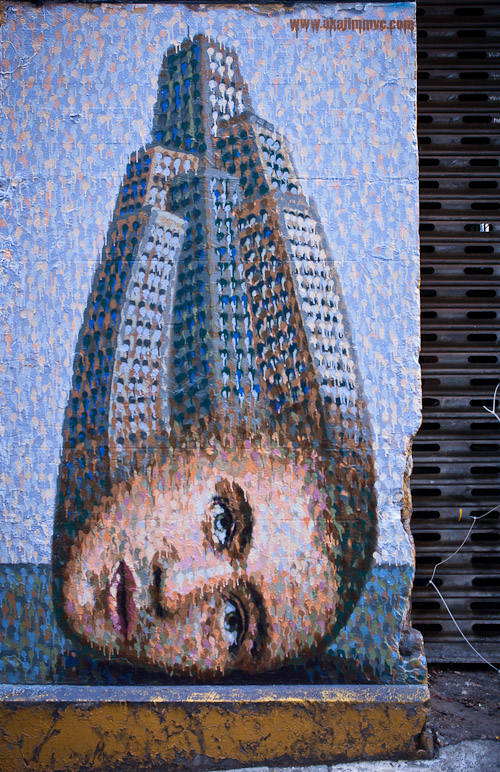 Gary Sauer-Thompson, street art, Jimmy Cochrane, Blyth St, Adelaide 2011
Charles Purcell says that many councils spend a frustratingly large amount of time and money cleaning up the mess our urban graffiti ninjas leave behind. They're not handing out grants in the search of the next Basquiat. They feel the same as he does.
He writes:
Put your graffiti detector on as you travel to and from work and you'll be astounded by how many instances you will spy. Hasty scrawls on power plants. Words winding up power poles. Tags on buildings. Tunnels completely covered in drivel. Schools covered in pubescent angst. Then consider your reaction to it. Do you ever feel uplifted? Amused? Entertained? Has a clever pun ever tickled your fancy? Has an important message ever been passed on? Have you ever stopped and thought, "Hmm, knowing 'Gordo has herpes' is something that really has brightened my day"? Are public parks improved with black and blue scrawls everywhere? Or do they add a sense of urban decay to the swings and greenery? In short, does graffiti fulfil the proper function of art? Because I've yet to see some that has moved me like a Carvaggio. Or even the Ginger Meggs cartoons in the newspaper. Or Garfield...
Purcell adds that he has yet to see compelling cases of graffiti adding anything to the urban landscape. Banksy's works could be seen to legitimise an army of youths with cans rampaging through our streets, leaving incoherent colour schemes everywhere.
Purcell does not clearly distinguish between tagging and street art----he runs them together --and he fails to acknowledge that some city councils give up walls for street art.
August 29, 2011
an anti-Apple tirade
There is a lot of nonsense in the mainstream press these days and this account of Apple by Julian Lee, the deputy editor of the National Times online is one. It's thesis that Apple's "technology is making us introverted" highlights the decline of journalism at Fairfax.
Lee says:
Those among us who have an iPod, Macbook, iTouch, iPhone or iPad have surrendered our powers of concentration and free time to this cult, not to mention our personal data. An entire generation will only be able to walk into its future so long as Apple holds its hand. They will only be able to commune with each other via their devices and a shared experience will only be truly shared through Facebook or Digg. Who talks with strangers on the buses today? You can't flirt with someone on a train if they are plugged into a two-hour shuffle of easy listening.
So the changes in culture and society towards an increasing individualism, the emergence of social media and people not flirting on public transport are caused by Apple's products! That really is technological determinism. Lee continues:
There's a reason why Apple put the ''i'' into its products and it has nothing to do with information. It cannily recognised that in a world of globalised products the consumer yearned to be recognised as an ''individual''. Apple's candy-coloured iMac computers of the mid-1990s played to that and from there it flowed through to the music service iTunes that lets you upload and customise your music, your films, your contacts, your life. Even the TV screen has been shrunk to a neat little portable device - the iPad - that enables you to slink off into a corner and watch it on your own. And how we have fallen for it. We have become slaves to Apple's brand.
This ignores that we buy Apple products because they work as well having a minimalist design, high quality, and they--eg., the MacIntosh computer and its operating system -- work better than the low end Windows based PC's.
It also ignores the way the Apple, or rather Jobs, revolutionized the content market for music, newspapers and magazines.
August 28, 2011
F. Jameson on finance capital
In his essay Culture and Finance Capital in The Cultural Turn: Selected Writings on the Postmodern 1983-1998 Frederic Jameson refers to Giovanni Arrighi's The Long Twentieth Century, who he says, shows us, there comes a moment in which the logic of capitalism - faced with the saturation of local and even foreign markets - determines an abandonment of that kind of specific production, along with its factories and trained workforce, and, leaving them behind in ruins, takes its flight to other more profitable ventures. Hence we have the recent shift to finance capital.
Jameson says:
Now this free-floating capital, on its frantic search for more profitable investments (a process prophetically described for the US as long ago as Baran and Sweezy's Monopoly Capital of 1965) will begin to live its life in a new context; no longer in the factories and the spaces of extraction and production, but on the floor of the stock market, jostling for more intense profitability, but not as one industry competing with another branch, nor even one productive technology against another more advanced one in the same line of manufacturing, but rather in the form of speculation itself: spectres of value, as Derrida might put it, vying against each other in a vast world-wide disembodied phantasmagoria.
He adds that this might be dramatically heightened, for our own period, by a reminder of the results of the cybernetic 'revolution':
might be dramatically heightened, for our own period, by a reminder of the results of the cybernetic 'revolution', the intensification of communications technology to the point at which capital transfers today abolishes space and time and can be virtually instantaneously effectuated from one national zone to another. The results of these lightning-like movements of immense quantities of money around the globe are incalculable, yet already have clearly produced new kinds of political blockage and also new and unrepresentable symptoms in late-capitalist everyday life.
Globalization is a kind of cyberspace in which money capital has reached its ultimate dematerialization, as messages which pass instantaneously from one nodal point to another across the former globe, the former material world.
August 25, 2011
Wolfgang Sievers + landscape photography
This kind of photography is not seen as part of the canon of Australian art photography. For some reason landscapes are excluded:
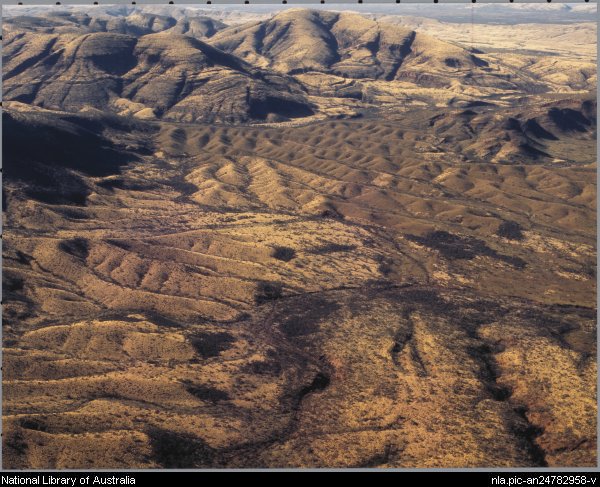 Wiofgang Sievers, Hamersley Iron, aerial of the Hamersley Ranges, [Western Australia], 1974-77, NLA
Mining has dominated Australian history, yet the art institution has turned its back on good quality photos that represent this regional part of Australia. Does that reflect the hegemony of the Canberra, Melbourne, Sydney axis?
August 16, 2011
Fred Williams: seascapes
There is an exhibition of Fred Williams' paintings at the National Gallery of Australia. It is entitled Infinite Horizons. This is the first major retrospective of Fred Williams’ work in over 25 years.
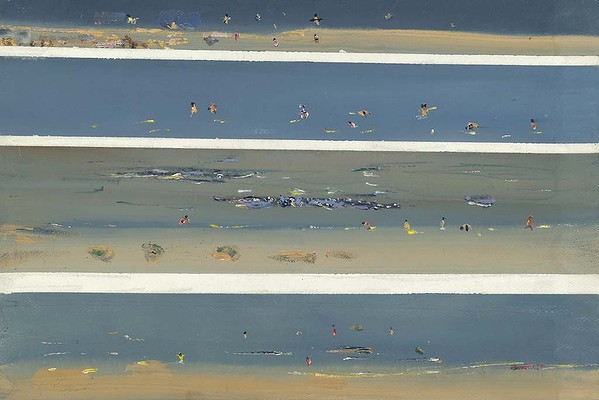 Fred Williams, Beachscape with bathers,1971.
I do not know much about his seascapes series done in the horizontal strip format. Williams is known for his landscapes as the subject than seascapes.
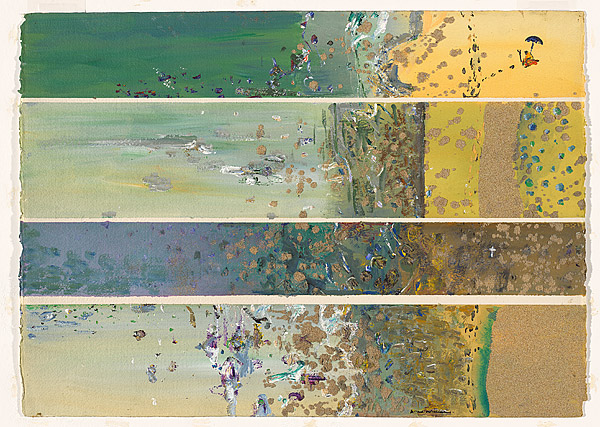 Fred Williams, Beachscape, Erith Island, 1974
These look to be painting en plein air to me. The horizontal strip format in his paintings were designed to present different aspects of one scene on the same sheet
August 14, 2011
Ballarat International Foto Biennale 2011: Cynthia Karalla
The core programme of the Ballarat International Foto Biennale 2011 includes work by Cynthia Karalla
 Cynthia Karalla from After Death Options
Karalla works between New York City and the rural south of Basilicata, Italy.
August 8, 2011
Ballarat International Foto Biennale 2011
The Ballarat International Foto Biennale 2011 opens next week and runs for a month. It is part of the Asia Pacific PhotoForum, a consortium of professional photography festivals--- Auckland, Ballarat, Fotofreo, HeadOn, Pingyao, Queensland and Vivid---that aims to build on photography’s wide appeal across borders as a means of artistic expression and disseminating ideas and information.
The Ballarat International Foto Biennale 2011 has a similar program to the 2009 one: core and fringe programmes; a variety of workshops--including ones with Blurb, large format and John Gollings ---and portfolio reviews.
August 5, 2011
Thomas Struth: vacant urban streets
The urban landscape work of the late 1970s Düsseldorf-based photographer Thomas Struth consisted of a series of empty, almost anonymous streets, which he has referred to as “unconscious places”. These render the street as void yet present the void as a concrete visual experience.
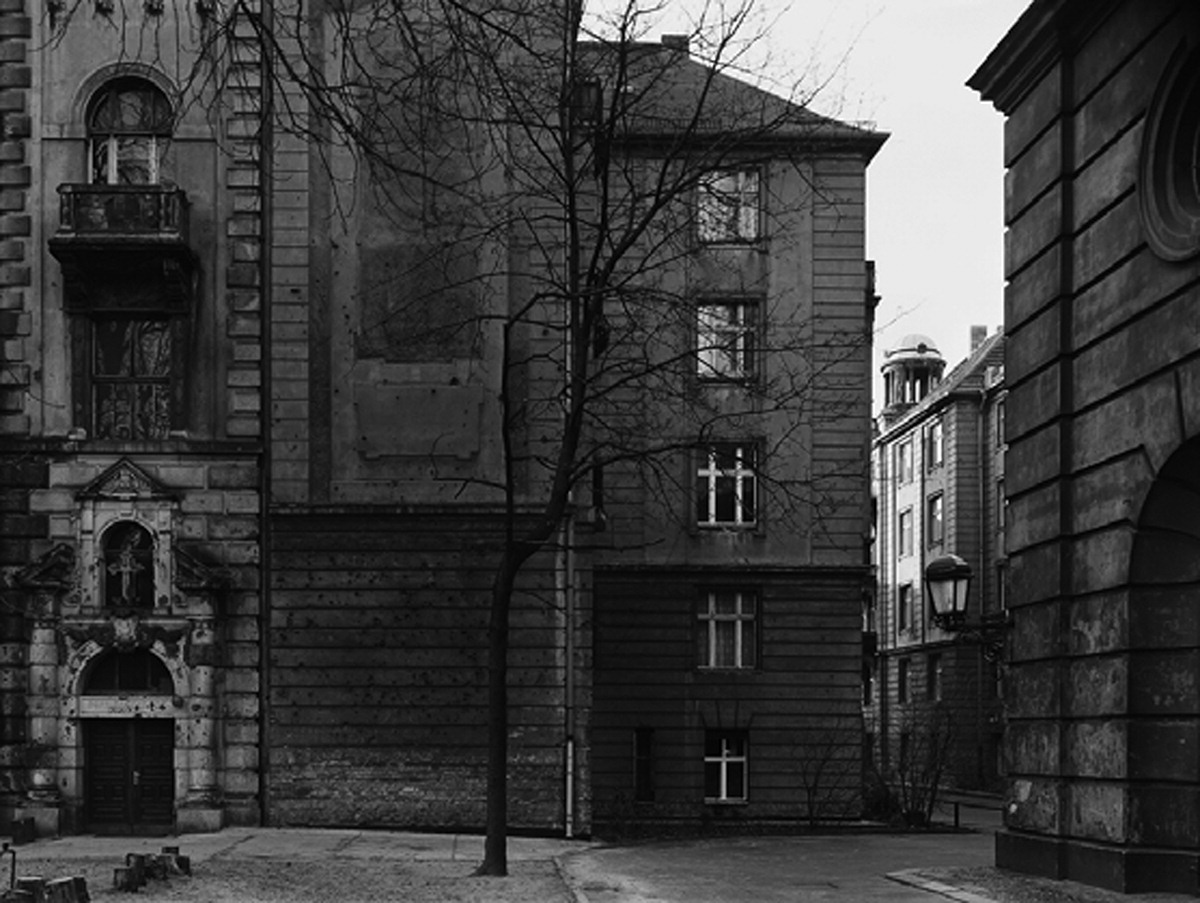 Thomas Struth, Sophiengemeinde 1, Grosse Hamburgerstrasse, Berlin 1992.
Melissa Miles in Donna MF Brett in The Uncanny Return: Documenting place in post-war German photography in Photographies (no. 3, Issue 1, 2010) says that:
In the series of street photographs Struth places the observer in the role of the Ausländer (foreigner or stranger) when our eyes are opened to the “fleeting impressions” of the city via the map or the lens of the camera, traversing the landscape from one street sign to another in a form of Kracauer-like self-estrangement. Struth's typological repetition of vacant streets becomes the images of our half-awakened wanderings and memories of streets once known, familiar but strange, or of streets we encounter in glimpses as we lose our way.
The absence of people in a city like Berlin is unsettling --given the evidence of life: multiple bullet holes and shrapnel wounds on the surface of the building and the chalked graffiti notations and messages on doorways. Yet emptiness and absence predominate
August 1, 2011
Simon Norfolk, Afghanistan, John Burke
I October 2010, Simon Norfolk began a series of new photographs in Afghanistan, which takes its cue from the work of nineteenth-century Irish photographer John Burke. Norfolk’s photographs reimagine or respond to Burke’s Afghan war scenes in the context of the contemporary conflict. John Burke's photographs of the Second Afghan War of 1878-1880 were among the first ever taken in Afghanistan.
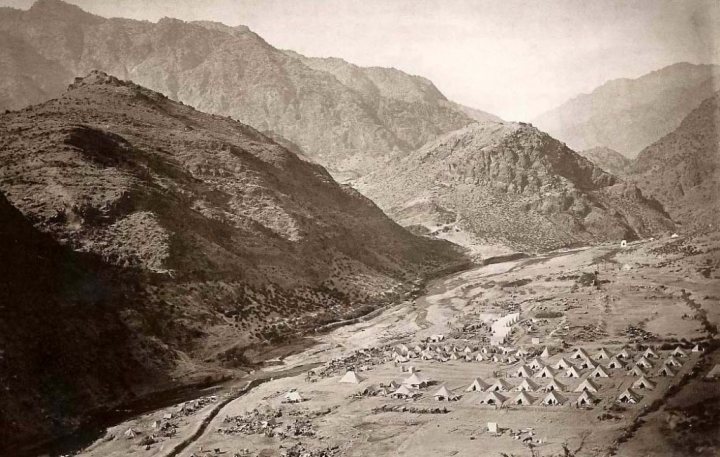 John Burke, Khyber pass, Afghanistan, 1878
Burke accompanied British forces during the invasion that became the Second Anglo-Afghan War from 1878-1880 producing a small number of albums of prints for sale to the general public.
Throughout 2001 Simon Norfolk worked extensively in Afghanistan producing a now seminal body of work titled Afghanistan Chronotopia (Dewi Lewis, 2002), in which he contrasted the hardware of warfare, against the beautiful, yet rugged mountain and desert landscape in which this vicious conflict was waged. Working in colour with a large-format camera, he enters into collaboration with his 19th century colleague.
Norfolk says that ‘Imperialism is what interests and enrages me more than anything else,’ says Norfolk, who believes that todays war should be considered the Fourth Anglo-Afghan War (the first was fought between 1839 to 1842; the second 1878 to 1880; and the third in 1919).
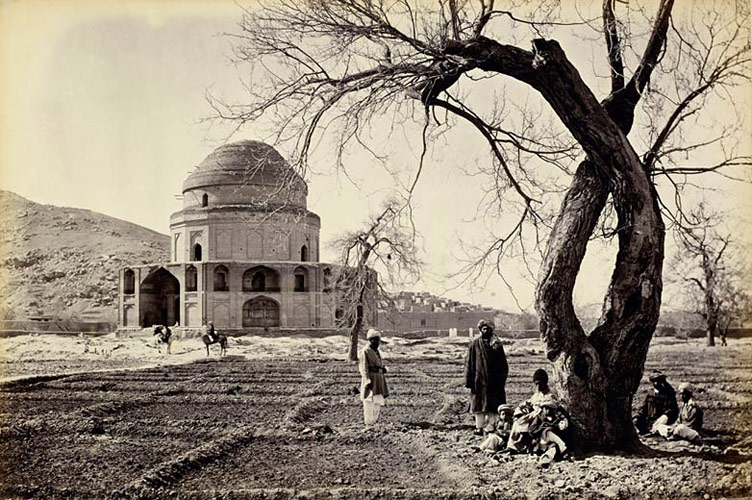 John Burke, Timur Shah's Mosque, 1879
Burke’s photographs are use the technology of the wet plate collodion process that produces creamy browns and reds, a spectrum of color and movement in the photograph that has no equivalent today. The image is textured, detailed, and yet, soft and silken.
Norfolk says that his:
2001 book was informed by romantic paintings of the 18th century, with their golden light of progress. Then, despite the destruction, there seemed to be the beginning of some kind of opportunity, a better future perhaps; rational, perfectible. A liminal moment at the close of one thing and the beginning of something new. To use the golden kiss of the dawn light seemed the right approach at the time. Now it seems completely inappropriate: my emotional response now is much more mixed; more uncertain. In 2010/11 I preferred to shoot in pre-dawn or post-sunset light, using that blue palette as a way of venting my disappointment and disillusionment with what has happened.
Norfolk wasn’t interested in replicating old cameras and lenses or finding precise fields of view. He was interested to see the kind of ground that Burke covered, how did he get to where he took his pictures.