July 30, 2011
e-flux
e-flux is an international network that consists of a news service about conventional exhibitions, conferences, or book launches and a journal. It is a self-organizing platform for communications on contemporary art within the context of the global culture industry and contemporary artists working with their materials in a variety of different, and more often hybrid, ways.
In Comrades of Time in Journal no 11 (12/2009) that addresses contemporary art Boris Groys says:
A work of art is traditionally understood as something that wholly embodies art, lending it an immediately visible presence. When we go to an art exhibition we generally assume that whatever is there on display—paintings, sculptures, drawings, photographs, videos, readymades, or installations—must be art. The individual artworks can of course in one way or another make reference to things that they are not, maybe to real-world objects or to certain political issues, but they are not thought to refer to art, because they themselves are art. However, this traditional assumption has proven to be increasingly misleading. Besides displaying works of art, present-day art spaces also confront us with the documentation of art. We see pictures, drawings, photographs, videos, texts, and installations—in other words, the same forms and media in which art is commonly presented.
He then adds that
when it comes to art documentation, art is no longer presented through these media, but is simply referred to. For art documentation is per definitionem not art. Precisely by merely referring to art, art documentation makes it quite clear that art itself is no longer immediately present, but rather absent and hidden.
The emergence one of mass artistic production and mass art consumption in the early 21st century (Facebook, YouTube, Second Life, Flickr, and Twitter) means that contemporary art has today become a mass-cultural practice.
So the question arises: How can a contemporary artist survive this popular success of contemporary art? Or, how can the artist survive in a world in which everyone can, after all, become an artist?
July 28, 2011
the era of Google controlling all content is over?
Roger McNamee has an interesting take on creativity and the internet that is different to the take on the politics of anonymity on the internet--eg., the trolls and their online violence. McNamee's argument is that the era of Google controlling all content is over.
He says:
When Google showed up, the World Wide Web was a wild environment. No one was in charge. The prevailing philosophy was "open source" . . . and free software.Google had a plan for organizing the web’s information that treated every piece of information as if all were equally valuable. To create order, Google ranked every page based on how many people linked to it.What we all missed at the time is that by treating every piece of information the same, Google enforced a standard that permitted no differentiation. Every word on every Google page is in the same typeface. No brand images appear other than Google’s. This action essentially neutered the production values of every high end content creator. The Long Tail took off and the music industry got its ass kicked.
He says that Google’s success eventually filled the web with crap, so consumers began using other products to search: Wikipedia for facts, Facebook for matters of taste, time or money, Twitter for news, Yelp for restaurants, Realtor.com for places to live, LinkedIn for jobs. Over the past three years, these alternatives have gone from 10% of search volume to about half. Thenalong came Apple with the iPhone and App Store. Apple offers a fundamentally different vision of the internet than Google.
People who have iPhones and iPads do far fewer Google searches than people on PCs. The reason is that Apple has branded, trustworthy apps for everything. If they want news, Apple customers use apps from the New York Times or Wall Street Journal. If they want to know which camera to buy, they ask friends on Facebook. If they want to go to dinner, they use the Yelp app. These searches have economic value and its not going to Google, even on Android....When Apple and the app model win, Google’s search business loses.Google and Microsoft will remain huge, but their influence is evaporating, which means we can ignore them. Apple is winning big. However, HTML 5 will give you a better product than the Apple app model at a lower cost and with more value.HTML 5 is just getting started, but the learning curve is less expensive and more profitable for those who commit to it from the beginning.
July 27, 2011
Bernd & Hilla Becher
Bernd and Hilla Becher utilized the classic documentary approach of a straightforward “objective” point of view (New Objectivity?) but they made the image autonomous.
The buildings have been isolated from their surroundings, put centre stage, and reproduced without distortion. All that is superfluous and narrative has been stripped away. The light is diffuse, with no shadows and not a cloud in the sky. People are rarely present in the images, and if there are any it is by accident.
The Bechers are best known for their ‘typologies’ - grids of black and white photographs with variant examples of a single type of industrial structure. The images of structures with similar functions were then displayed side by side to invite viewers to compare their forms and designs.
 Bernd & Hilla Becher, Maisoncelles, Seine Marne, France, circa 1972-79.
What I don't understand is why the Becher's long-term project has also had a considerable impact on Minimalism and Concept Art since the 1970s.
Was it because they often organized their pictures in grids that brought them recognition as conceptual artists as well as photographers? Or did the Conceptual and Minimalist American artists recognize their position as explicitly artistic?
July 21, 2011
Rebecca MacKinnon: Let's take back the Internet!
Rebecca MacKinnon describes the expanding struggle for freedom and control in cyberspace, and asks: How do we design the next phase of the Internet with accountability and freedom at its core, rather than control?
McKinnon argues the internet is headed for a "Magna Carta" moment when citizens around the world demand that their governments protect free speech and their right to connection.
July 6, 2011
Cy Twombly
CyTwombly's paintings in the 1950s bear the marks of graffiti on bare blackboard like surfaces.
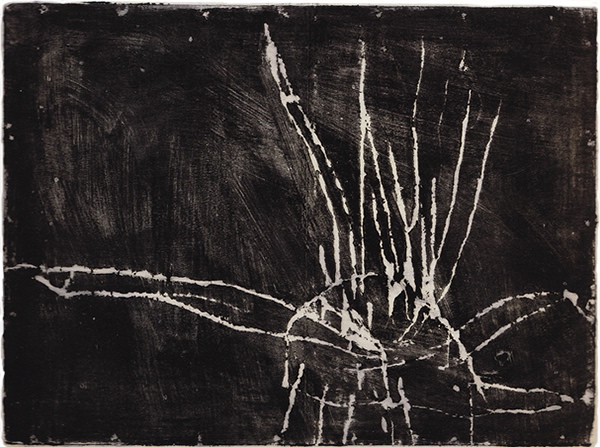 Cy Twombly, Untitled, 1953
From an art historical perspective these abstract expressionist works refer to the themes of archaism and ‘primitivism’ that informed many Abstract Expressionist representations. They reference the primitive, the ritual and fetish elements and express the abstract expressionist ethos of creating a penetrating access to the non-rational forms of knowledge and experience.
They claim that the so-called ‘primitive’ mind have more emotional, intuitive depth and humanity than the reasoned, controlled, modern one.