June 27, 2011
Frank Hurley's Australia
I've never really explored Frank Hurley's photographic work in Australia after 1946 as my impressions have been that it is rather boring and uninteresting. It's as if he is doing a commercial photography for a publisher on a book celebrating Australia.
 Frank Hurley, The Causeway [Perth, Western Australia], NLA
The Australian work---eg., Australia: A Camera Study --- was made after 1946 when he began a series of long car journeys, preparing books on Australian subjects until his death in 1962. This body of work celebrates the achievements of white settlement, and Australia's place in the Empire. In his view, Australia was an outstanding example of successful colonisation.
Julian Thomas in Showman: The photography of Frank Hurley says that Hurley s view was that:
Hard work, ingenuity, and the vision of a few founding heroes had transformed Australia from 'a trackless wilderness' into a thriving, modern nation. Hurley's Australian work celebrated picturesque landscapes, industrial and agricultural productivity, and clean, prosperous cities...Australia was a land of progress, with a prosperous, secure future.
Thomas says that The Camera Study books, like the earlier films, concentrated on two aspects of Australia: its natural beauty and its industrial productivity. Hurley's aesthetic was perfectly suited to the task:
Wheat fields, waterfalls and beaches all looked good in bright sunshine, and a picturesque sky completed them. There was very little of the tension between composition and subject matter that appeared in his wartime photography. Good will was represented in the heavens; energetic activity on the ground. There were certain images that Hurley used to express this harmonious relationship again and again: the mass of sheep ambling through trees was one favourite scene, as was the wheat harvest in a wide, bright, shallow valley. The countenance divine shone forth upon those clouded hills.
Australia's national destiny was provided by God. Australia the natural setting for the new Anglo-Saxon Empire under the Southern Cross.
June 25, 2011
Gillian Welch: spare and subtle
Gillian Welch has a new album entitled The Harrow & the Harvest which is due out in late June It is her fifth album and eight years since Gillian Welch's last album. Welch works within the familiar blending of traditional sounds and moods with modern sensibilities.
In the meantime here is Welch's interpretation of an old favourite--Gram Parson's Hickory Wind-- with Dave Rawlings. Minimal comes to mind. Deceptively simple comes to mind next.
Parsons, in his brief career, had broken new ground by combining rock, soul, gospel, and country. Welch, in contrast, is more traditional, with an emphasis on the spare and the subtle eg., Time (The Revelator)
This is the classic Byrd's version with Gram Parsons from the Sweetheart at the Rodeo (1967) album:
Judging from the reviews “The Harrow And The Harvest” is ten simple songs, featuring just the two of them singing and playing guitars, banjo and harmonica, with no great stylistic departures.
June 22, 2011
Richard Misrach: On the Beach
Richard Misrach has become a crucial voice in the reemergence of color photography and the large-scale format during the 1970s.
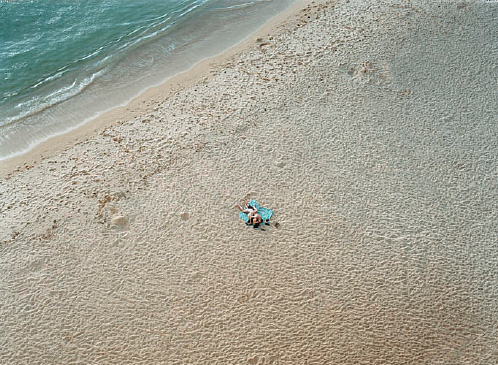 Richard Misrach, Untitled , 2004, On the Beach
To create the pictures, Misrach used a view camera that holds 8-by-10-inch negatives. He scanned the negatives into a computer, and sometimes digitally removed people, heightening the feeling of isolation. When he was satisfied with an image, it was burned with lasers onto photographic paper that then went through a chemical developing process.
June 15, 2011
going digital
The future is digital in photography it is said.
Oleg Novikov had the opportunity to use the Hasselblad H3DII–50 camera system in a three day photographic expedition to Pingyao, Shanxi Province, China. Lucky fellow. Few of us will ever have that opportunity.
 Oleg Novikov, Pingyao #2, from Poetry of Pingyao
He has also has had the opportunity to use the CFV–39 digital back on his Hasselblad 503CW, which is the only classic mechanical SLR camera that officially is still in production.
To extend the legacy of the system and breathe new life into it in this digital age, as well as allow existing V system users to "go digital" without having to change camera systems, Hasselblad launched the CFV line of digital backs that are specifically designed to fit the aesthetics and functionality of the V system.
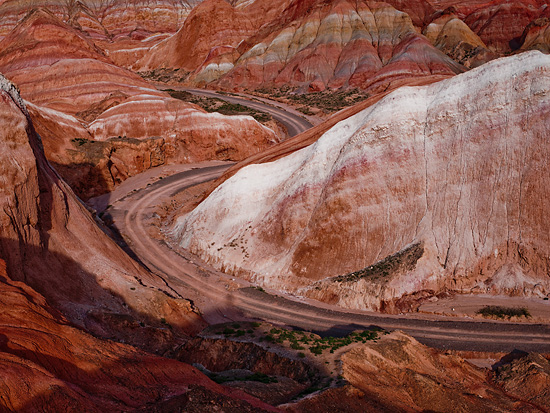 Oleg Novikov, Danxia landforms at Zhangye
Zhangye, Gansu Province, China
Oleg Novikov, Danxia landforms at Zhangye
Zhangye, Gansu Province, China
His judgement is that the CFV–39 lives up to the purpose of transforming the classic V series cameras into digital workhorses while retaining the aesthetics of the V system. The CFV–39 successfully extends the legacy of the Hasselblad V system into the domain of digital photography while providing the users of the system with state–of–the–art image quality.
This may be the case, but we are talking about investments of $20, 000---$40,000 to make the transition to digital medium format.
June 13, 2011
a human disaster
Boris Mikhailov pays his subjects to pose for him, often exposing their ravaged bodies with their tattoos, scars, bulging bellies and sagging breasts. These are photos of human wreckage, variously drunk, mad, glue-sniffing, filthy, delusional, impoverished, sick, hysterical and defeated, sloping towards death in post-Soviet Russia.
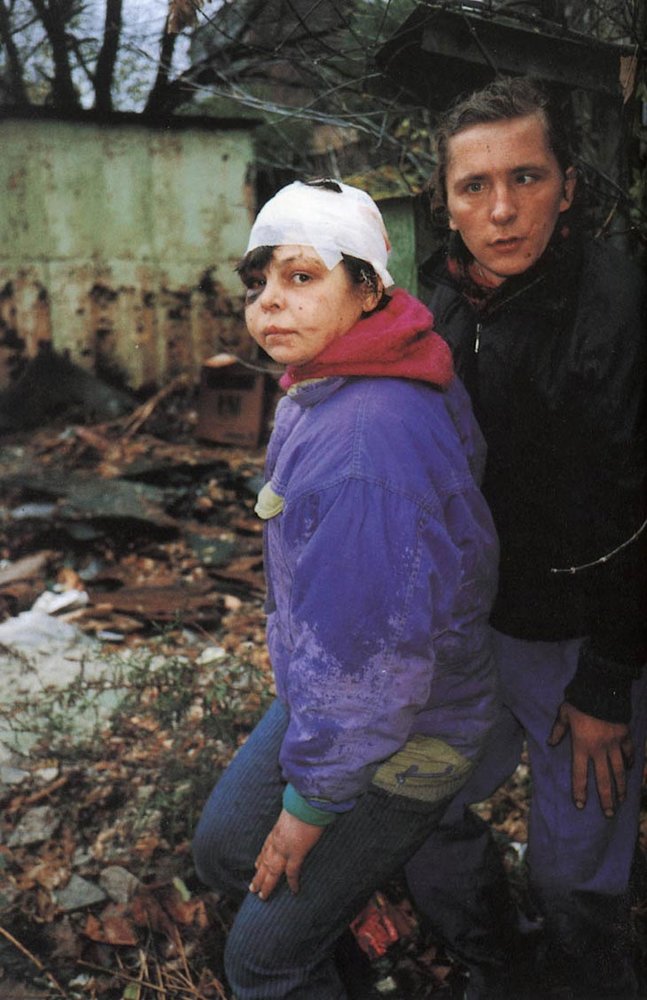 Boris Mikhailov, Untitled, from Case History, 1999
Mikhailov has defended himself against charges of voyeurism, arguing that it is better to document and draw attention to the suffering and degradation of his subjects than to pretend it doesn’t exist. The harsh realism of these works can be seen as an ironic retort to the airbrushed deceptions of the Soviet-approved ‘Socialist Realism’.
June 12, 2011
musical nostalgia
The album--It's only Rock and Roll-- was a hit and miss affair as the Rolling Stones slipped into rock star excess and addiction. The music never really catches fire and there is too much filler. The album marks the end of a very creative era for the Rolling Stones both in terms of commercial sales and artistic creativity. It's a return to a quintessential Stones album after the poor critical reception that Goat's Head Soup had received.
This was Mick Taylor's last LP with the band. In retrospect, Taylor ended up being the perfect guitarist to replace the late Brian Jones. Taylor was a very essential and integral cog in shaping the music the Rolling Stones created in the early to mid 1970s. Taylor's lack of a co-credit on the album's second best song, "Time Waits For No One," was reputedly the last straw that ensured his departure.
This version of Tumbling Dice shows what the band was were capable of circa 1973.
The 1973 Brussels recordings showed the band at their peak. Ladies and Gentlemen...The Rolling Stones --based on their concert in 1972 and the music from Exile from Main Street--- shows the stripped down band raw and energetic. The band looking or sound better here than there more recent outings.This is a musical unit at its peak-- and they know it----which they then translated into celebrity status.
June 11, 2011
distinguishing between photographs and images
In 'Camera lucida: Roland Barthes, Jean-Paul Sartre and the photographic image' in Continuum: The Australian Journal of Media & Culture vol. 6 no 2 (1991) Photogenic Papers Ron Burnett introduces a important distinction between photographs and images:
The former inevitably plays into questions of sight and object, questions of verification and truth - the latter is the result of an act of consciousness and therefore subject to a different, though related set of questions. The former must be seen to gain status, though as Barthes suggests, a photograph ' ... is always invisible: it is not it that we see' ... Images cannot claim the autonomy of photographs. Images can never be separated from vision and subjectivity. Images are part of a mental process, the result of an interaction between photographs and viewing subjects. Images are products of perception and thought, conscious and unconscious, looped in a spiral of relationships which are continuous - a continuum.
He says that often, the assumption is made that photographs have an existence outside the exchange between viewer and object. 'Unlike any other visual image, a photograph is not a rendering, an imitation or an interpretation of its subject, but actually a trace of it. No painting or drawing, however naturalist, belongs to its subject in the way a photograph does' . This assumption is a central one in all discussions about photography, the notion that there is a reality outside of the photograph for which the print becomes the representation.
Berger extends his argument with the assertion that a photograph 'fixes the appearance' of an event. In the moment and flow and flux of everyday life, the photograph preserves what the eye might otherwise not capture.
This is the point at which image and photograph must be seen as dramatically different. For although the photograph has an existence separate from the viewer it can never be removed from the process of interpretation. As soon as there is a spectator for the photograph an image results.Images are seen as carriers of meaning and images cannot exist outside of their context of use.
June 6, 2011
Mitch Epstein: American Power
In this interview at Bombsite the American photographer Mitch Epstein say that the genesis of his American Power book arose from being hims commissioned by the New York Times Sunday Magazine to do a piece about the small town of Cheshire, Ohio.
It sits in the shadow of one of the largest coal-fired power plants in the US, owned by American Electric Power (AEP). There were lots of environmental issues with the plant’s emissions. So the company decided to buy everybody out. Erase the town. I spent a couple weeks there, on two trips, and there was one experience in particular that I couldn’t shake off. About a dozen hold-outs wouldn’t sell to AEP, one of whom was Beulah Hern. She was around 80. Her nickname was Boots.
Meeting Boots and watching the Cheshire houses being demolished were what got me started on this project.
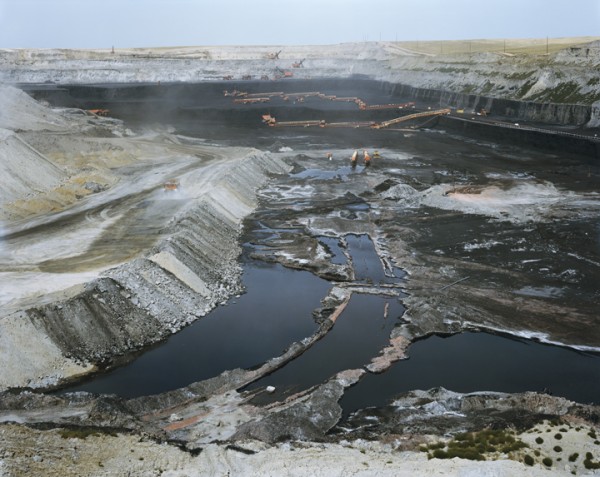
Mitch Epstein, Mwydok coal mine, Wyoming, USA , 2008, from the American Power series
Epstein says that he faced harassment from local and federal law enforcement agents whenever I went to shoot in the vicinity of a corporate energy production site, despite being on public property.
The project began about energy, but quickly became about power in all its dimensions—not only voltage power, but governmental and corporate power. The power of nature. The power of community. An artist’s power.
June 5, 2011
advertising in the city
We are often very aware of the general role of advertising in ordering the material world, organising social relations and the significance of advertising in urban spaces. Advertising is a core element in the visual mix of the city-- the complex interplay between the architecture of shops, hotels, and casinos, and the illuminated signs and advertising billboards which lined the routes to and around these sites.
So we have an understanding of city spaces as sign systems and a conception of the city as a site of consumption that we read or interpret in some form.
 Gary Sauer-Thompson, advertising signs, Adelaide, 2011
Advertising marks the everyday, routine experience of traveling to and around cities, and it has become a staple, taken-for-granted element of our cities. Advertising has an impact regardless of whether or not we register the textual messages of specific campaigns.
The various rhythms of the city--going to and from work, the rules of traffic control, the pattern of children going to and from school, or the opening and closing times of shops--- that help produce forms of knowledge of the city suggests that as we moving through the spaces of the city we don't actively `decode' or respond to advertising messages that are presented to us in in any focused or consistent manner.
June 3, 2011
travel, photography, tourism
In the Broken Power Lines blog we find two interesting paragraphs on travel and photography in relation to tourism. It is difficult not being a tourist when travelling in another state or country.
The first paragraph says:
The Facebook or Flickr Photo Album says this: Look at all of the beautiful places I’ve been to and seen (I am so cool)! Our pictures serve as badges, testifying to our courageous traveling spirit, when truth be told, they are more like a collection of dead, petrified butterflies pinned under glass. To put it simply: what kind of deeper understanding about existence is gained or opened up to by simply seeing beautiful landscapes? Again, please don’t think I am hypocritical. I relish the aesthetic pleasure of seeing mountain scapes, among other forms of natural and manmade beauty. However, what I am challenging, is the idea that this form spectatorship naturally makes us cosmopolitan, open-minded, and adventurous people.
The next paragraph accurately states that:
... often what we are seeing and photographing is spectacle produced specifically for the gaze of the tourist/foreigner. I will never forget arriving in the grasslands of Inner Mongolia and being welcomed by a troupe of Inner Mongolians dressed in traditional costume, singing traditional songs. Later on in the evening I shared a cigarette with them and listened to them tell me about how boring it is to sing the same fucking song again and again; discuss where they were going to drink that night; who is dating who, etc.. Much more insightful to me than the spectacle of cultural authenticity was this group of ordinary, bored, young people, who reminded me of characters from Jia Zhangke’s “Unknown Pleasures.”
The point being made is that aesthetics needs to be combined with critical thought in order to bring about a shift in one’s being; traveling needs to be combined with an ethos of openness and attentiveness if it is to live up to its promise of providing new ways of understanding the world- if it is not simply to be a cocoon for the rich (relatively speaking), bored, and pampered.
June 2, 2011
photography + the concept of a medium
In Infinite exchange: The social ontology of the photographic image in Philosophy of Photography (vol.1/ no.1) Peter Osborne says that the photographic present is, clearly, digital.
He then asks:
'What, if anything, does digitalization tell us about the nature of photography?’ and more specifically, ‘What does digitalization tell us about the nature of photography as a form of art?’ Please note, I say ‘form of art’ and not ‘medium’ because I wish to problematize (indeed, to reject) the assumption that what may legitimately be called ‘photography’ today displays the unity of a ‘medium’, in the sense adopted and developed by modernist formalism: namely, a specific combination of material means and conventions governing practices of production.
He adds that in the light of this, the critical-philosophical task wouldbe to update or redefine our conception of that medium under the changed technological conditions of ‘digitalization’ .
The problem with the concept of medium is that it mortgages discussion of the relationship of photography and art to a particular problematic critical tradition (modernist formalism). Not only is this tradition inadequate to the comprehension of nearly all the most significant developments within the visual arts over the last fifty years (as well as in the second and third decades of the twentieth century); it has also come to function philosophically as the historical ground for the revival of a (broadly Kantian) aesthetics of contemporary art, and thereby, the perpetuation of a fundamental conflation of ‘aesthetics’ with the philosophy of art (a conflation which, historically, photography played a central role in breaking up).