May 29, 2011
photography + time
In Photography, cinema, memory : the crystal image of time Damian Sutton says that photography’s history has been one in which subjectivity has been excluded from the internal mechanism of the camera. First the drawing implement and then photographic cameras operated as a lens or mechanism through which the world could be viewed, subjectivity hidden behind the laws of optics and chemistry.
What was forgotten was photography’s ability to depict time as a passing. The photograph is often considered timeless, negating time or simply poor in comparison to cinema--eg., photography “embalms time” itself. What we have forgotten is a different experience of time altogether, one that is very different from chronological time and that can be considered only in terms of pure duration
May 25, 2011
the indexicality of photography
This image by Taryn Simon is from An American Index of the Hidden and Unfamiliar (2007).The book reveals objects, sites, and spaces that are integral to America's foundation, mythology, or daily functioning but remain inaccessible or unknown to a public audience. These unseen subjects range from radioactive capsules at a nuclear waste storage facility to a black bear in hibernation to the art collection of the CIA.
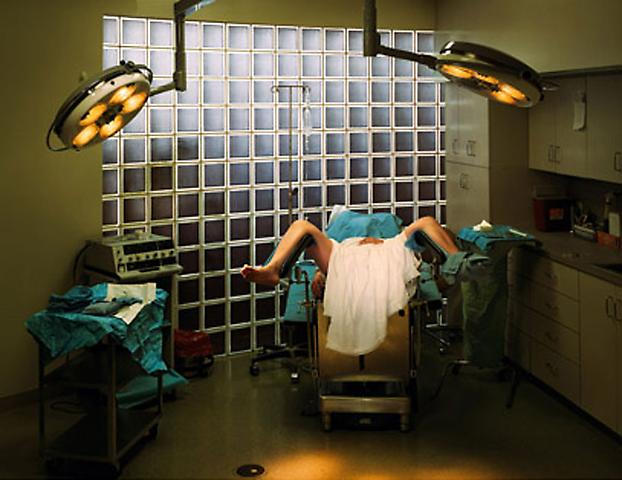 Taryn Simon,Hymenoplasty Cosmetic Surgery, P.A.
Fort Lauderdale, Florida, 2005/2007, Chromogenic color print.
Taryn Simon,Hymenoplasty Cosmetic Surgery, P.A.
Fort Lauderdale, Florida, 2005/2007, Chromogenic color print.
The photographs in th3 book are very much like opening a ‘cabinet of curiosities’ where the photographer is attempting to challenge the categorical boundaries of environments and objects, things that are yet to be defined and fixed in place.
Taryn Simon says of the Hymenoplasty, Cosmetic Surgery, image that:
The patient in this photograph is 21 years old. She is of Palestinian descent and living in the United States. In order to adhere to cultural and familial expectations regarding her virginity and marriage, she underwent hymenoplasty. Without it she feared she would be rejected by her future husband and bring shame upon her family. She flew in secret to Florida where the operation was performed by Dr. Bernard Stern, a plastic surgeon she located on the internet. The purpose of hymenoplasty is to reconstruct a ruptured hymen, the membrane which partially covers the opening of the vagina. It is an outpatient procedure which takes approximately 30 minutes and can be done under local or intravenous anesthesia. Dr. Stern charges $3,500 for hymenoplasty. He also performs labiaplasty and vaginal rejuvenation.
May 19, 2011
photographic seeing
Sarah James in her Photography's Theoretical Blind Spots: Looking at the German paradigm in Photographies (vol. 2 No. 2) explores the notion of photographic seeing in German photographic discourse that is based on the concept of “authored photography” (or Autorenfotografie).
This concept refers to a photographic art – as exemplified by the Bechers – which we can understand as a documentary form of photography that incorporates the documentary, conceptual and aesthetic.The photographer must be considered in terms of the full artistic responsibility which they bear for the photograph. Central to the concept of author photography is the idea that it goes beyond a singular photograph, and can only be understood in the greater context of a photographer’s oeuvre.
According to the art historian Klaus Honnef, the illusion of a singular image as a symbol of the whole of reality or as a general reality complex is the direct result of the false conviction that reality in its extent and totality is easily comprehensible. The photographer’s selection of topics produces the overall context, which comes from a closer understanding of reality, without which his work would be spoilt. Primarily, though, “authored photography” can be understood as based on a subjective way of seeing which is understood as becoming objective.
James says:
Significant in itself, the term Autorenfotografie suggests the reassertion of the author as opposed to its poststructuralist dissolution, and the deliberate reclamation of photographic art from the flood of cultural images. Paradoxically the term was developed to conceptualize photographic practices which could not be less subjective; a documentary photography that avoids expressing a personal vision, resolutely refusing the autographical, the individual, or the creative. However, photographers and critics maintained that a subjective investment in a lived experience was retained in such photography, and in its critical conception of objectivity.
Like many German theorists, Honnef returns to the question of redefining an aesthetics for photography, and considers it in relation to the Adornian problem of constructing an aesthetics after Auschwitz.
Honnef insists that an aesthetics of photography should not be disavowed but that past aesthetic theories invested in a dialectical construction of aesthetic experience, such as Kracauer’s, offer an extremely productive and under-explored approach to the medium. Here, photography is understood primarily in terms of its creation of a distinctive aesthetic, which unites new elements from the technical structure of the medium with several aspects of the art of earlier epochs.
Honnef utilizes Kracauer’s theory of photography as a source for his own methodological approach to the medium. In Kracauer’s view, the photographer appears as the empathetic interpreter of historical events, thus the photographer’s selectivity is of a kind which is closer to empathy than to disengaged spontaneity, and he resembles the imaginative reader intent on studying and deciphering an elusive text.
Mac malware
The malware authors are beginning to adapt to changing habits of PC users. There’s nothing inherently safer about alternative browsers—(Internet Explorer, Safari, Chrome, and Firefox) or even alternative operating systems.
The slow decline of the Windows monopoly and the steady rise of alternative platforms including Google Chrome and the OS X platform on Apple Macs is resulting in increasing malware run by criminals using crime ware kits to make money. For instance, the number of reports of Mac malware found in the wild are increasing.
One of these is MAC Defender a fake antivirus programme that targets mac users. It changes its name to MacSecurity and MacProtector and is now served to Mac users from a page that resembles the Mac OS X Finder. This is a basic social engineering attack customized for the Mac OS X.
Instructions on how to remove Mac Defender (it's basically scareware) etc are available at Fixkb.com. For protection measure see TUAW
Only a tiny percentage of Macs run antivirus software, and Mac users have been conditioned to believe they’re immune from Internet threats. That’s a deadly combination. Because Apple is a secretive company, it's not easy to find out whether malware on the Mac is indeed becoming more common, or it's simply being reported on more often.
Mac users have been lucky up to now. As market share for Macs continues to inch up, that equation is going to change and bad guys will begin to focus in on Macs. Macs are no more inherently secure than Windows. Hackers are now starting to pay attention to the Mac's previously malware-free world.
May 17, 2011
a visual world of commodities
We live in a visual world of commodities as much as we live in a material one. The everyday life of the consumer is surrounded by manufactured images and hence also played out in the field of the visual. ‘Global consumers enthusiastically consume images; brand images, corporate images and self-images are critical economic and consumer values.
The commodity has entered and transformed the realm of the visual and it has become a hegemonic visual rhetoric that enters the realm of sense perception.
 Gary Sauer-Thompson, mannequins, Collins Street, Melbourne, 2010
We live in a society where things have taken on social characteristics of a flow of commodity images whilst social relations have taken the form of relations between things. Commodities were socially significant not so much as material objects which were produced by labor but as signs, as a mode of signification that was independent of the mode of production.
Commodities no longer function as use values, as things which serve the needs of the rational individual, rather they are part of the social system of the exchange of meanings---as a self-sufficient system of signs that have a magical appearance. They have and objective reality that come to constitute a universe of sensory experience.
The phantasmagoria of modernity is a mechanism of transforming seeing into believing and of fabricating realities out of simulation. It is a mechanism through which modernity constitutes itself as a regime of visibility and more generally, of representation; thus asserting itself as reality in which we live.
May 9, 2011
Japan: after the earthquake
On March 11, the 9.0-magnitude earthquake and tsunami struck northeastern Japan. As of today, nearly 15,000 deaths have been confirmed, and more than 10,000 remain listed as missing.
In some coastal communities, where the ground has sunk lower than the high tide mark, residents are still adjusting to twice-daily flooding. Many thousands still reside in temporary shelters because their homes were either destroyed or lie within the exclusion zone around the damaged Fukushima Dai-ichi nuclear power plant.
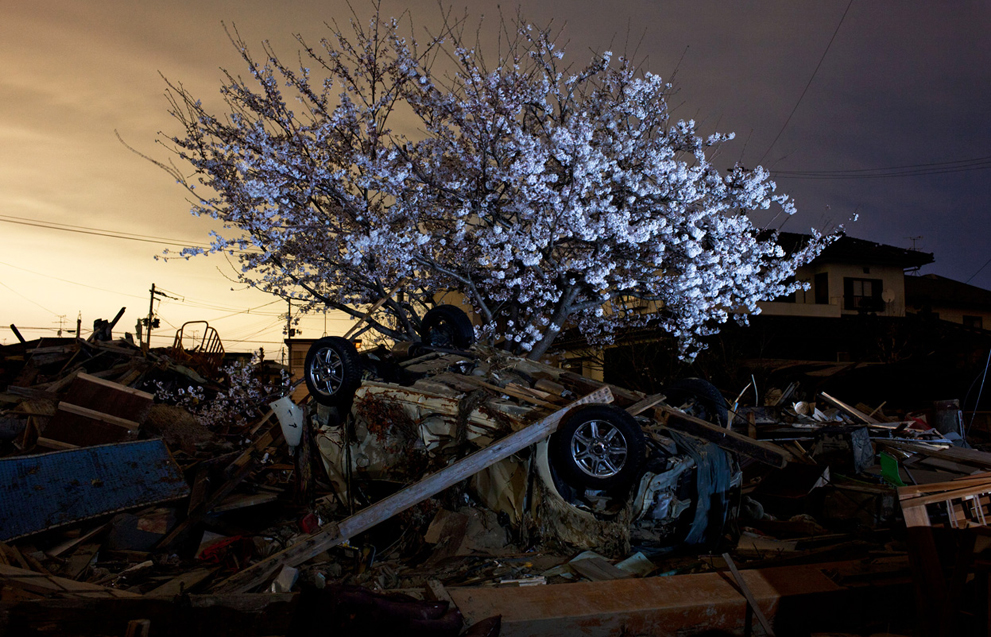 Yasuyoshi Chiba, Cherry blossoms cover a tree among tsunami wreckage in Natori city, Miyagi prefecture, Japan, on April 18, 2011
Japan has faded from the 24 news cycle. The clear-up that will last 3 years and cost billions has finally swung into gear. Fleets of bulldozers, dumper trucks, drills and cranes are clearing the wreckage with the focus of the clear-up being to remove the corpses of dead cities and towns. Residents are being allowed to salvage as many of their belongings as possible.
May 7, 2011
the aftermath-culture of Australia
Ross Gibson in “Places past Disappearance” in Transformations 13-1 (2006) says that rummaging in Australia’s aftermath cultures he tries to re-dress the disintegration in our story-systems, in our traditional knowledge caches, our landscapes and ecologies:
My job is to investigate and recuperate scenes and collections of artifacts that have been torn apart somehow, torn by landgrabbing, let’s say, or by accidents, or exploitation that ignores rituals of preservation and restoration. Typically, the scenes and systems I investigate were once a good deal more coherent, but now they are ailing or out of balance. I’ve come to understand that most of Australia is like this, that the place we inhabit is our best evidence about our unbalanced selves and that this place has so much raggedness in it because it is patterned to the society that has used it so roughly.
It’s an attempt to chant some patterned significance back into places that have long been denied custodial care. It’s the first step in imagining how a new, relatively cohesive present might evolve from adjustments and activations of vestiges from the past.
He adds:
Our Australian part of the world is strewn with vestiges of cultural and natural systems. Consider the vulnerable skeins of indigenous dreamings; the remnants of endemic ecologies; consider also the myriad systems of work and belief that have been refined elsewhere in the world and partially transplanted here. The good news is that in some cases, despite two hundred years of colonial disturbance, we have managed to avoid terminal damage, either by getting out of the way of resurgent nature or by applying design and labour attentively and adaptively. But in many instances our places are teetering with a minimal degree of systematic cohesion, and they will be made sensible only if we act promptly and boldly, so that our aesthetic and civic patterns might help us project our thinking across everything that’s missing or ailing.
It's a process of uncovering fragments that you know have been discarded by the world.
May 5, 2011
Grateful Dead: Scarlet Begonias '77
This is the band on form during the Godchaux period of the Dead. The video uploader blurb says that it is "Scarlet Begonias" live in concert at the Capitol Theater in Passaic, NJ April 27th, 1977. It sounds like Barton Hall, Cornell University 8 May 1977 to me, but Garcia's solo is too short.
It's a warm up for the Barton Hall concert version which is over the page.
It flows into "Fire on the Mountain":
There is little quality video from the 1970s. So this is to be welcomed.
Here is the Barton Hall, Cornell University 5 8 77 interpretation: it's tight and inspired.
Barton Hall is widely considered one of the best shows in the Grateful Dead's 30-year career.
questioning the creative industry discourse
The creative industry discourse is positive in that it does indeed expand the opportunities for many young people in fields of great interest, e.g. visual arts, media, design, popular music, performance studies, etc. And, in addition, there has long been a tradition of radicalism and critical thinking as well as politicisation in the arts and in culture in general.
Angela McRobbie argues in Variant (issue 41, Spring 2011) that the ‘creative industry’ argument re the importance of the talent-led economy is a form ‘cultural neo-liberalism’. In the remaining social democratic provision in the form of arts education and training is transformed through a new rhetoric to become a space for producing young people who are to be ‘entrepreneurs of the self’ just as Foucault predicted in his mid-1970s lectures.
The creative industry argument is premised on the promotion of creativity. The emphasis on ‘pleasure in work’, the idea of finding yourself in creative practice, appeals to all of our own narcissistic and private desires, that somehow under the right conditions we will plug into a core of talent that will relieve us of the burden of wage labour, a tedious job or unrewarding work. McRobbie comments that:
such a call can be a profoundly effective form of new disciplinarity, a technology of the self as Jacques Donzelot argued. We are increasingly required to ‘be creative’. We are expected to tap into our own inner resources and to find a way of using our talents. Indeed not to do so will increasingly be seen as a source of chastisement or even penalty. New subtle forms of cultural capital begin to appear; a creative elite who are able to take advantage of the support on offer from what was New Labour, and the others, who for whatever reasons resist this call, become instead reliant on a normal job and who are then in some ways social if not economic failures because on the party circuit of ‘network of sociality’ they do not have an interesting creative job to talk about
She adds that in recent years there is a requirement to have a working identity which is interesting, even fascinating. For young people this becomes part of their own self-identity, their value in the social world.
I am referring largely to those young people who are being trained in the arts and cultural and humanities fields. Many of them in the past would have gravitated to jobs which were socially valuable, if unexceptional, but the ‘dividing practices’ which accompany the intense processes of individualisation mean that in work, the person is called upon to be unique, and as a result this means pursuing jobs which appear to be more attractive, even if they have no rights and require long hours.She says that her main point main point is that the dominant vocabulary for undertaking creative work under the auspices of neo-liberalism is one which shuns ‘old’ ideas such as protection and entitlement, and favours instead self reliance, ambition, competition and ‘talent’. The push was really to move the burden of workplace protection and security away from the ‘employers’ and onto the shoulders of the individual freelance person. A cultural agenda for encouraging new forms of work was at the same time a symbolic gesture to employers indicating a commitment to lowering their costs of labour.
With the emergence of the politics of austerity be a significant decrease in resources across the world of arts and culture, including education and training. McRobbie says that we will soon look back at the 1997-2007 decade as one where the state mobilises substantial resources to support a neo-liberalisation effect in the creative sector. Structural under-employment and the normalisation of under-employment is here to stay
May 4, 2011
food security
In The New Geopolitics of Food in Foreign Policy Lester Brown argues that we are entering a new era in which world food scarcity increasingly shapes global politics. He asks: 'What will the geopolitics of food look like in a new era dominated by scarcity?'
His argument is that it is not merely a story about the booming demand for food. Everything from falling water tables to eroding soils and the consequences of global warming means that the world's food supply is unlikely to keep up with our collectively growing appetites. He states:
....as land and water become scarcer, as the Earth's temperature rises, and as world food security deteriorates, a dangerous geopolitics of food scarcity is emerging. Land grabbing, water grabbing, and buying grain directly from farmers in exporting countries are now integral parts of a global power struggle for food security...At issue now is whether the world can go beyond focusing on the symptoms of the deteriorating food situation and instead attack the underlying causes. If we cannot produce higher crop yields with less water and conserve fertile soils, many agricultural areas will cease to be viable.
He says that the increase in grain prices since early 2007 has been driven primarily by two factors: accelerating growth in demand and the increasing difficulty of rapidly expanding production.
The result is a world that will look strikingly different from the bountiful global grain economy of the last century.
The Pilbara Project
The Pilbara Project--called 52 Weeks On---involved Les Walkling, Tony Hewitt, Christian Fletcher, Peter Eastway, filmmaker Michael Fletcher, and writer William L. Fox, who toured the Pilbara, creating stories through images and words that represented the collision and interconnection of the land,industry and cultures of the Pilbara.
From what I can gather, the project and the team at FORM was organized by Christian Fletcher, a West Australian based photographer whose work explores natural and urban/industrial landscapes:
 Christian Fletcher, containers, Port Hedland, 2010
Bright colours, clean lines, minimalist. It's snappy image making that represents Port Hedland's role as the main container receival point for the Pilbara iron ore region.