September 27, 2013
Jeff Rich: Watershed
A watershed is the name for an exit point of a basin that collects surface water from rain or melting ice. Many big rivers such as the Mississippi and the Amazon have them. A watershed consists of not only the springs, creeks, brooks, rivers, ponds and lakes, but also the land surrounding these water bodies. The reason this concept is so important is that most of the pollution that impacts our waterways occurs on land.
Jeff Rich's work on the environmental stress of rivers flowing through Tennessee and North Carolina in the US was made on film, with either a 4×5 or 8×10 camera.
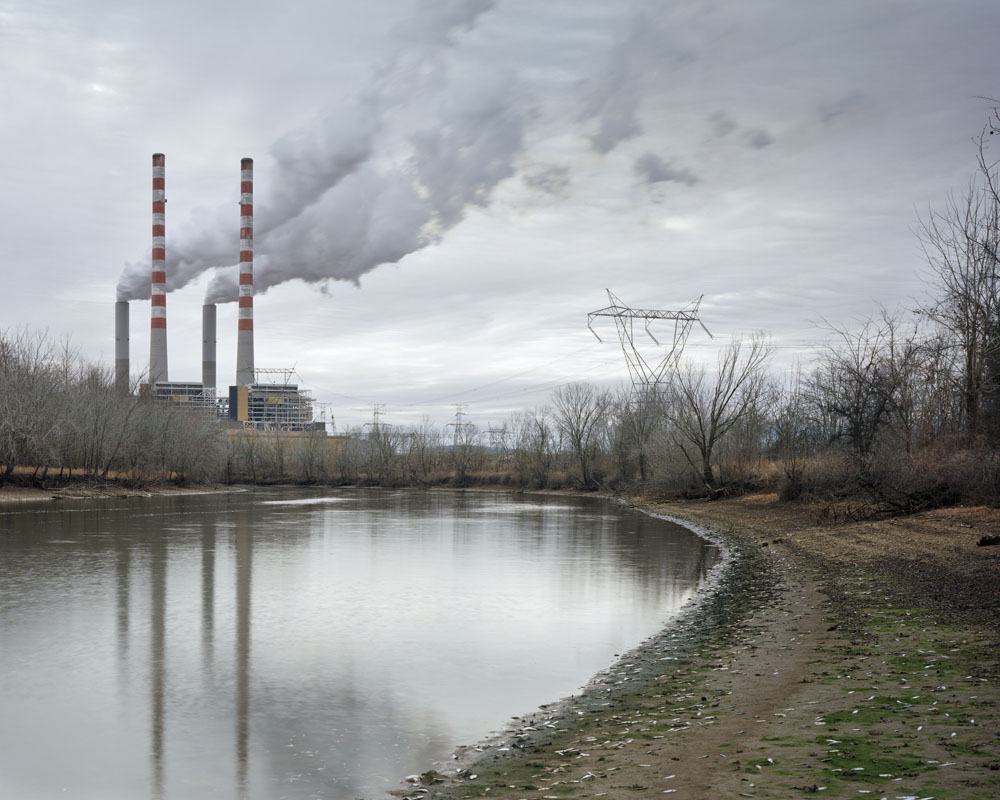 Jeff Rich, Fish kill, Cumberland Fossil Plant, Lake Barkley, Cumberland City, 2011
Rich chose to start the project with the 213-mile-long French Broad river since it was close to his home in Asheville, North Carolina. He expanded and start photographing the Tennessee river, then the Mississippi River south of St. Louis. His work documents the effects of development, exploitation and abuse amid rich Southern landscapes, beautifully exposing the devastating toll of environmental degradation.
September 23, 2013
Joni Sternbach: Promise Land
Joni Sternbach's series Promise Land highlights decaying houses peek out from behind branches, creepers, trees and water. These abandoned homes in the rural east end of Long Island, (a storied retreat for the wealthy of New York, are embedded in the natural world that threatens to overtake them.
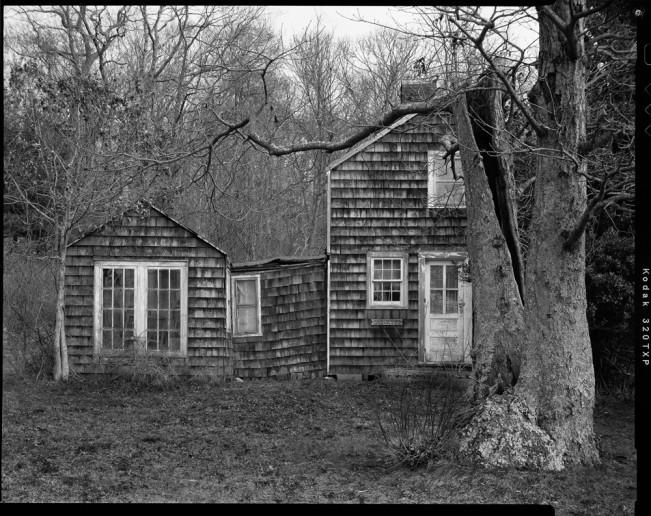 Joni Sternbach, Three-Mile-Harbor-Road, from Promise Land, gelatin silver print
The series depicts the demise and destruction of homes on the eastern end of Long Island. It is done in a documentary style and the body of work addresses a local view (Sternbach lives in the same area of Long Island) on the effect of the current economic crisis on real estate, the landscape, and the perception of home.
Sternbach says:
It’s kind of mind blowing to see how simple a life they lived here compared to what this area has become. For me, the structures I’ve been photographing have become a symbol of the past. Home, the American Dream as we once knew it. People don’t build or even live like this anymore. Middle class values have been replaced by big bucks. When I first started shooting I called the project “Un Real-Estate,” because the architecture is photographed straight on, dead pan style, like you’d expect to see in a realtors office, except the houses are not in livable condition.
The modest middle class homes of yesteryear have been replaced by the McMansions of today?
September 20, 2013
Alex Boyd: The Stack of Coire Faoin
Alex Boyd is known for his landscape work with antique processes such as wet-plate collodion.
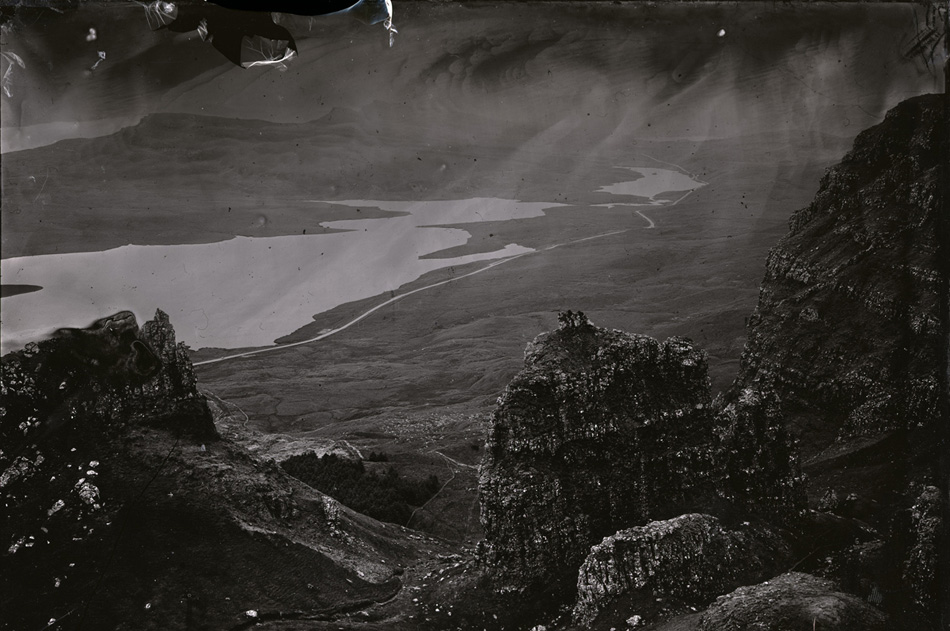 Alex Boyd, The Stack of Coire Faoin, Isle of Skye, 2013
Wet-plate collodion is a slow process and requires the use of chemicals on location. The process was pioneered by Frederick Scott Archer and Gustave Le Gray in the early 1850s. Until it was largely replaced by other processes in the 1880s, it revolutionised photography, making it easier to obtain images with exposures of only a few seconds, and allowing multiple copies to be made from the same glass negative.
September 19, 2013
moral panics in Adelaide
Bill Henson has withdrawn from the 2014 Adelaide Biennial, under pressure from what appears would have become a sustained campaign against his participation in an exhibition of national importance, hosted by our own Art Gallery of South Australia. The work was unseen and none of those crying “exploitation”--including News Ltd--- actually knew what work he would be showing at the biennial.
None of the works , according to the Art Gallery of South Australia, were of children.They consisted of landscapes and doorways!
 Richard Avedon, Stephanie Seymour, model, New York City, May 9, 1992, gelatin silver print, printed 1997
Bill Henson has become a lightning rod - a bête noir - for those who are closely involved in the issue of child protection The heated controversy in NSW in 2008, was convincingly shown to be an opportunist one exploited and fanned into hysteria by conservative activists who equate sexuality with pornography.
This public vilification of the artist is also what happened in Adelaide.
Teen sexting + rape
In Sexting, Shame and Suicide in Rolling Stone Nina Burleigh says:
The ability to record and communicate gang-sex assaults has added a new enhancement to an old and ugly crime against women. From Instagram to Snapchat to texting, young people with raging hormones and low impulse control are passing around what amounts to child pornography. And the bodies most frequently watched and passed around are female.
Most rapes don't make the local news or even reach school administrators because the girls are too embarrassed to do anything.
She adds:
Prosecutors all over the nation are facing the same social and legal quandary: How do you protect young women from not just sexual assault but the magnification of those assaults via the Internet? How much punishment can they mete out to boys, who in many cases are only a year or two removed from childhood, who seem to think they are committing pranks with phones and passed-out girls, and for whom the ultimate charge – rape – means the end of their lives before they start? Finally, how do you instill in impulse-driven teens of both sexes the knowledge that whatever they record on their phones and send can reach the entire world and stay public forever?
September 18, 2013
on “being online”
Greg Pollock in Connection, Language and Family at Cyborgolgy critiques the view that “technology” or “social media” or “the digital” have impinged on an authentic mode of life that previously existed and which we retroactively call “offline.” He says that:
Saying that “online” is a modality means, as many at Cyborgology and elsewhere have argued before, that “being online” is not something that is either on or off, true or false, but always there in varying degrees of attention, intensity, and praxis. It also means that being online is not zero sum with being offline. Pulling out your phone doesn’t flip you over from offline to online. The phone was sending and receiving data while out of sight. Your brain was also aware of the potential for digital communication at a background level. Engagement with the digital modality can be more or less or intense, and regulating that modality of being is not a bad thing–it is probably a necessary practice in the care of the self, just as other modalities have been in the past.
Online is not a bewitched place to treat with mystical apprehension.The metaphor of “on” and “off” implies a dualism that we need to avoid. The more precise language of network access understands the conditions of connectivity to be always variable, often intersecting, never mutually exclusive, and never conflated.
September 16, 2013
the “conservation” of philosophy
Robin James at its her factory has an interesting post on contemporary philosophy and its relation to the digital humanities and science.
Some quotes:
Philosophy’s value isn’t in what it is currently, but in the transformations it will help bring about. So, attempting to conserve a hypostasized snapshot of the discipline impedes it from participating in the very transformations that give it value. Or, preventing it from changing undercuts the most important contributions philosophy can make to ongoing intellectual life.
If philosophy wants to be continually relevant and adequate to contemporary life and its problems, then it needs to transform itself, to work in and with the media in which our societies most readily represent, express, record, and communicate themselves.
In order to practice philosophy in the way I think it must be practiced–not conservatively, but progressively, pushed to new media, new experiences, new phenomena, new problems–I must actively engage intellectuals from all over the academy and, importantly, from beyond it. I need to be in conversation with people whose training and research “inputs” are different than mine. At the same time, I still have something distinctively philosophical to offer, based on both my training and research “inputs,” but also on my “outputs”.
These are important insights given that philosophy majors and departments are being eliminated and the Abbott Coalition government is on record decrying the uselessness of philosophy. Philosophy’s unique contribution to intellectual life will help transform intellectual life, and it won’t be recognizable as “philosophy” in and by today’s disciplinary standards.
September 15, 2013
John Austin: flora images
One strand of John Austin's large format black and white forest photographs in south west of Western Australia is the flora images. These focus on showing the rubbish that is ignored or swept away for the clear felling of the native old growth forests by the timber industry.
 John Austin, Fruiting Zamia, Wilmott State Forest, Western Australia
Plants like Xanthorrhoea and Zamia are “scrub rolled” to make way for the clearfelling of the “target species --the karri and jarrah trees.
You can see the destruction legally wrought, and the protest against this ecological destruction, in a video made by Austin from scans of his still black and white images made between 1994 and 2013.
Forest Threnody from John Austin on Vimeo.
The notes and snapshots about Austins professional black and white photography can be found on his blog.
September 14, 2013
Michael Light: photographing the American West
Michael Light is a San Francisco-based photographer, bookmaker, and pilot whose focus is the environment and how contemporary American culture relates to it. His work is concerned both with the politics of that relationship and the seductions of landscape representation, particularly as found in the arid Western spaces of America.
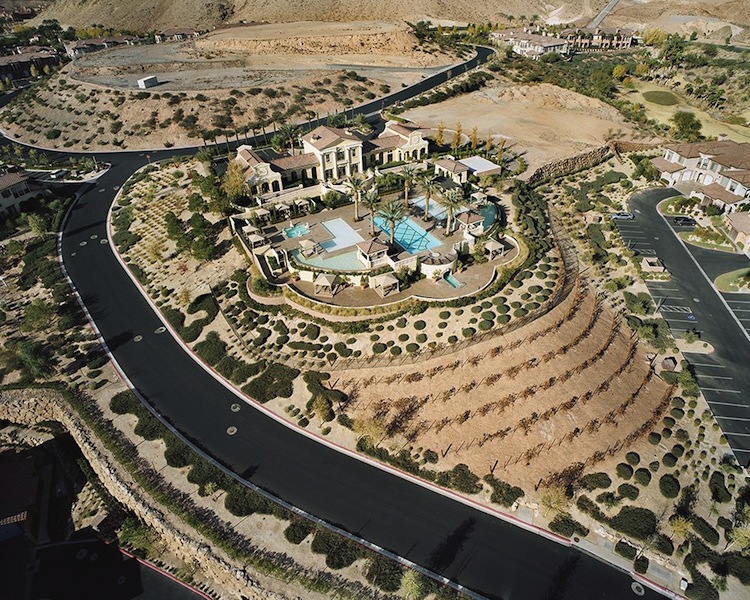 Michael Light, Lake Las Vegas, 2010
He is currently working on an aerial photographic survey of arid western America, tentatively titled "The Inhabited West." Carefully shot from a self-piloted airplane or hired helicopter, Light’s images of the Sierra Nevada region, Southeast California and Phoenix, Arizona present a still life of manufactured landscapes set in the sage-brush fields of the American West.
September 11, 2013
the post industrial
The post industrial is often characterized by empty abandoned buildings--factories, warehouses, high rise housing. People have discovered these abandoned buildings, figured out how to get hold of them, and then tried to use them for something really unusual or different.
Thus a lot of the old factory buildings — old tanneries and warehouses---- in Australia's inner city (eg., Fitzroy, Melbourne or Port Adelaide) have been converted into lofts, galleries, creative hubs, and living spaces. This kind of renovation and revitalization of industrial space--urban renewal---is happening across Australia.
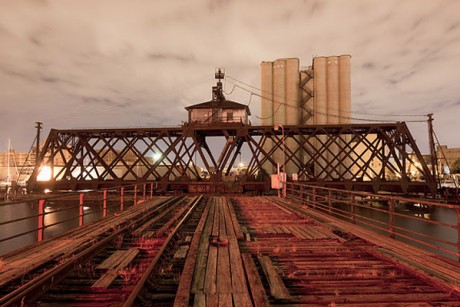 David Schalliol, "Chicago and Northwestern Transportation Company Swing Bridge" (2011)
The industrial jobs that brought so many people to the cities in the early 20th century just aren’t there anymore. More and more of these kind of jobs have moved out to the suburbs and there is the reclaiming of spaces of work that involves the returning urban space back to the people that it was meant to serve.
September 2, 2013
on "the game of politics"
In their Why Nations Fail Daron Acemoglu and James A. Robinson point out that when there is conflict over institutions, the resolution depends on which people or groups win out in the game of politics – who can get more support, obtain additional resources and form more effective alliances. In short, who wins depends on the distribution of political power in society. They add:
The political institutions of a society are a key determinant of the outcome of this game. They are the rules that govern incentives in politics. They determine how the government is chosen and which part of the government has the right to do what. Political institutions determine who has power in society and to what ends that power will be used.
If the distribution of power is narrow and unconstrained, then the political institutions are absolutist. In contrast, political institutions that distribute power broadly and subject it to constraints are pluralist in nature. Instead of being vested in a single individual or a narrow group, political power rests with a broad coalition or a plurality of groups.
By vesting power broadly, inclusive institu- tions tend to uproot economic institutions that expropriate the resources of the many, to erect entry barriers and to suppress the func- tioning of markets so that only a few benefit.
This synergy between extractive economic and political institutions creates a strong feed- back loop: political institutions enable the elites controlling power to choose economic institutions with few constraints or opposing forces. They also enable the elites to structure political institutions and their evolution. Extractive economic institutions, in turn, enrich the same elites, and their economic wealth and power help to consolidate their political dominance.
Inclusive economic institutions, in turn, are forged on foundations laid by inclusive po- litical institutions, which broadly distribute power and constrain its arbitrary exercise. These political institutions also make it harder for others to usurp power and to undermine the foundations of inclusive institutions. Those controlling political power cannot easily use it to set up extractive economic institutions for their own benefit