August 22, 2013
rethinking photography’s impact on our culture
In the book Photography Changes Everything --a collection of essays and images edited by curator and writer Marvin Heiferman argues that photography is multiple languages rather than a universal language.
In the Introduction we find this paragraph:
Most of the billions of pictures that are made with cameras every year are made for purposes that have nothing to do with art. They are made for quite specific reasons, some exalted and some mundane, and their value is dependent on how well they serve a purpose that, more often than not, has nothing to do with photography itself. Scientists, engineers, sociologists, historians, advertising agencies, and fashion designers use photographs to prove a point, influence behavior, interpret human nature, or to preserve a moment in time. Their pictures end up in discipline-specific archives, where they await rediscovery and reinterpretation by subsequent generations.
Photography changes everything as it continues to expand into new fields and take them over. Photography appears in each new domain often in a quite restricted role, fulfilling a function. But that grows until whole specialities now revolve around the application of photography within fields which used to get along quite well without it. The overriding impression is that we are all camera operators now and this causes angst in the art-photography business.
August 2, 2013
Captain Sweet: architectural photography
Captain Samuel White Sweet settled in Adelaide in 1866 and spent the next twenty years photographing the most important period of South Australia’s development. He ran his photography business in South Australia between 1866 and 1886, under the professional name of ‘Captain Sweet, Landscape Photographer’.
He photographed the growth of the city from its infancy to economic, cultural and industrial maturity; witnessing the construction of some of Adelaide’s most important buildings and the establishment of its first major transport and communication systems.
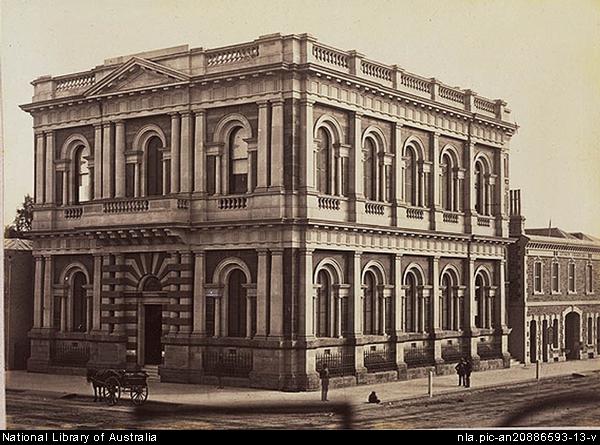 Captain Sweet, Bank of Adelaide between 1869 and 1889, gelatin silver, Part of Captain Sweet's views of South Australia
Sweet became a master of the photographic methods of the time – wet plate glass negatives and albumen silver photographic prints – and was the first to use dry plate negatives in South Australia.
Most mid-19th century photographers kept to studio portraiture and only a few, like Bernard Goode, George Freeman, Captain Sweet and Townsend Duryea, took landscape photographs and views of Adelaide's buildings and city streets. Captain Sweet remained the foremost landscape photographer in South Australia until his death in 1886.
August 1, 2013
Heartland: Kate Breakey
This is one of Kate Breakey's images that features in the Art Gallery of South Australia's Heartland: Contemporary Art from South Australia exhibition:
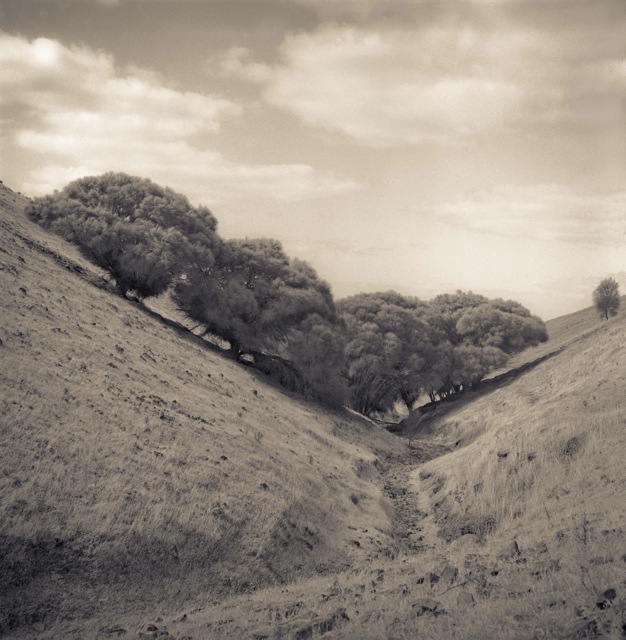 Kate Breakey, Cape Cassini, Kangaroo Island, 1999, archival pigment, inkjet prints, hand-coloured with pencil and pastels
Heartland conjures up ideas of Australian outback landscapes and the way that Australia's cultural identity has been constructed by the traditional concepts of landscape. Kate Breakey, like Ian North, is presenting photographs that were taken up to 30 years ago.
The focus of this work is on Kangaroo Island, Meningie and further afield in South Australia: places with natural-seeming scenery that nonetheless bear the trace of human interference. She appears to photographing ephemeral moments in the landscape created by the light.
They are constructed from black, white and gray tones and Breakey applies just a touch of color by hand: a tiny bit of blue in that ocean, a trace of yellow in the Irish sky, just enough to make her mark as a painter.