July 31, 2012
Adam Cullen
The graffiti-like style of the recently deceased Adam Cullen became nationally famous with his portrait of actor David Wenham in the film The Boys, loosely based on the Anita Coby murder. The portrait won Cullen the Archibald prize in 2000.
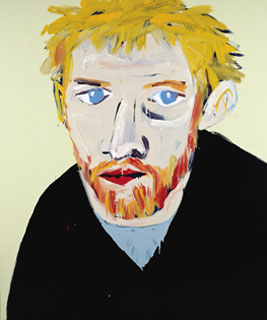
Cullen paints types, stereotypes and genres that have been identified as ‘Australian’: larrikins, bushrangers, drovers, footy players, beauty queens and antiheroes including criminals, prostitutes and drunkards. He also regularly depicts a particular type of soft-bellied, butt-crack-exposing, balding older male who seems as overly familiar as Donald Bradman or budgie-smugglers.
Cullen's painting conjures up an awkward humanity, frequently dangerous and often clunky. It is peopled with several recognisably Cullenesque types: male figures whose flesh melts down to the hips where it thickens in folds and useless genitalia, headless females and garishly pneumatic women that bring to mind the word 'floozy'. Popes, crooners, crooks and kangaroos also pop up, with and without antennae, in barely sketched landscapes redolent of disconnectedness, dysfunction and failure.
July 19, 2012
London Olympics: Brandalism
A group of artists calling themselves Brandalism have been posting their work over dozens of existing billboards in protest at the amount of advertising around the Olympic Games in London.
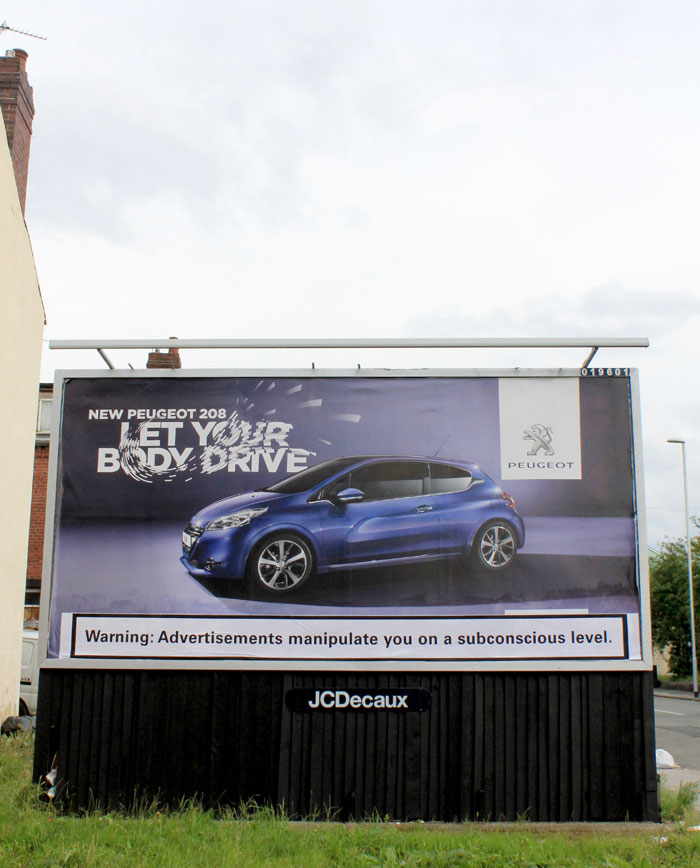 Shift//Delete, 'warning', Install in Leeds.
The protest group said that the strict enforcement of branding regulations for the 2012 Olympics had been a strong part of provoking their reaction and have promised more action.
One of the groups taking part is the Melbourne-based street artist and illustrator Ghost Patrol:
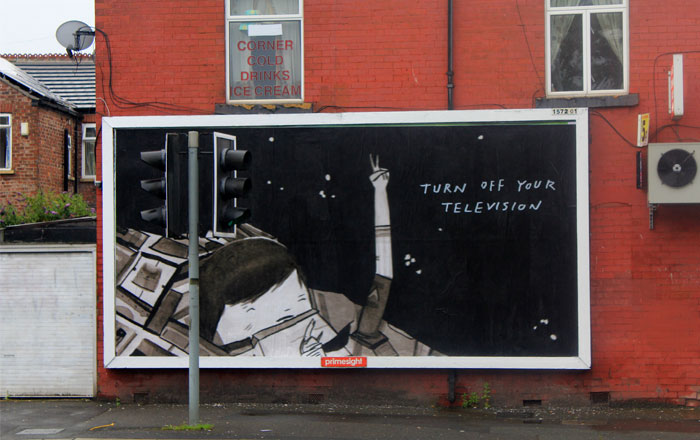 Ghost Patrol, Turn Off Your Television', Install in Fallowfield, Manchester.
He has a Flickr Stream.
The Brandalism project saw 25 artists from 8 countries coming together for the biggest subvertising campaign in UK history. Over five days a team of guerilla installers travelled to Manchester, Birmingham, Leeds, Bristol and London and put up artworks that seeks to confront the ad industry and take back our visual landscapes.
July 16, 2012
Jon Rafman + Google Street View
In 2007, Google released Google Street View, in which a computer user could access a virtual panoramic image of many streets in the world. Jon Rafman curates images from the Google Street View all-seeing machine. Rafman hunts through Google Street View pictures and accesses notable, jarring moments.
In this interview the Canadian photographic artist Jon Rafman says:
People often ask me what the future is going to look like… I’m not really sure why… maybe simply because I work with new technologies.In the past we relied on dystopian and utopian views of the future. The future was thought of as fundamentally different from the present. Today, there is a sense that the future is going to be a lot more banal, that we are already living in the future (like with the phone that you are recording this conversation with), that the future is going to be more of the same… more apps and technologies that are designed to mediate and ‘improve’ our experience of reality. It is essentially a more Facebook-like future. This is very different from the early Internet, which was more like an exploration of a vast unknown territory.
Rafman takes screen shots of images culled from Google’s huge digital compendium of worldwide street scenes, and he runs a Tumblr blog that periodically adds new photos found.
Two years ago, Google sent out an army of hybrid electric automobiles, each one bearing nine cameras on a single pole. Armed with a GPS and three laser range scanners, this fleet of cars began an endless quest to photograph every highway and byway in the free world.
July 10, 2012
Avedon's portraits
Gagosian Gallery is showing an exhibition of Richard Avedon's photographic murals and related portraits of the 1960s and 1970s.
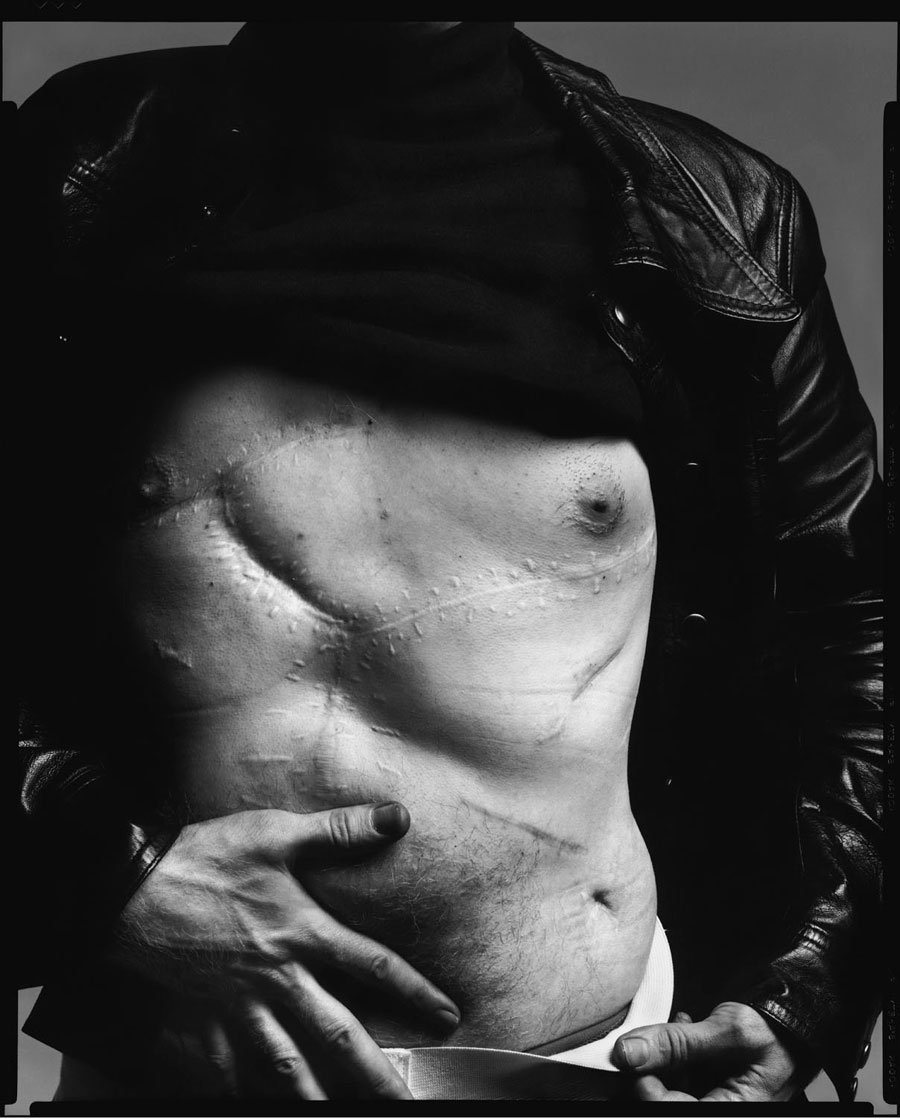 Richard Avedon, Andy Warhol, artist, New York, August 29, 1969, 1975, Gelatin silver print
These are photographs of counterculture activists, writers and artists, especially Warhol and The Factory., done in Avedon’s style of plain white backdrop and frontal, direct gaze with even lighting.
July 1, 2012
painting + photography as two modes of representation
In the first chapter of their Photography Theory in Historical Perspective entitled Representation in Photography The Competition with Painting Hilde Van Gelder and Helen W. Westgeest explore the measure to which photography and painting are capable of representing reality and the differences in character and origin of the two modes of representation.
As is well known soon after its invention, photography was employed to record facts – which were often, but not always, facts of historical value. It was argued ---eg., by André Bazin--that photographs offered immediacy and transparency of depiction in a way that traditional artistic forms of representation such as sculpture, painting, and the graphic arts could not possibly achieve. This argument has been put forward to underscore the supposedly essential differences between paintings and photographs and, subsequently, to identify photography as “a different kind of art” --most notably by John Szarkowski.
Photography, on this account should define its own medium-specific identity in contrast to painting. Szarkowski championed the modernist idea of formalist art photography’s medium specificity in technical terms.
They say that Szarkowski distinguishes five phenomena he considers unique to photography: The Thing Itself, The Detail, The Frame, Time, and Vantage Point – and this list is not meant to be exhaustive.
Photographers, Szarkwoski argues, can only record reality as they encounter it. The photograph reflects a fragment of reality, and does not explain it. Rather than being a story, it only offers scattered and suggestive clues of what was once there. The photograph is unable to assemble these clues into a coherent narrative, he continues. It somehow tells of reality itself, so to speak, while simultaneously re-presenting it to us.
This stands in contrast to Greenberg who stated that photography's specificity lies in the fact that it is a narrative practice, that photography is a “technology plus narrative”.