August 25, 2012
the negative space of the internet
The Fibreculture Journal is calling for papers for a special Issue entitled The Politics of Trolling and the Negative Space of the Internet.
They say that the Internet has continued to function as a “redemptive technology”. Social media is just the latest in a long line of technologies which may, on a certain vision, rescue liberal democracy, with its decaying civic life and corrupt media, from itself.However, there is, proportionally, too little attention to the everyday conflicts that haunt all such communities. Some conflict is temporary, and can be accounted for in terms of long-standing democratic theory. But some conflict is persistent, intractable. Some of it is gratuitous, and deliberately disruptive. Online, those who bring it about are often subject to normative disapprobation. Sometimes people call them trolls.
Troll”, as a term of moral opprobrium, indicates an online actor who is not interested in deliberation, but in derailing it. Trolling is not apt to be captured by network maps or visualisations of online publics, because these teachniques cannot discern which nodes in a conversational network are created in bad faith, or in a spirit of disruptive play. Trolls are not interested in redeeming democracy through deliberation, and they mock attempts to do so. Trolls respect no procedural rules, though they may be generative of them. Trolls are the constitutive outside of online communities of political discussion, they are the intolerable of the most tolerant communities. Trolls are usually someone else, defined from our own position and interests. When they are not, and we inhabit trolling, we discover that trolling requires know-how, close reading, experience, sometimes sympathy with those we would disrupt.
They add that the intellectual desire for open and constitutive democracy has overridden the ‘actually existing democracy’ of bullying, trolling, threats, inane memes and low signal-to-noise ratios.
There is a lot of internet misogyny because what what men can no longer say in public, they can and do say anonymously on the internet. The standard justification is that they fed up with political correctness. It's not just misogyny either. There is partisan politics based on an existential friend/enemy distinction; climate change denial;
Wilson, McCrea and Fuller, the editors of the special journal, ask: 'what are the consequences to seeing trolling and other forms of affective behaviour as the norm, rather than the aberrant?'
August 15, 2012
Mars: Curiosity
The image is of a distant wall of Gale Crater captured by the Curiosity rover that landed on Mars last week. A corrected colour image.

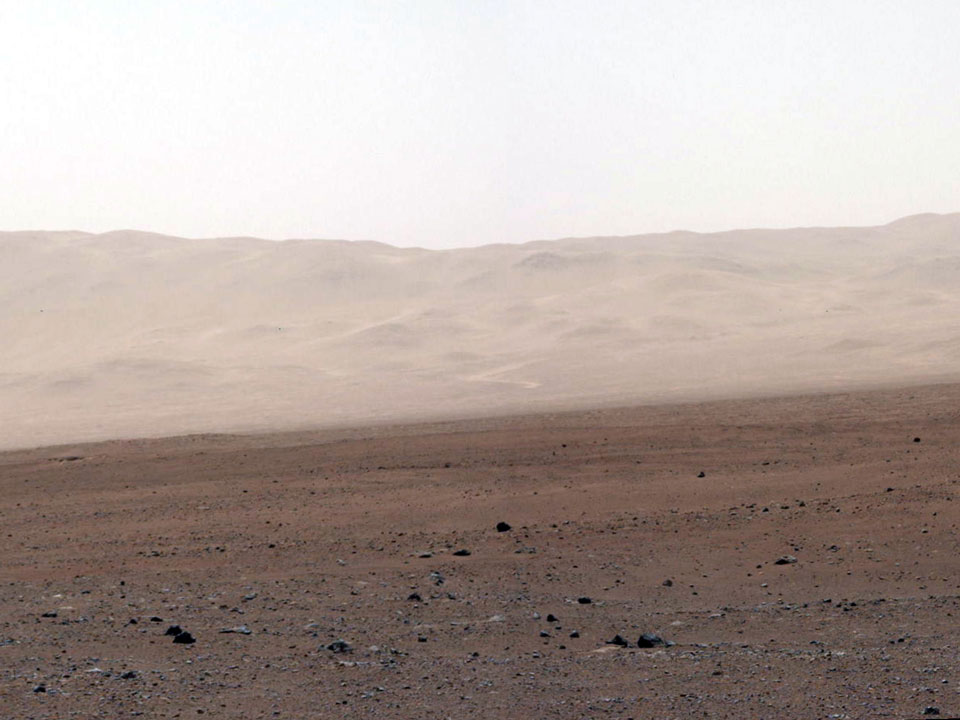
The landscape has the appearance of being an unusually layered dried river bed.
August 11, 2012
Curiosity: Mars
This is the first 360-degree panorama in color of the Gale Crater landing site taken by NASA's Curiosity rover. The panorama was made from thumbnail versions of images taken by the Mast Camera.
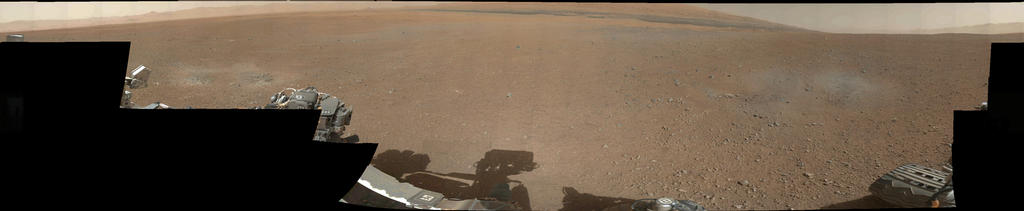
The late-afternoon view reveals a gently-undulating plain surrounded by the hills that form the crater's walls. There are dark grey dunes cross the plain between the rover and 5.5km-tall Mount Sharp at the crater's centre.
August 9, 2012
Australian photography: Richard Daintree
Richard Daintree was a pioneering geological surveyor and one of the most significant photographers working in Australia in the 1850s and 1860s.
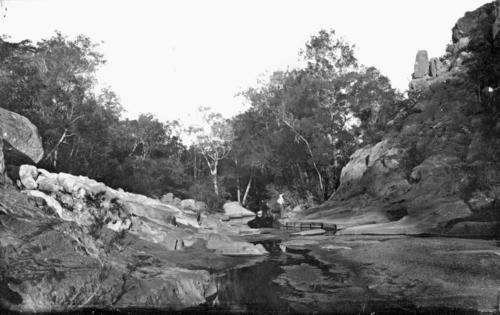 Richard Daintree, Creek cutting through solid marble, Queensland
August 8, 2012
NASA: Curiosity on Mars
The image comparison below shows a view through a Hazard-Avoidance camera on NASA's Curiosity rover before and after the clear dust cover was removed. Both images were taken by a camera at the front of the rover. Mount Sharp, the mission's ultimate destination, looms ahead.
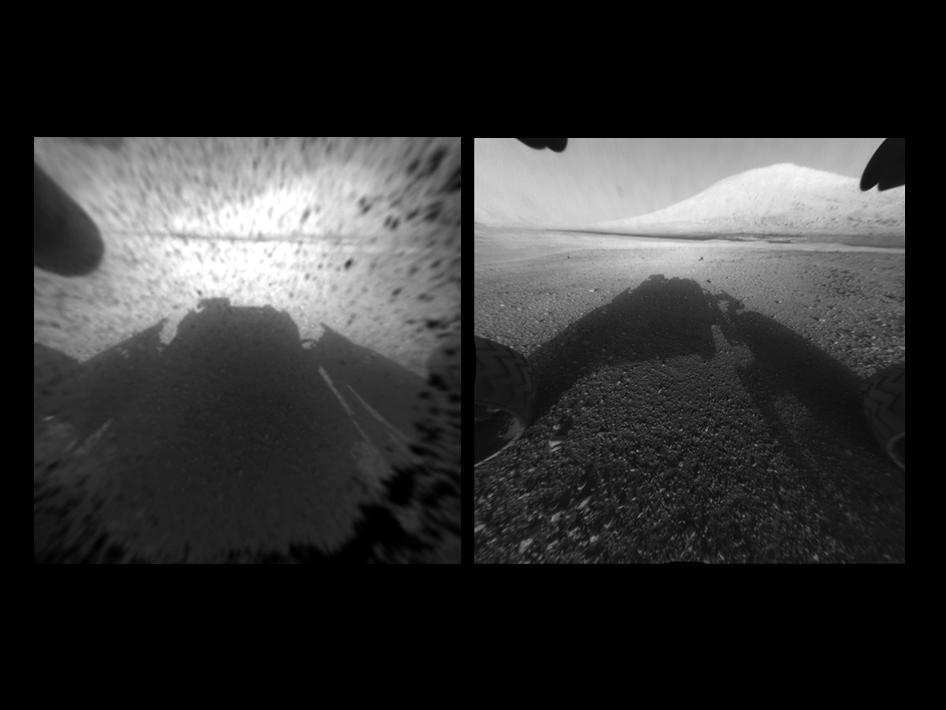
The view on the left, with the dust cover on, is one quarter of full resolution, while the view on the right is full resolution.
Mount Sharp, is located inside the 154 kilometres-wide Gale Crater, which sits just south of the Martian equator. Ii looks strikingly similar to California's Mojave Desert with its looming mountains and hanging haze,
Each of Gale Crater's geological layers is a page in the story of the planet. Stuart Clarke says that the outline of Mars's life story has already been sketched. It starts billions of years ago when Mars was a warmer, wetter, more habitable place and ends in today's barren, airless desert.
The question is whether this was a gradual process, in which Mars changed slowly over a billion or so years, or whether it was much quicker. A gradual scenario may be more conducive to the establishment of widespread life in Mars's past.
August 7, 2012
the anti-aesthetic stance
I've never really understood what the anti-aesthetic stance that has been a current in the art world since the 1960s stance stood for. That current appears quite strong in postmodernist criticisms of formalist modernism. Postmodernism was created as the antithesis to modernist emphasis in aesthetics. From what I can gather he anti-aesthetic stance rejects the aesthetic because it is either invites irrational sensuous indulgence, or it embodies elitist class-biased standards of taste, which are ideologically complicit with instrumental reason.
Howere, if we dig a little deeper, then those who adopt the 'anti-aesthetic stance' appear to mean different things, such as:
(1) pertaining to art, (2) pertaining to the sensuous and affective aspects of experience, (3) pertaining to pictorial representations, images, or icons, (4) pertaining to the philosophical discipline of aesthetics, (5) pertaining to norms or standards for the evaluation or critique of artworks or other images, (6) pertaining to beauty, (7) pertaining to the autonomy of art.
Key texts are Terry Eagleton’s Ideology of the Aesthetic, Tony Bennett’s Outside Literature, Pierre Bourdieu’s Distinction, and Hal Foster’s anthology, The Anti-Aesthetic.
Proponents of ‘the anti-aesthetic’ have sought to undermine aesthetics by casting it as an excrescence parasitic on art itself; moreover, aesthetics has, on such readings, been taken as an obfuscation of the politics of art and thus a direct competitor with politicizing readings of artworks: where aesthetics, so it is held, maintains the credo of ‘art for art's sake’, the anti-aesthetic clears a space for the possibility of a politically engaged art.
Owens' oppositional postmodernism takes issue with a Kantian understanding of the aesthetic, which is understood in terms of:
the idea that aesthetic experience exists apart, without "purpose," all but beyond history, or that art can now effect a world at once (inter)subjective, concrete and universal a symbolic totality....."anti-aesthetic" marks a cultural position on the present: are categories afforded by the aesthetic still valid?(For example, is the model of subjective taste not threatened by mass mediation, or that of universal vision by the rise of other cultures?) What is hard to that is hard to relinquish: the notion of the aesthetic as subversive, a critical interstice in an otherwise instrumental world--as held by Adorno. Now, however, we have to consider that this aesthetic space too is eclipsed or rather, that its criticality is now largely illusory (and so instrumental).
It was a strong current of the 1980s