June 27, 2012
Australia's coastal towns
In Coast goes from green to greedy in the Sydney Morning Herald Elizabeth Farrelly says that Australia's
Coastal towns, even those as sweetly self-conscious as Noosa, suffer from a single organising principle: water. Nothing else figures - church, square, town hall, market, windmill. Only water, which is to say, money. Water makes a town self-arrange like iron-filings along a magnet, its streets pervaded by a palpable straining for view, proximity or access. Architecture is tyrannised by it and those not so blessed are permanently blighted by its absence.It's as though water is the one common value remaining. And it has remade our coast, one of the longest and loveliest littorals in the world, into an encircling crust of suburban gentility.
Water means a desire for unrestricted panorama view, the protection of nature, and tourism attracted to paradise. On her urban rhubarb blog Farrelly says with respect to Noosa that:
perhaps it’s just that, by the beach, there’s only one value: view. And that translates as money, and you either have it or you don’t And if you have it, you’re in and if you don’t, you can bugger off.
The resistance to development is habitual with density and high-rise are the enemy. This results in suburban sprawl--a low density, bush-pocked suburbia.
The built environment of the coastal town--eg., Victor Harbor in South Australia--- is ugly, seedy and neglected. Beauty is in nature not the built environment and with the focus is on the natural environment--the sea--the new buildings are dreary. It's bad architecture that is tarted up by developers. The two agendas – sustainability and development---are opposed rather than coincide.
June 14, 2012
David Stephenson: Sydney at night
An example from David Stephenson's Light City project which he started around 2006 with Australian cities--Perth, Hobart, Melbourne and Sydney.
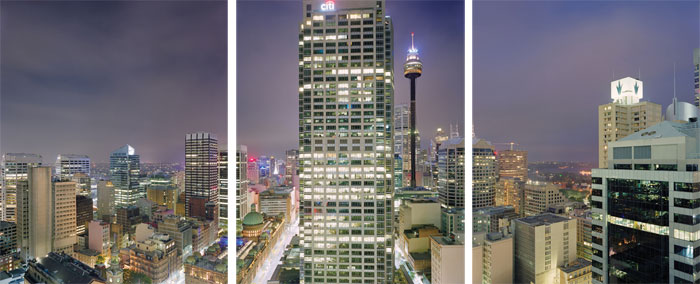 David Stephenson, Sydney, from Pitt Street, 2010, from Light Cities
These pictures show views of the energy flows of cities highlighting how they consume power in spectacular yet wasteful ways.
June 13, 2012
rethinking suburban urbanism
The Conversation, in conjunction with Griffith Review, is publishing a series of provocations in the form of asking some big questions to encourage a robust national discussion about a new Australian identity that reflects our national, regional and global roles.
Bernard Gleeson says that the suburb contained the desire lines of modern fulfilment that in the twentieth century became the map work of suburban expansion. It was also a model of human growth freighted with self-‐‑ endangerment, which become clear late in 20th century. He adds:
we now view human possibility solely through the lens of the market economy. Consumptive suburban and city landscapes franchise and confine the human conversation about development and self-realisation. It is a model of urbanism dependent upon resource and human exploitation, largely in the developing world....The desired urban model is opposed to, but also dependent upon, the shifting, boiling hinterlands that constitute the alternative and larger human reality – what the American urban theorist Mike Davis calls the “planet of slums”.
There is a need to develop new structures and ways of living but this requires breaking out of the closure of a neo-liberalism that holds that free markets define democracy, and thus the prospects for human freedom and fulfillment.
June 8, 2012
putting a face to a name
An exhibition at the archive, Fichés?, trace how attempts to identify individuals evolved with technology of photography.

Daniel Nethery in France’s first facebooks at Inside Story says that:
It was the repression of the Paris Commune in 1871 that gave impetus to the rise of the mug shot. Police sent photographers into the prisons to photograph those arrested, and then they composed the first criminal record cards to include a photographic portrait ... By the end of the Great War it had become commonplace for French people to have their photograph taken for administrative purposes. The portraits were required for a whole range of new identity documents
The darker side of the growing use of photographic portraits emerged when French police began to build collections of individual record cards, not all parts of the population were catalogued with the same fervour in that Roma and other nomadic peoples were targeted.
The habit of attaching photographic portraits to anything remains in France, where it is still common for job applicants to send off their curriculum vitae with a photo attached.
June 4, 2012
The Beach Boys: That's Why God Made The Radio
There's been a Beach Boys' official reunion and a new album That's Why God Made the Radio. The Beach Boys had become living jukebox of hits endlessly recycled as an oldies act, whilst Brian Wilson and the Beach Boys hadn't made a record together in 16 years. They did, however agree to release the original Smile Sessions in 2011.
One of the tracks That's Why God Made the Radio is a ballad written by Brian Wilson and sung by For Al Jardine entitled From There to Back Again:
The final three tracks – From There to Back Again, Pacific Coast Highway and Summer's Gone – form a kind of suite written by Brian Wilson. It is melancholic rather than nostalgic as in Pacific Coast Highway which refers to the late Dennis Wilson's "Pacific Ocean Blue" and the final song Summer's Gone, which marries beach imagery with resignation:
The album appears to be part fun-in-the-sun agenda and part Requiem for a Beach Boy. Even at its most remorselessly upbeat schmaltz the Beach Boys' music was marked by an ineffable sadness---or even a sad, stark splendor.