February 25, 2011
yet more social media naying saying
In We owe the internet for changing the world. Now let's learn how to turn off in The Guardian Jonathan Freedland recycles an old criticism of social media advanced by Nicholas Carr in The Shallows. Freedland is part of the backlash against social media by a movement of social media critics.
Freedland says:
What the internet has done, say the dissenters, is damage our ability to concentrate for sustained periods. Being connected meant being constantly tempted to look away, to hop from the text in front of you to another, newer one. This, the worriers fear, is not just irritating; it might even damage our civilisation. How capable will people be of creating great works if they are constantly interrupted, even when alone?
Twitter is distracting us westerners from our important work of deep reading and deep thinking and so we have a crisis of concentration brought on by a crisis of distraction.
What can be done to save us?
Freedland says that we cannot turn back time. Nor, given the internet's power for good currently on display around the Middle East, should we want to. But we need to reassert control. We need, in short, to rediscover the off switch. So we turn off the BlackBerry or iPhone, ignore Facebook, and shun Twitter.
And then what? Return to the world of books that we cannot afford? Read the op-eds in Rupert Murdoch's trashy newspapers?
February 24, 2011
modernist architecture, space, photography
The The Journal of Aesthetics and Art Criticism, vol. 69 no.1 is a free sample copy. In it Filip Martens in his The Aesthetics of Space: Modern Architecture and Photography observes:
Those who fail to appreciate modernist or contemporary architecture tend to lump together the most divergent problems as all originating in the invention of modern architecture. Without distinguishing the naive intentions of its pioneers from the practical failures of their inheritors, they uphold a caricature of the modernist spirit, which is held responsible for every single abuse and indiscretion in postwar building history, from the monotony in urban planning to excessive use of concrete in commercial towers. In this way, the very idea of an aesthetics of space characteristic of modern architecture is absorbed in the general picture of an inhuman, or even antihuman, architectural ideology and then dismissed.
He adds that a more nuanced approach to the elements involved, however, reveals a remarkable intrigue between modernism, space, and photography.
The first observation is that:
Architectural modernism was consciously developed as a programmatic movement. In its program, we find dwelling—the traditional inhabitation of space—to be an issue of high priority. .... Dwelling had become a part of the agenda of architects because it had lost its naturalness. There is no need to deny that several modernists’ visions and practices display a blatant misjudgment of the nature of dwelling. However, this does not imply that modernist architecture itself created the disintegration of the natural relation between building practices and traditional life. To the contrary, faced with this problematic situation, early twentieth-century designers set themselves the task of providing an architectural solution. Moreover, the origin of what has become the aesthetics of modernism lies in a reaction against those movements that did not truly address the issue of dwelling, most notably, the many “aestheticisms” that tried to cover up the problematic conditions of life with decorative profusion.
The second observation is that:
Against the widespread but idle criticism that the ‘modernist style’ flows from a blindness to the true purpose of buildings, I have pointed out that the forerunners of contemporary architecture reacted against the decline of architecture's integrity. The very origin of the modernist aesthetic lies, at least partly, in this reaction against those movements that had themselves neglected to respond to the question of dwelling. But, even though an awareness of the crisis of human dwelling lies at the origin of the modernist movement and its aesthetics, from the beginning, modernism was portrayed as misanthropic.
The third observation is that the emergence of modern architecture coincided with the popularization of photography.
For the first time in its history, architecture could be depicted by those who were not gifted aquarellists. Whereas previously the great majority of architectural drawings were presentations made before realization, in order to please the patron or client, architects could now record the result of their imagination at will so as to produce truthful depictions of unprecedented accuracy. However, there is something remarkable about the origin of architectural photography. Given the modernists’ fascination with the metropolis, the bustle of crowded streets and busy traffic, and given the typically modernist visions of the orchestration of the crowds, it is striking to see how desolate their interior spaces are when photographed. Schools, cinemas, houses, and the like are almost always shown as deserted, devoid of people, and often even completely cleared out, with no furniture or other signs of human occupation. This characterizes a great deal of architectural photography from its origin to the present day.
He asks what is the purpose of the ‘emptiness’ that so strongly characterizes architectural photography? Is it that (a) the emptiness of these depicted spaces merely serves the purpose of rendering a neutral photographical representation? Or is it that (b) this emptiness fulfills a specific role in that it influences—or has come to influence—our appreciation of the spatiality of architecture?
February 23, 2011
Eliot Porter + wilderness aesthetic
Eliot Porter's photographs comprising his Antarctica (1978) depict a "timeless" and composed Antarctic landscape, betraying no sign of the human intervention that nevertheless motivates and frames the album.
Porter helped create the Sierra Club aesthetic, which was also a complex strategy of promoting conservation in the U.S. post-War era. Advocates sought to curb development in Yellowstone Park, but advocacy required promotion. The photographic school that developed to capture and control the image of the western landscape created dramatic and anachronistic images of seemingly untouched nature.
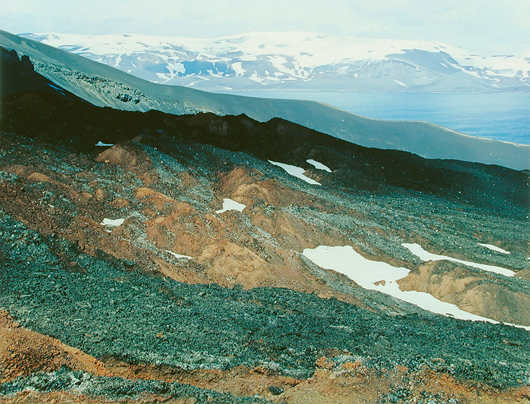 Eliot Porter, The Crater and Lava, Deception Island, Antarctica, January 19, 1975, Dye imbibition print (Kodak dye transfer)
Porter aimed to preserve the Antarctic wilderness against the inevitability of capitalist development through the power of his lush, full color coffee table book. But bringing the little known, non-nationalized Antarctic to a U.S. audience as wilderness, and as a handsome album of carefully framed photographs, also heavily marked the Antarctic as an object of U.S. national concern, and possibly of ownership.
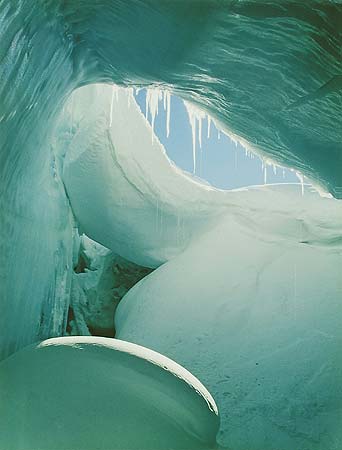 Eliot Porter, Ice Cave, Scott Base, Ross Island, Antarctica, December 7, 1975
February 18, 2011
Radiohead - Lotus Flower
Video for 'Lotus Flower' from The King of Limbs (named after a spooky tree in Wiltshire's Savernake Forest) their new album --- which is due online today. With eight tracks, and just over thirty-seven minutes of music, The King of Limbs is Radiohead's shortest album to date.
Produced and Directed by Garth Jennings
Choreographed by Wayne McGregor
Director of Photography- Nick Wood
Editor- Leila Sarraf
Two weeks ago, nobody really even knew a new Radiohead album was going to exist, and yet here it is. From what I can gather the new release continues to play out the drama between human imagination and artificial intelligence that has driven Radiohead since at least OK Computer, though perhaps more on a compositional level than as a conceptual thematic on this occasion.
The King of Limbs is a sparse eight tracks of clicking drumlines, disjointed synth loops, and dour noise, with nary a moment of wallowing melody or even diversionary experimentation filling the ranks. The two Radiohead albums that The King of Limbs bears the closest resemblance to are Amnesiac and Hail to the Thief.
February 13, 2011
Grateful Dead: Winterland 1977
An experiment. I've never accessed Wolfgangs Vault before.
From the magic that is the Grateful Dead in 1977. The “Scarlet Begonias > Fire on the Mountain” is probably my favourite jamming song, though “Eyes of the World” runs it a close second.
This particular grouping of 'Scarlet Begonias' and 'Fire on the Mountain' is from the Winterland Concert in December 1977. It is the second set:
Listen to more Grateful Dead at Wolfgang's Vault.
Then we have 'Fire on the Mountain' that continues the jam:
Listen to more Grateful Dead at Wolfgang's Vault.
As this concert is in December 1977, it is not from the monumental 9 disc release of the three night run Grateful Dead – Winterland June 1977: The Complete Recordings. I have yet to hear that.
February 10, 2011
ruins
Mogadishu is a quite ruined city. It brings to the foreground the antihistoric rhetoric of modernity (and to some extent postmodernity), which has has lost favor. The ruin is a specific "remembrance" of the past and the ground for ruins, and our interest in them, is memory, and along with it, matters or affects such as continuity, stability, nostalgia, desire.

Jose Miguel Calatayud, old Italian lighthouse Mogadishu, 2010
The ruins of something is a powerful source of conceptual remodeling of the past, rather than the ruin being just a former building with certain functionalities--an edifice. Our interpretation of ruins can redefine the past and the future. Dictatorships have engaged in a struggle to erase a past that was not convenient and that which was a trace, in ruin, was recontextualized, thus offering a “different vision” on the past.
The same ruin can be interpreted and reclassified according to different interests. In the The aesthetics of ruins Robert Ginsberg sets out to celebrate ruins in themselves, fragmented and incomplete.