March 29, 2011
Daniel Gustav Cramer: Woodland
Berlin based photographer Daniel Gustav Cramer has got three interesting sets of images: Woodland, Mountain and Underwater in his trilogy series:
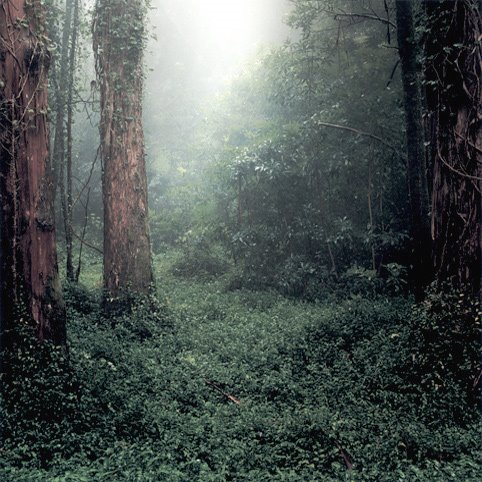 Daniel Gustav Cramer woodland, Trilogy
The three parts of his Trilogy were exhibited separately over the course of multiple years. In his own words:
The Woodland Project is a photographic series taken in several forests including Yakushima (Japan), Blackforest (Germany), Big Sur (California), Biealowitzka (Poland), Siebenbrgen (Romania), etc. It started in 2002 and is extending since then. In 2005 a second series of photographs taken underwater joined. Since the end of 2006 a third series of observations of mountain and mist closed the cycle and formed the Trilogy.
Cramer, from what I can see, focuses on texture with a broad composition.
March 26, 2011
autumn
It is autumn in Victor Harbor and the garden roses have suddenly bloomed:
 Gary Sauer-Thompson, apricot rose, Solway, 2011
We have a small rose bed at the weekender and the roses are going gangbusters. They are truly magnificent.
March 21, 2011
surveillance photography
In Public eye, private eye: Sydney police mug shots, 1912-1930 in Journal of Media Arts Culture ---Vol 2 Number 3 entitled Shadows of the Dead: Mediating the Archive Photograph Peter Doyle analysis the photos in the NSW police archive. This Forensic Photography Archive can be accessed through the Historic Houses Collection.
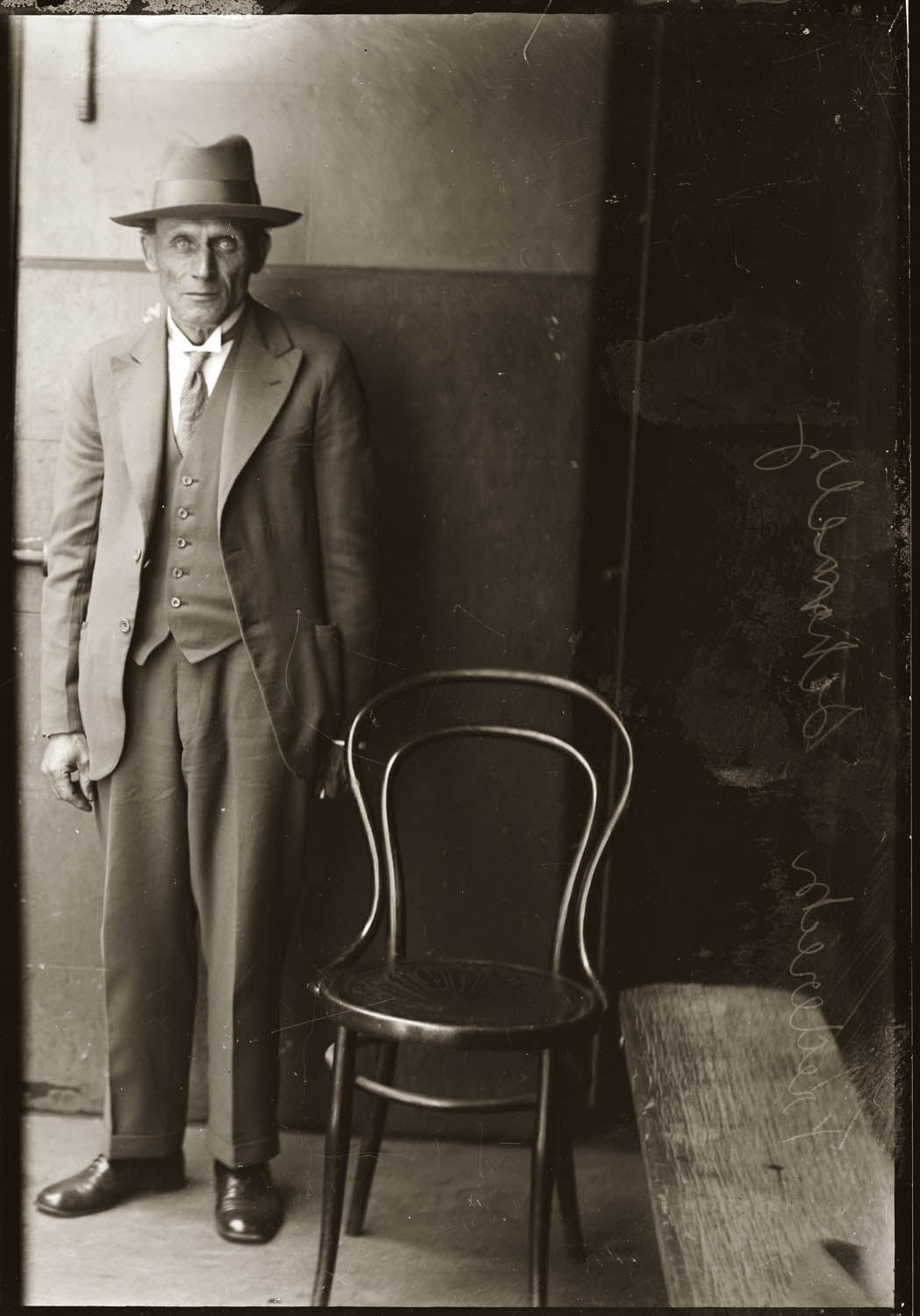 NSW Police Dept, Drugs Bureau, Frederick Schmelz, 1930
Doyle says that all these mug shots — whether taken in prison or the police cell — are the product of a state surveillance project, and were certainly not intended at the time to be publicly exhibited. And in the case of the prison photographs we see little evidence of any complicity in the photographic process. He adds:
Many previous studies of photography, including archival photography, have privileged the voyeurism, surveillance and control implicit in the photographic process. As a result, the selfhood of the photographed subject has often been elided. My analysis here explores those aspects of display or expression of selfhood apparent in the subjects brought before the police photographer.
They are different to the standard mug shot because they are rich in the contingent and ephemeral. We see cigarette butts and discarded newspapers on the floor, graffiti on the cell wall, stitch marks and repairs evident in the subjects’ clothing, minor scars and blemishes on their skin.
March 14, 2011
The Smiths
I know little about The Smiths even though were the most influential British guitar group of the 1980s, were an integral part of British cultural politics in the ‘80 and were influential on the Britpop movement.
The band lasted only five years, from 1982 to their acrimonious breakup in 198 and they are notable for the unique sound they infuse into all their material, a fusion of Morrissey's voice and an instrumental backing helmed by Johnny Marr's guitar.
This track-- "The Boy With the Thorn in His Side"---is from their The Queen Is Dead album(1986), which many regard as their peak.
It appears that the band's oppositional youth culture drew its strength from a nostalgic version of northern working class life in England as Morrissey mined the representation of the loneliness and longing and hopelessness in the proletarian domestic life in the kitchen sink dramas, social realist films. But then pop music is nostalgic to its bones.
Another song from The Queen is Dead album---"There is a light that never goes out":
This is the time-honoured Smiths formula of fruity bass, uplifting melody jarring with some of the darkest pop lyrics around, and of course a closing mantra to hammer it all home.
March 10, 2011
the internet as a black hole of memory?
In this interview conducted by Hans Ulrich Obrist in e-flux journal no 21 with
HUO: The historian Eric Hobsbawm always speaks about a protest against forgetting, and Rem Koolhaas suggested to me recently that amnesia might be at the very core of the digital revolution. It seems that with more and more information, there might be less and less memory. Would you agree? Has it become urgent now to protest against forgetting?
HB: I think so. I mean, I probably have a much more dire view of cyberspace and the internet than Rem Koolhaas. I think of it as a black hole of memory, and I think memory is disappearing at an alarming rate, thanks to this idea that everyone now has a prosthetic memory. The idea is that this prosthetic memory means that no one needs to remember anything anymore. You just push a button and get any information you want. Well, you first of all need to know what questions to ask. If you don’t even know what you want to know, how can you know it? That’s what I mean about the black hole—it sucks in knowledge. It’s actually worse than forgetting—it works against memory itself.
HUO: It’s like an antimatter of memory. But was there any moment when you believed that the internet would provide possibilities for new forms of freedom? Did you always have this position that the internet is a black hole?
HB: Well, I have to admit that, like everybody else in the 1980s, I was much more optimistic about these things. And in some of my writing I may have given the impression that I would become some sort of cyber libertarian. I have many friends in that camp, but then as time went on, I became more of a Luddite. I believe that technology should not consist of an attack on the social. And if you think about the symptom that everybody talks about, the loss of privacy, or even the redefinition of what privacy could possibly be, well, I see this as an actual attack on society. And it’s interesting that it comes at the same time as Thatcher saying that there is no such thing as society. It’s an ideological move against the social. And it’s not for the glorification of the individual, either. To me, the individual also loses in this formula. But it’s primarily meant to break society down into individual consumer entities, because that’s what money wants. Capital itself wants everyone to have everything. It doesn’t want you to share your car with anyone, it wants each person to have their own. And by the way, the US has achieved this—we now have one car for every adult in the country. Capital wants everybody to have to own everything, and to share nothing. And the social result of this is ghastly. It’s scary, frightening. For me it’s apocalyptic.
March 8, 2011
Alex Frayne: Modern Love
The opening scene from Alex Frayne's psychodrama Modern Love (2006).
Modern Love is a starkly filmed gothic psychodrama about a family man afflicted by radical personality change in a weird coastal town. The narrative is described thus:
John (Mark Constable), Emily (Victoria Hill) and their young son Edward (Will Traeger) leave the city for what they believe will be a brief foray into the countryside to claim the small shack John has inherited. The family finds itself in a rural setting where nothing is what it seems. John's behaviour becomes increasingly bizarre as he crosses paths with the area's unusual inhabitants, some of whom he knows from a distant past. As his connections to the area are gradually uncovered, we witness a man with a long lineage of disaster, mishap and rural weirdness. Is this a dream? A nightmare? A rural fantasy? Is this a journey into the gothic heartland of rural Australia? Or is it one man losing his mind?
This film looks and feels like almost nothing else in the Australian genre catalogue.
March 7, 2011
Apple and the Charlie Factory
A little fun at Apple's expense care of the creative video makers at College Humor.
It is a parody of the movie, Willie Wonka and the Chocolate Factory.
March 6, 2011
Mike Davis: Ecology of Fear
Mike Davis in his Ecology of Fear: Los Angeles and the Imagination of Disaster delivers a powerful main thesis: Los Angeles has, stupidly and defiantly, placed itself in the crosshairs of disasters--natural and manmade; its political institutions have cavalierly dared the poor to protest their treatment, and its builders, developers and growth junkies have built a city that sits squarely across fault lines, killer bee invasion routes, mountain lion ranges, and tornado corridors, to name a few.This is no place for humankind to make itself at home.
Southern California paved its orchards and built along its dangerously dry hillsides. Rapid market-driven urbanization has transgressed environmental common sense. The suburban expansion placed housing in the way of fire and that the political determination to protect rich people from inevitable blazes undermined the need to protect poor people from preventable building fires.
March 5, 2011
the in-between position of photographs
Alexander Streitberger in the Introduction to Vol 11, No 4 (2010) of Image and Narrative --entitled Photography and the book--- says that:
Whereas traditionally the term of ‘documentation’ is linked first and foremost to photography and that of ‘fiction’ to the arts, artists’ books using photography challenge this division in several respects (representational, functional, contextual). Common strategies in artists’ books are, for instance, to base fictional narratives on documentary photographs taken out of their contexts (Broodthaers, Boltanski), to use photographs in artists books in order to document an event, to trace an activity or to visualize an artistic concept (Rusha, LeGac, Huebler), and to compose typological series of the everyday (Feldmann, LeWitt). All these examples have in common an equivoque, ambivalent use of photographs. On a structural level, the interstices between the images and the act of turning the page are often used to leave in suspense the photographic image between reproduction of the real and the imaginary fiction.
Artists’ books, rather than constituting an autonomic genre, often are realized within a wider artistic project, enclosing e.g. installations, expositions, performances (Boltanski, Goldin, Rist, Downsbrough). In all of these cases photographs act as agents between different ‘realities’ – between the object depicted in the image and the image as composition, between image and narrative, between art and documentation, between space and time – in order to create “‘work’ providing work between reader and text.”
March 4, 2011
the neo-liberal university
According to David Harvey, neoliberalism is the idea that “the social good will be maximized by maximizing the reach and frequency of market transactions, and it seeks to bring all human action into the domain of the market.
In Neoliberal Arts and the 21st Century University in The Post-Corporate University ----part of the experimental series of Liquid Books by Culture Machines Stefano Harney says that in a neo-liberal university:
higher education promises... “success.” And in the 21st century, success refers to specifically to an integrated relationship between the daily life and capitalism, held in place by a career. Those who do not have a career, who are “unsuccessful,” are consigned to a lower tier of existence, characterized by fewer rights and privileges. While success may find representation in many socially valuable signs (a fit body, a manicured mind, a well-planned family, a managed portfolio, and a learned approach to stylish consumption), at the end of the day, these signs are only the symptoms of late-stage capitalist development, when every expression of the self can become an exploitable resource.
The consequence of all this is that we live in a culture which teaches that success is reflected in signs of care and management (what Foucault calls “governmentality”), but that these signs both emanate from the economic means to pursue them and, in the end, result in economic opportunity. In this mode of governance both as an end point and origin for human life, capitalism is elevated to a formidable metanarrative in our neoliberal era, and the university administration’s agenda tends to be driven by market concerns.
The university is no longer a site of knowledge --it is also a site of business:
Not only does it produce the workforce of this new economy, from bond traders in the business school, to graphic designers in the art school, to biochemists in the science labs, but it increasingly enters that urban economy directly. This is so not just in the old ways of land speculation and urban development, so characteristic of American urban universities in the last thirty years, but also with joint ventures with the private sector, intellectual property right controls, more targeted state-funded policy research, and privatised education and health management. It shows its hand as an employer in this new economy seeking flexibility and specialization from its graduate student workers, and it reaches into the global economy for overseas students and cheap sports team shirts.
Such a university is no longer a special place in capitalism one removed from incessant comparison and competition in preparation for exchange. It is an educational business.
March 1, 2011
This Icy World
Judging from this video by glaciologist Professor Julian Dowdeswell from the Scott Polar Research Institute (SPRI) at the University of Cambridge, Greenland's glaciers appear to be putting more ice into Arctic waters
As Director of the Scott Polar Research Institute at the University of Cambridge, this film follows him to Greenland and the Antarctic as his research reveals the challenges we all face from climate change.
The Institute has an extensive photo library--one of the world's most comprehensive collections of polar imagery.