January 31, 2011
the West's Orientalism
Soumaya Ghannoushi in The propagation of neo-Orientalism argues that a constant stream of war images from Iraq and Afghanistan are re-inforcing an association of Islam with violence and instability. She says:
In a globalised world governed by the power of the image, the question is no longer what has sparked this event or that incident and how it has unfolded on the ground, but how it gets captured by the camera and reported to viewers, listeners, and readers at home.Some might argue, that the media merely reports what is already in existence. However things are not so straightforward in the real world. For the lens is neither neutral nor objective.It is subject to a set of pre-defined choices and calculations that decide what we see and do not see, know and do not know.The media is not a mirror reflecting what is out there. Its role is not simple, passive transmission, but active creation, shaping, and manufacturing, through a lengthy process of selection, filtering, interpretation, and editing.The hidden arms that hold the reins of our media - the giant news corporations and their masters - are not benign charities driven by the love of humanity.
The west seems to have created its own "machinery of truth" about Islam, Muslims, Arabs, and the Middle East.Through it the lens is directed and small narratives are produced and reproduced ad infinitum.The titles and headlines may vary, but they lead back to a narrow ring of notions that define Muslim society in the eyes of manufacturer and domesticated consumer alike.
She adds:
These boil down to violence, fanaticism, irrationality, emotiveness, stagnation, subordination, and despotism. They are the pillars of an orthodoxy, which is popularised by the media and bolstered by a complex network of power centres and institutions. To defy it is to place oneself outside the mainstream and within the margins, alongside outsiders, heretics, and truth monsters.
The US and the UK governments insist on seeing things in the region as they want, not as they are. They create their own reality through the flow of images associate Muslims and their faith with the most horrifying of practices, from violence and cruelty to fanaticism and oppression.
The name for the flow of this kind of images is Islamophobia. So the fear is that a true democratic government in Egypt means support for Islamist terrorism, because our media constantly bombard us citizens with pictures of the terrorist bogeyman.
January 26, 2011
Frank van der Salm: Metropolis
Frank van der Salm photographically explores the form of the contemporary metropolis that has emerged around the globe.
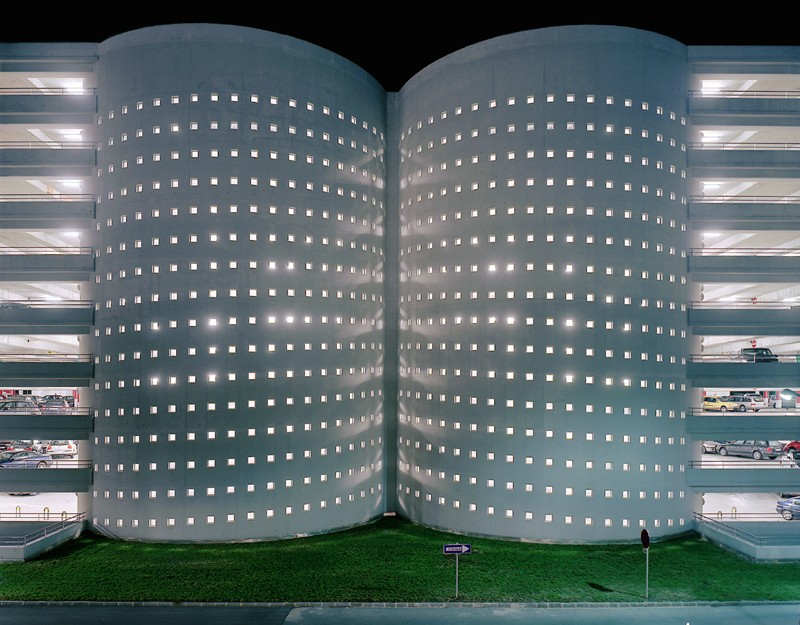 Frank van der Salm, Park, Austria, 2002 Frank van der Salm
The images interpret the urbanscape as if they are stage sets---they appear to be both gigantic and architectural models.
January 24, 2011
'liquid modernity'
Zygmunt Bauman has conceptualized modern society as increasingly “liquid.” Information, objects, people and even places can more easily flow around time and space. Old “solid” structures are melting away in favor of faster and more nimble fluids.
The argument was that liquid modernity is characteristicized by the privatization of ambivalence and increasing feelings of uncertainty. It is a kind of chaotic continuation of modernity, where one can shift from one social position to another, in a fluid manner. Nomadism becomes a general trait of the liquid modern man, as he flows through his own life like a tourist, changing places, jobs, spouses, values and sometimes even more (such as political or sexual orientation), (self-)excluded from the traditional networks of support.
Some have interpreted the faster and more nimble fluids in terms of "light capitalism”, one that is producing light (more changeable and disposable) products such as software, which is, opposed to heavier items such as automobiles, more changeable and disposable. This is a capitalism of informational products and as information becomes increasingly liquid, it leaks.
So argues Nathan Jurgenson in WikiLeaks and our Liquid Modernity. The technologies of digitality and Internet reate information that is more liquid and leak-able---eg., Wikileaks--and and have also allowed WikiLeaks to become highly liquid itself.
What we also learned from the Wikileaks furor is, as Zeynep Tufekci points out in The Atlantic that the:
Ability to disseminate one's ideas on the Internet is now a sine qua non of inclusion in the global public sphere. However, the Internet is not a true public sphere; it is a public sphere erected on private property, what I have dubbed a "quasi-public sphere," where the property owners can sideline and constrain dissent.During these past weeks, rather than a nerd takeover, I saw the crumbling of the facade of a flat, equal, open Internet and the revelation of an Internet which has corporate power occupying its key crossroads, ever-so-sensitive to any whiff of displeasure by the state. I saw an Internet in danger of becoming merely an interactive version of the television in terms of effective freedom of speech. Remember, the Internet did not create freedom of speech; in theory, we always had freedom of speech--it's just that it often went along with the freedom to be ignored. People had no access to the infrastructure to be heard. Until the Internet, the right to be heard was in most cases reserved to the governments, deep pockets, and corporate media.
Tufekci says that The Wikileaks furor shows us that these institutions of power are slowly and surely taking control of the key junctures of the Internet.
As a mere "quasi-public sphere," the Internet is somewhat akin to shopping malls, which seem like public spaces but in which the rights of citizens are restricted, as they are in fact private. If you think the freedom of the Internet could never be taken back, I implore you to read the history of radio. Technologies that start out as peer-to-peer and citizen-driven can be and have been taken over by corporate and state power. The real cause for concern is the emergence of an Internet in which arbitrary Terms-of-Service can be selectively employed by large corporations to boot content they dislike. What is worrisome is an Internet in which it is very easy to marginalize and choke information. The fact that information is "there" in a torrent, or openly on a website that is not easily accessible or has been vilified, is about as relevant as your right to shout at your TV.
It has become obvious that, increasingly, contentious content is going to require infrastructure far above and beyond what is necessary to support content that is mainstream, power-friendly, or irrelevant. And further, contentious content will likely be cut off from being funded through people-power, as was shown by the speed with which Paypal, Mastercard and Visa, representing almost all the conventional and easy ways to send money over the Internet, moved to cut off Wikileaks
January 23, 2011
backlash against social media
The social web is well established and Facebook's power lies in tips from friends and contacts. Increasingly our life---according to Facebook--- will be navigated through our social graph, our network of contacts and friends; it will be their recommendations that will prompt us to dip into the water. The volume and reach of data produced by Facebook's users – and the promise of the future of the social web – has investors so excited that they have just valued the company at $50bn.
Jodie Pfarr in The Age says Flick Facebook and tune in to real life understands her experience on Facebook as one of a daily fix of a weapon of mass distraction and becoming deactivated.The word 'fix' implies addiction addicted to a controlled substance which further implies that it is closing down my ability to function and so it needs to be stopped just like a controlled substance.
The article is not just about her experience--her addiction and being over social media--- as Pfarr adds a criticism of the technology of Facebook:
It also bothers me how Facebook has removed part of our humanity, becoming the acceptable medium in which to announce monumental news. Does such impersonal interaction not diminish the joy? You can't share squeals of delight online.
This cyber-sceptic appeal to face-to face contact is a part of the widespread backlash against social media. A recent bestseller in the US, The Shallows by Nicholas Carr, suggested that use of the internet was altering the way we think to make us less capable of digesting large and complex amounts of information, such as books and magazine articles.
Other books include The Dumbest Generation by Emory University professor Mark Bauerlein – in which he claims "the intellectual future of the US looks dim"– and We Have Met the Enemy by Daniel Akst, which describes the problems of self-control in the modern world, of which the proliferation of communication tools is a key component.
James Harkin in Cyburbia: The Dangerous Idea That's Changing How We Live and Who We Are is a critique of cybernetics, which he argues, is the birth-discipline of the internet. He assumes that because the creation of online networks treats people as nodes that’s what we are when we’re sitting in front of a screen. There is a blanket dismissal of blogs, the herd behaviour on the Facebook loop, and the explosion of creativity in music, video or photography enabled by cheap digital tools and internet distribution channels.
Sherry Turkle in Alone Together: Why We Expect More from Technology and Less From Each Other rejects the thesis she embraced 15 years earlier, as she states that the online world is no longer a space of freedom and re invention.
She highlights the banalities of electronic interaction--the way our range of expression is constrained by our gadgets and platforms---and argues that technology is threatening to dominate our lives and make us less human. Under the illusion of allowing us to communicate better, it is actually isolating us from real human interactions in a cyber-reality that is a poor imitation of the real world.
In this interview on Frontline: Digital Nation Turkle states:
If you're spending three, four, five, six hours in very fun interactions on Second Life, there's got to be someplace you're not. And that someplace you're not is often with your family and friends sitting around, playing Scrabble face to face, taking a walk, watching television together in the old-fashioned way...Many exciting and interesting things can happen when you are in virtual places, but for every hour of life on the screen is an hour not spent on the rest of life. And it's well past the time to take the measure of what are the costs.You have your face-to-face [life], and you have your virtual life, and you have your Second Life -- it doesn't take into account two things: the limitation of hours in the day and the seduction of the virtual, not just for teenagers but for all of us who don't want to do all the hard things that are involved in having relationships with other people.
Ultimately, she says, we are creatures with bodies, and the pleasures of our bodies are major. So real life should have priority over virtual life. She says if you don't learn how to be alone, you'll always be lonely, that loneliness is failed solitude. We're raising a generation that has grown up with constant connection, and only knows how to be lonely when not connected:
There is a wonderful Freudian formulation, which is that loneliness is failed solitude. In many ways, we are forgetting the intellectual and emotional value of solitude. You're not lonely in solitude. You're only lonely if you forget how to use solitude to replenish yourself and to learn. And you don't want a generation that experiences solitude as loneliness. And that is something to be concerned about, because if kids feel that they need to be connected in order to be themselves, that's quite unhealthy. They'll always feel lonely, because the connections that they're forming are not going to give them what they seek.
There is the need for stillness; to be deliberate; to live in your life and to never feel that you're just resigned to how things need to be.
January 22, 2011
Grateful Dead: Mississippi Half Step
This version of the song is from the Capitol Theatre - April 26, 1977 -show. The traditional jams of this era make 1977 one of my favourite periods after the Dead’s previous musical peak (the 1969-70 Live/Dead period).
The creativity kinda died in the band after the peak of 1977 and the early 1980s. The 1980s were marked by mumbled lyrics, flubbed transitions within songs, forgotten passages, frayed voices, poor song writing, show format set in stone. Garcia's drug habit--cocaine and heroin---began to have an effect in the mid 1980s, succumbing to a diabetic coma in 1986. Soon after getting clean he nearly died due to complication of diabetes in 1991 but survived and began the slow road to recovery.
The 1980s saw them embrace massive stadium tours, the backing of commercial products and commercial pop music. They managed to pull out some great shows around the very early 80's.....but from 83-87, that was it.They began to sound over the hill.
They surfaced in the early 1990s with some good jams eg., such as this one in Foolish Heart at Oakland Coliseum Arena, Oakland, CA, December 28th, 1990
The 1980s were polarizing years. I've come to generally skip listening to the first sets of their recorded concerts in this period, check out the meat of the band’s more musically powerful second sets, and avoid the cheesy oldie-finales and check out the encores. My interest is in really in the improvisational music.
Update
I should qualify my silly statement that "from 83-87, that was it . They began to sound over the hill" in the light of Michael's comments. I was working off two pieces of music . I should say that despite the rudimentary rock ’n’ roll songs the music of 1989 was energetic and it jelled. The band was on an upswing during the period 1989-1991, and many feel that the spring tour of 1990 was a highlight.
I have Go to Nassau (1990) and it indicates the metamorphosis of the Grateful Dead was experiencing at the time with keyboardist/vocalist Brent Mydland —who was behind the Dead’s late-’80s musical renaissance. Once the novelty of this particular transformation wore off, the Grateful Dead entered a rather lengthy period of decline that contained fewer and fewer sparks of brilliance, even though there were always moments within its concerts when of the music.
I also have Dozin' at the Knick (1990). It's choppy and solid, but it has its exploratory and improvisational moments. It's a reinvigorated band and the "Playing In The Band," "Uncle John's Band" and the "Terrapin Station" suite, along with the Mud Love Buddy Jam jam that follows, is the core of the album. Mydland died shortly after this.
January 18, 2011
Grizzling about Facebook
In Grizzling about Facebook in the Australian Humanities Review Meaghan Morris starts from those overheated moral blasts from cultural conservatives about social networking such as Facebook and Twitter.
The media grizzles are well known and familiar in the Australian media, and they usually centre around gossip and narcissism and the evils of the internet. Morris says, in reference to such a blast, that:
there is always superficiality to networking on the Web', the writer opined. If Facebook ‘perhaps' helps us keep in touch with friends in faraway places, ‘making new friends and maintaining old friendships requires effort, emotional commitment and contact in the real world. Facebook is no substitute for face time.
It means people sitting staring at screens for hours and not communicating with their loved ones who are in the same room.
Morris says that strong emotional sprays arise when the older media attack new media that threaten their markets, and in particular when the Murdoch newspapers wage culturally high-toned war on just those social networking sites that have been thumping MySpace, the site belonging to their proprietor.
Both politicians and the mainstream media persist in regarding social networks as exotic, which for them it is, which in turn highlights how out of touch they have become with reality. For the reality is that the net and social networking have become mainstream and connectedness is becoming a relatively mundane part of people's lives.
The Faces
When rock 'n roll had some energy:
This from the Final Concert (1974) . Tetsu Yamauchi had replaced Ronnie Lane on base. The Faces, a rough, sloppy rock & roll band, were underrated.
When Rod Stewart's burgeoning solo career began affecting the quality of the Faces' albums, Lane jumped ship to form his own band--Slim Chance--- in 1973.
January 14, 2011
Ezra Stoller: Architectural photographer
I've always admired this Frank Lloyd Wright's Guggenheim Museum in New York by Ezra Stoller. A pale Buick fills the lower foreground, its curvaceous shapes and sharp fins making visual rhymes with the building beyond. then hen, deeper in the picture, we notice two black-clad nuns hurrying along the sidewalk. Their tiny, dark shapes bring out, by contrast, the pale cloudlike volumes of the museum.
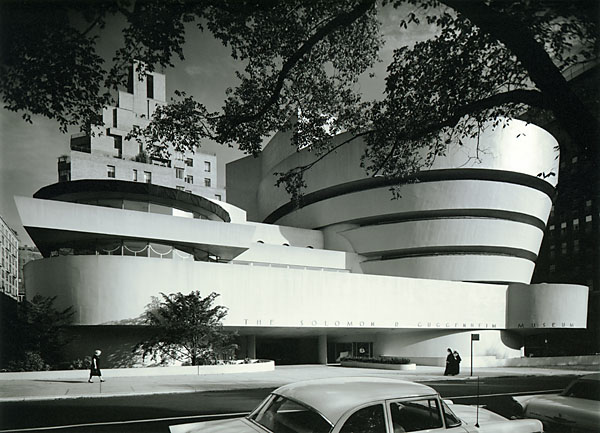 Ezra Stoller: Guggenheim (Frank Lloyd Wright), 1959. Gelatin silver print.
The Buick places the Guggenheim in space but also in time, reminding us that even this architectural masterpiece is a product of the taste of its era. Stoller celebrates modernism whilst making it historical.
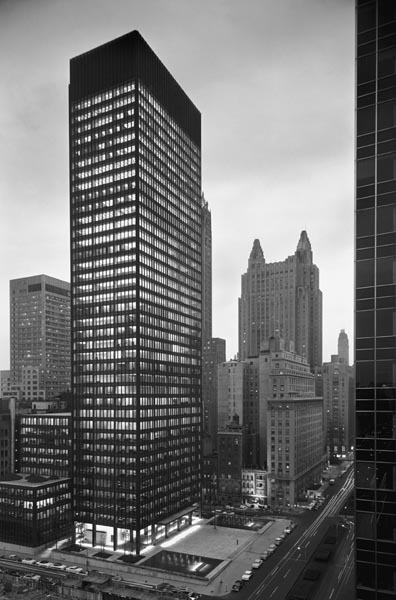 Ezra Stoller, Seagram Building, Mies van der Rohe with Philip Johnson, New York, NY, 1958
Some have criticized Stoller of abstracting buildings, reducing them to “precious objects.” Others have praised his ability to subtly contextualize buildings in time and space, including small details of history and geography.
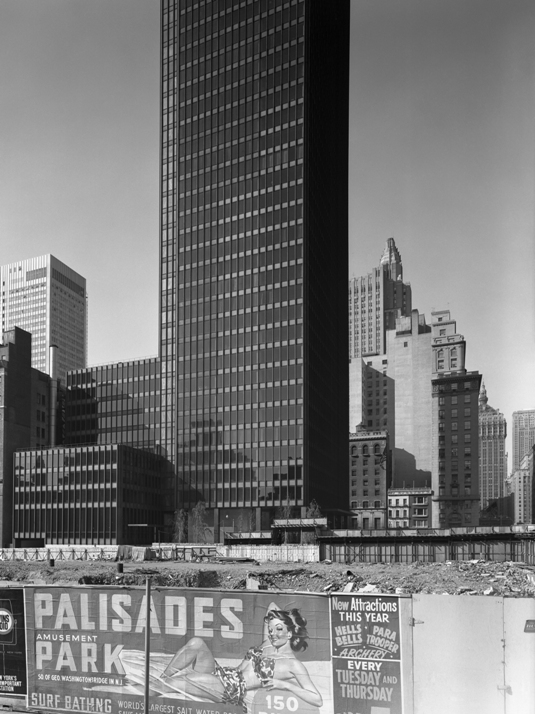 Ezra Stoller, Seagram Building, New York, Architect: Mies van der Rohe with Philip Johnson, 1958
Stoller could do both.
January 12, 2011
Antarctica: icebergs
Each December Antarctica enjoys round-the-clock sunlight. The light arrives at a low angle, however, as the Sun makes a daily circuit around the horizon, and icebergs cast long shadows over the surrounding sea ice.
 NASA’s Earth Observing-1 (EO-1) satellite, icebergs along the Princess Ragnhild Coast, East Antarctica, 2010
Surrounding the icebergs are two kinds of ice: sea ice and fast ice. Along the left edge of the image, the sea ice is thinner, with gaps that reveal the dark ocean below. Clinging to the shore, fast ice is thicker,
January 9, 2011
Deleuze: the fold
Deleuze suggested that the central concerns of the Baroque era still survive with us (or are enjoying a resurgence) into the new media age. He stretches the baroque ‘outside of its historical limits’.
 Gary Sauer-Thompson, folding, 2010
What we inherit from the Baroque is described by Deleuze as ‘the fold,’ in his book on Leibniz----The Fold Leibniz and the Baroque Deleuze focuses on Leibniz’s ‘labyrinthine continuousness’. For Deleuze the baroque endlessly produces folds. It does not invent things. The emphasis is on fluidity and plasticity--the folds expand infinitely in all directions rather than definitely in the shape of a cone, line or sight that culminates in a single point or subjectivity.
Gary Sauer-Thompson, folding, 2010
What we inherit from the Baroque is described by Deleuze as ‘the fold,’ in his book on Leibniz----The Fold Leibniz and the Baroque Deleuze focuses on Leibniz’s ‘labyrinthine continuousness’. For Deleuze the baroque endlessly produces folds. It does not invent things. The emphasis is on fluidity and plasticity--the folds expand infinitely in all directions rather than definitely in the shape of a cone, line or sight that culminates in a single point or subjectivity.
The continuous labyrinth resembles a sheet of paper in origami that is divided into infinite folds or separated into bending movements
January 4, 2011
Art and Letters Daily
Denis Dutton, founder and editor of Arts and Letters Daily, had died. I looked at Art and Letters only every now and again. Nor did I read Dutton’s own recent book in aesthetics, The art instinct with its attack on social constructivism and its argument that art is based on human nature and natural selection.
At Open Democracy Tony Curzon Price says that:
Dutton influenced the daily reading habits of thousands of people. And I am sure that web-site editors all over the world will have looked out for the “Arts and Letters bump” in the graphs and, when working on a piece, will have thought “might this be one that Denis likes?” This is influence and power, and, as Khanna says, its prerequisite is authority.
Dutton’s authority came from his ability to consistently provide very high quality links to material that single readers would be unlikely to come across; an ability marked by Dutton persistent desire to marry the causal account of Darwinism with the meaning-based accounts of phenomenologists.
Curzon generalizes from Dutton's web achievements:
The web has done two fundamental things: reduced the cost of information reproduction to almost zero and has allowed us to link all that information together. In the context of editorial work, this has allowed a complete disaggregation of functions that used to be carried out within large institutions like newspapers and magazines. Dutton, a brilliant reader, could select articles, headline their essence (something he perfected well before the Tweet made us all try to do this) and link to them. The key editorial function of the filter no longer needed a commissioning budget, let alone a printing press and distribution network.
Arts and Letters Daily creates a lens for the cultured, conservative Anglo Saxon, entirely by selecting from other web sites 3 noteworthy articles per day.
January 1, 2011
Adorno + modern art
In Politics and the Enigma of Art: The Meaning of Modernism for Adorno in Modernist Cultures (vol.1 No 2) David S. Ferris says that Adorno claims that with the advent of Modernism art enters into a relation with itself that threatens its future.
Adorno clarifies this effect of Modernist art when he describes how the revolutionary art movements of this period are forced to contradict the freedom their revolutionary intentions seemed to bestow so easily. For Adorno, a contradiction arises within these movements because what is at stake in them is not just freedom but absolute freedom. By pursuing such a freedom these movements went against a condition to which art must submit if it is to remain art. This condition, Adorno states, requires that art is “always limited to a particular.” As a result, the freedom sought by Modernism “falls into contradiction with the perennial foothold (Stand) unfreedom retains in the whole” (AT, 9/1). The one thing that the absolute freedom sought by these movements cannot overcome is this unfreedom retained in the whole – whole in the sense of everything that is not art, the world, the social, etc. For Adorno, every work of art must submit to this foothold, to the particular. Consequently, it is to this foothold that the adventure of Modernism will always be forced to return and as it does so, it comes into contradiction with the freedom it sought to affirm: it meets the unfreedom of its own existence, it meets the particular that scarcely supports the freedom of the unforeseen sought by Modernism’s revolutionary art movements.
What Adorno understands by the movement of art is revealed in this return: inasmuch as art moves towards a freedom in which its autonomy is absolute, it can only do so as art, but to do so as art is to recognize its limitation in relation to the whole, to recognize its particularity.