May 31, 2004
Bukowski: Poems#14
Shoes
when you're young
a pair of
female
high-heeled shoes
just sitting
alone
in the closet
can fire your
bones;
when you're old
it's just
a pair of shoes
without
anybody
in them
and
just as
well.
Bukowski
May 30, 2004
Bukowski: Poems#13
Retreat
this time has finished me.
I feel like the German troops
whipped by snow and the communists
walking bent
with newspapers stuffed into
worn boots.
my plight is just as terrible.
maybe more so.
victory was so close
victory was there.
as she stood before my mirror
younger and more beautiful than
any woman I had ever known
combing yards and yards of red hair
as I watched her.
and when she came to bed
she was more beautiful than ever
and the love was very very good.
eleven months.
now she's gone
gone as they go.
this time has finished me.
it's a long road back
and back to where?
the guy ahead of me
falls.
I step over him.
did she get him too?
Charles Bukowski
May 28, 2004
Heidegger: The Age of the World Picture
Trevor,
In the previous post you wrote:
"There is one thing you say that I am still having trouble with and that is that you say you don’t work in terms of interpretations being correct but at the same time get irate about things I say about Heidegger. I can’t see how you can have it both ways – either mine is just a different story about Heidegger or its wrong. Or is it both? I don’t know. Perhaps you can sort this one out."
I got irate because you said that I was not addressing the issues raised by your interpretation of the differences and relationships between Adorno and Heidegger around metaphysics. I thought that was a misreading, as I was addressing the issue of Heidegger's metaphysics, albeit from a different perspective.
Context is impotant here. The North American political reception of Heidegger appropriates Heidegger fascist as part of larger reactionary strategy to discredit the critique of humanism enabled by Heidegger's writings and by other recent works in contemporary philosophy. The argument in this reception of Heidegger by liberal humanist critics holds that, since Heidegger is guilty of complicity with Nazism, we can then delegitimize his critique of humanism. The object of this policing action is to tainting Heidegger as fascist to the core so as to innoculate Anglo-American philosophy against questions posed to its hegemony by contemporary poststructuralism.
I have previously addressed some of the concerns you raise about Heidegger's metaphysics. If by metaphysics we mean something in the Aristotlean sense of ontology, then I have suggested that Heidegger can be read as undertaking a destruction of the scientific metaphysics of modernity. I interpret him to be working within the tradition of Hegel's critique of atomistic/mechanistic metaphysics of the Enlightenment's conception of natural science in his Philosophy of Nature. This reading of Hegel is to be contrasted with those analytic philosophers who hold Hegel is caught up in animist magic, a pantheist fog, or the self-development of an anonymous Spirit.
The relevant text of Heidegger's is the essay, "The Age of the World Picture" in The Question Concerning Technology and Other Essays. As far as I know the essay is not online, but I have found this excerpt. There is enough there to get some idea of what Heidegger is doing.
This is the questioning bit:
"When we reflect on the modern age, we are questioning concerning the modern world picture [Weltbild].We characterize the latter by throwing it into relief over against the medieval and the ancient world pictures. But why do we ask concerning a world picture in our interpreting of a historical age? Does every period of history have its world picture, and indeed in such a way as to concern itself from time to time about that world picture? Or is this, after all, only a modern kind of representing, this asking concerning a world picture?"
This critical reflection upon a historically-formed metaphysics of science ineeds to be taken into account if you flavour an Adornoesque reading, that places an emphasis on an ahistorical or timeless account of metaphysics and metaphysics as a re-mythologizing.
The historical emphasis can be seen in the next fragment of Heidegger's essay:
"What is a world picture? Obviously a picture of the world. But what does "world" mean here? What does "picture" mean? "World" serves here as a name for what is, in its entirety. The name is not limited to the cosmos, to nature. History also belongs to the world. Yet even nature and history, and both interpenetrating in their underlying and transcending of one another, do not exhaust the world. In this designation the ground of the world is meant also, no matter how its relation to the world is thought."
Heidegger then goes on to give an account of what is meant by world picture in two stages. First:
'With the word "picture" we think first of all of a copy of something. Accordingly, the world picture would be a painting, so to speak, of what is as a whole. But "world picture" means more than this. We mean by it the world itself, the world as such, what is, in its entirety, just as it is normative and binding for us. "Picture" here does not mean some imitation, but rather what sounds forth in the colloquial expression, "We get the picture" [literally, we are in the picture] concerning something. This means the matter stands before us exactly as it stands with it for us. "To get into the picture" [literally, to put oneself into the picture] with respect to something means to set whatever it is, itself, in place before oneself just in the way that it stands with it, and to have it fixedly before oneself as set up in this way.'
However, there is something still missing from this account as it does not dig deep enough:
'But a decisive determinant in the essence of the picture is still missing. "We get the picture" concerning something does not mean only that what is, is set before us, is represented to us, in general, but that what is stands before us -- in all that belongs to it and all that stands together in it -- as a system....Hence world picture, when understood essentially, does not mean a picture of the world but the world conceived and grasped as picture. What is, in its entirety, is now taken in such a way that it first is in being and only is in being to the extent that it is set up by man, who represents and sets forth.'
The fact that the world becomes picture at all is what distinguishes the essence of the modern age.
This text is usually read as Heidegger furnishing philosophers and others with a stick to beat the scientists. This holds that modern science and technology represent the cancer that needs to be eradicated if we are to be true to ourselves. There is a different way of reading Heideger's text that is more in tune with your concerns.
Patrick Heelan makes some points that are of relevance here. He says that the common [Platonic] view of natural science (physics) in the early 20th century held that scientific theory and the timeless theoretical categories were the historical expression of the transcendental entities. This was grasped by the infinite process of pursuing better and better empirical approximations in physical measurements.
Heidegger, in contrast, saw:
"...these same mathematical models, not as transcendental eidoi or metaphysical entities, but as historical inventions of the human spirit intending to reduce the world of experience to manipulable ontic entities with the suppression of what is particular, historical, contingent, creative, poetic, and ontological in Dasein's 'being-in-the-world.' From the start Heidegger saw the scientific culture of modernity as the 'Age of the World Picture' in which the 'real' is constituted by the theoretical representations of modern science rather than as a revelation of what constitutes the foundational structure of what is, or what Heidegger called, 'ontology.'"
Heelan adds that the 'world' for Heidegger, like the Lifeworld for Husserl, is, perhaps, best seen as the everyday world after the removal of all theoretical representational elements objectified as 'real.'
I presume that you'd want to say that the everydayness that is disclosed after this process of destruction or displacement is what constitutes the remythologizing. I interpret this in an ecological way: as doing what Adorno promised but never delivered on.
May 26, 2004
Adorno's Metaphysics
Gary,
I think a few things are becoming clearer as a result of your latest post. I can see now how you were answering some of my questions but in a way that wasn’t particularly clear to me at the time, and perhaps in a way that I didn’t want. This is to some extent a problem of conducting a conversation in writing over the internet. If we were speaking we could quickly sort these things out, whereas we must wait some time for a written reply, and there is so much that can be said in words that just isn’t practical in writing.
There is one thing you say that I am still having trouble with and that is that you say you don’t work in terms of interpretations being correct but at the same time get irate about things I say about Heidegger. I can’t see how you can have it both ways – either mine is just a different story about Heidegger or its wrong. Or is it both? I don’t know. Perhaps you can sort this one out.
I’ll explain my motivations and it might help you to understand my perspective and my concerns, and perhaps indicate why what you have been saying about Heidegger doesn’t help me all that much.
My conference paper is on Adorno’s metaphysics. I’ll tell you about it in a moment. But one of the things I would like to do is to indicate the similarities with Heidegger and also how they differ. It’s not an important part of the paper but it’s a useful thing to do. That is why getting what I say right is important. I don’t want people saying, ‘but that’s not Heidegger’s position. You’ve got it all wrong’. Do you see what I’m after?
Okay, now, in a nutshell, this is Adorno’s view on metaphysics – which, as I said, owes most to Walter Benjamin for its influences and, as far as I can ascertain, nothing to Heidegger. Metaphysics came into existence as a philosophical concern as part of the process of rationalisation in European culture. It also happened as part of the process of secularisation and demythologisation. Metaphysics is a secularisation of theology and Plato’s Ideas can an example of this, although Plato hadn’t reached the stage of metaphysics because he didn’t really look into the consequences of this secularisation. That task fell to Aristotle, who critically reflected on this secularisation process and called the activity ‘metaphysics’.
By its very nature, metaphysics is anti-theological in that, through secularisation and rationalisation it does away with theology, metaphysics is also anti-metaphysical. Through its process of rationalisation, metaphysics will eventually do away with itself – at least, that is its tendency. Then along came Kant and stopped this process of the self-destruction – through rational secularisation – of metaphysics, even if he thought he was completing the process. A metaphysic of reason, a new set of universals, blocked the path. So, for Adorno, the problem is not to resurrect metaphysics in the face of Kant but to put metaphysics back on course so that it can complete its process of self-destruction. The anti-metaphysical metaphysics of the 20th century is as close as European culture has come to the elimination of metaphysics.
The end of metaphysics will not be the end of life on the planet but the end of history, which will be followed by messianic time. Messianism is the drive to end oppression, while human history is the history of oppression, so messianic time will be the time when humans no longer live lives of oppression. Until that time metaphysics will continue to exist, which means that the secularisation process will continue.
For Adorno, above all, secularisation refers to the breaking down of universals, or timeless truths, or abstract generalisations, or whatever you want to call them. The direction of metaphysics is towards the singular and ephemeral, and truth – which remains, as it was for Benjamin, the death of all intention – attaches to the latter. Metaphysics begins with theology and ends as history.
If the general direction of metaphysics can be seen as progressive demythologisation in this sense, then Heidegger’s move, as far as I understand it, can be seen as a remythologisation. Abandoning Kantian universals, he looks for more adequate universals for the present, ones that relate to the ordinary everyday lives of ordinary everyday people. In contrast, Adorno wants to push on with the abandonment of all universals.
I see Adorno as a Kantian who wants to correct an error in Kant’s critical philosophy. Gillian Rose was more correct in seeing him as a neo-Kantian than those are who see him as a Hegelian. Negative dialectics, such as Hegel developed but then tried to subvert through the negation of the negation, is a fundamental development in resolving Kant’s problem. Adorno even conceives of categorical imperatives in exactly the way Kant conceives of them, and they are connected to metaphysics, rather than epistemology, again as they are for Kant. Adorno recognises one categorical imperative: we should conduct ourselves in such a way that Auschwitz is never repeated. By ‘Auschwitz’ Adorno means more than a particular place or what happened there – he means all the death camps, all the concentration camps, all the prisons where torture, degradation and humiliation take place, all the immigration detention centres, all the weapons of mass destruction. As you can see, we haven’t got very far in meeting our moral obligations under this imperative. In fact, we’ve done quite the opposite.
Adorno even subscribes to Kant’s idea of enlightenment. History will only be overcome when we see through it and recognise it for what it is. The Christians have got it all wrong. It won’t end in judgment day. As he wrote in The Dialectic Of Enlightenment, ‘in laughter, blind nature becomes conscious of itself precisely as such and gives up its destructive force’ – not in judgment, in laughter. The history of oppression is the history of one person judging another. This is what Karen Blixen found in the Africans: ‘they sum you up but they do not judge you’. Somehow, in the end, judging is like drawing on universals. When there are no more universals governing us there will be no more judging either.
Anyway, there’s a pretty potted Adorno. I’ve left heaps out. But at least you have a sense of what I am doing and where I am coming from in approaching Heidegger. Maybe you can see why I want to get Heidegger right, rather than just understanding how you come at him.
biases and prejudices
Trevor,
You say that I never responded to your Kant post other than to talk about Routley's environmental philosophy and hermeneutics. It should have become clear from the conservation and its silences that we do "philosophy" in very different ways.
We have very different ways of relating to the philosophical tradition. I presume that German philosophers work within a tradition and know it well. So Adorno would know Hegel, Nietzche and Heidegger. It is home. Much more so than Australian philosophers who are learning to understand this tradition from a great distance and from within an empiricist culture. So I know very little about the turn of century neo-Kantian idealism, their interpretation of Kant, the transcendental ego, Husserl's appropriation of neo-Kantianism, or Husserl's constant appeal to Kant. All that is the philosophical background to Heidegger and it is a blank:--- I just map it as presupposing that science was the model of knowledge, the mastery of reality, transcendental justifications, methodology, an objectifying consciousness and its culmination in science.
It is the recoil from philisophy as science and science as the model of knowledge that I am interested in because that was the hermeneutical structure of my own philsophical situation in the academy. What I would call overcoming the tradition to bring philosophy into everyday life.
My way of reading Heidegger presupposes that the boundedness of our present historical situation is constitutively involved in the process of understanding this philosophical tradition. It shapes our understanding. So the present situation is where I'm rooted (hence my gesture to environmental philosophy), and this constitutes my bias or prejudice and the temporal character of my interpretations. We are situated by the past as a heritage of background meanings not isolated from it and so philosophical knowledge involves understanding tradtion. So I respond to the German philosophical tradition in terms of its recoil from scientism.
This approach does not give much weight to the intention of individual philosophers such as Adorno as a way to understanding meaning.
Now I reckon I did respond to your Kant post over a series of posts. What I described in the initial post was how I read Heidegger--the prism through which I viewed his texts---and why thought he was important in terms of Australian philosophy. I said I read Heidegger's texts backwards, and in latter posts gave an account of metaphysics in terms of the technological mode of being and then the metaphysics of everydayness in Division one of Being and Time.
It is a different account of metaphysics (a pragmatic one) to the one you offered in terms of Kant--a non-transcendental one. I also said that I did not work in terms of interpretations being correct, accepted different readings of Heidegger, and that we were reading Heidegger from quite different perspectives. I then outlined how I read Heidegger's metaphysics, and said I was interpreting your reading of Heidegger as a reading through Adorno's texts. What I was trying to do by this way of approaching the texts is to make the hermeneutical circle more explicit.
Somewhere along the way I made my perspective explicit by saying that I came to Heidegger through reading Gadamer's interpretation of Heidegger's ontological hermeneutics. So I read Heidegger as engaging in a radical critique of the foundations of Western philosophical thinking or tradition. His philosophical project was, 'what is the meaning of being"? The purpose of Being and Time was recover the mode of experience of being that lies concealed behind the dominant modes of western metaphysics.
If modern metaphysics is a technological mode of being then what lies concealed is an ecological mode of being. That way of exploring Heidegger is about metaphysics. I was under the impression that you were also talking about metaphysics. Sure, the historicity dimension of Heidegger's metaphysics was not mentioned--but you could infer from what I have written that I would place an emphasis on the historicity of philosophical hermeneutics.
I do not have time, energy or the resources to read Heidegger's interpretation of Kant vis-as vis Adorno and Benjamin's interpretation of Kant. I left that up to you though, I suspect the turn in Heidegger has something to do with transcendental reflection. I am quite willing to acknowedge that Heidegger undertook a trancendental analytic of of everydayness and to this extent was carrying through Husserl's phenomenology, or executing transcendental phenomenology. However, my interest is in reading the ontology of Being and Time from a more pragmatic perspective.
What I was willing to do was to explore Division Two of Being and Time since this was where the 'existential Heidegger' arose. It would probably be the one closest to Bataille. So I was willing to invest time and energy in that since this is where the structure of temporality and historicity can be found.
What I would be doing by this was conveying the past into the present through translating past meaning into the present in terms of reading the philosophical tradition as a source of possibilities. So a text speaks differently as its meanings find conceretizaton in different hermeneutical situations.
I will leave Adorno be for another time. I have given some indication of how I understand the commonalityof Adorno and Heidegger: philosophy as interpretation, a thinking otherwise to instrumental reason, an emphasis on poetics and a reaction against the tradition of philosophy as epistemology and philosophy as science.
May 24, 2004
Heidegger and Adorno
Gary,
Forget about reading me through somebody-or-other’s prism. What I am trying to do is read Heidegger critically, and that means among other things seeking answers to all the questions about him that are bothering me. And there are a lot.
Now on May 6 I wrote at length about how I understood what Heidegger was doing in relation to Kant, about various of his terms, like ‘ontology’, for instance, and asked to be corrected wherever necessary, if I was misrepresenting him or getting him wrong in some way. You never commented on anything I raised there but instead outlined what you called a ‘hermeneutic’ interpretation of Heidegger (May 9), which you used to criticise the approach of the Routleys to conservation and other mostly related matters. Where you directly used Heidegger’s terms you used them for quite different purposes than Heidegger, and they don’t mean the same things they do in Heidegger’s discourse. If this strategy is useful to what you are doing then I’ve got no problem with it – good luck with your endeavours – but it doesn’t interest me. That is why I was happy when you started to talk about things I found more interesting – Bataille et al. You can talk about your stuff, which you derive from Heidegger, all you like. I just haven’t got anything to say about it. I just keep quiet until you say something that provokes a reply or until I have something I want to say about some topic.
This doesn’t mean that I haven’t got an interest in discussing Heidegger. I still have all the critical problems I had at the beginning, I might add, partly because you haven’t tried to show me where I’m going wrong if I’m misinterpreting Heidegger. I feel as if you talk past me and I talk past you.
Most of what you wrote in your last post is just a giant ad hominem. The problems with analytic philosophy have got nothing to do with the bile-filled analytic philosophers but reside in their philosophy. All the stuff about blocking and bile is irrelevant.
What you said about Adorno being unfair because of what he didn’t say is also wrong. He has no obligation to identify aspects of similarity between his ideas and Heidegger’s. What possible purpose would be achieved by this? Adorno does not ‘build on Heidegger’. Historically the claim is false. If you think that it is not false produce the documentary evidence. The major contemporary influences on Adorno’s thought were Kracauer and particularly Benjamin. If you mean that Adorno’s theory somehow inadvertently profits from Heidegger’s ideas, that claim is also false, as I will try to briefly show.
Heidegger and Adorno – and Sartre – have in common that they see Kant’s approach as effectively reducing philosophy to epistemology. Metaphysics, for one, lives on in most post-Kantian philosophy but in a form and with a content derived from epistemology and subservient to it. The metaphysical invariants have become the invariants of (abstract) reason. So metaphysics becomes much reduced and generally unacknowledged. Heidegger, Adorno et al want to reinstate metaphysics as a more substantial component of philosophy. Both Kracauer and Benjamin also saw things this way.
This is where Adorno and company part company from Heidegger, however. Whereas Adorno and Benjamin maintain that Kant’s epistemological critique cannot be ignored in specifying this new metaphysics (I’m being a bit crude in my description) Heidegger looks elsewhere, or perhaps I should say that he thinks differently than Kant. He relates this new thinking about metaphysics to everyday existence and also to philosophy prior to Kant. For Heidegger, we have a new metaphysical invariant – the story about being, death, anxiety, et cetera. As you show so amply in your own appropriation of Heidegger for the environmental story, it can be shown to fit anywhere. It’s a new story of being, of essence – an ontology.
For Benjamin and Adorno, metaphysics can no longer have any invariants. So, while there are some close similarities in various things that Adorno and Heidegger say, their approaches are diametrically opposed. Your assertion that Adorno builds on Heidegger is simply incorrect.
Now, according to Adorno, Sartre is preferable to Heidegger when it comes to appropriate metaphysics, because he gives existence priority over being. The problem is that he then makes existence into a new essence, undoing all the good work.
I think there is some justification in the criticism – from a number of sources – that Adorno is sometimes less than fair in his interpretation of certain elements of Heidegger’s ideas, and so perhaps he doesn’t get them right. That’s a problem. But nobody has yet shown that he misrepresents the core of Heidegger’s philosophy and thus mistakes a fellow traveller for someone going in the opposite direction. You may be able to do this – it’s not impossible that it could be shown – but you haven’t done so yet, at least not in any way I find convincing. That could be a topic for a future fruitful discussion.
The literature on Heidegger’s creative misinterpretation of the Greeks is quite extensive – see the Macmillan Encyclopaedia Of Philosophy article by Margorie Green. Adorno gives a good example himself and it is not from poetry but a well-known phrase by Aristotle. I won’t bother with all the Greek letters. Heidegger translates this phrase as ‘the care of seeing is essential to man’s Being’. The standard translation is ‘All men by their very nature feel the urge to know’. There are a variety of other interpretations but they are all more or less similar to the standard one, whereas Heidegger’s sentence even contains a word that doesn’t occur in the Greek and for which there is no precedent in interpreting the way he does. The sentence is interpreted so that it fits his perspective. As I said, there are other examples around.
I don’t know what to make of all this but it seems to me that Heidegger is doing something very different from Adorno, and in my view he’s doing something very wrong. I won’t go into all the details here but I’m happy to provide them later if you want.
And if we put all this to one side, my point about the use of ordinary expression in your own discourse hasn’t been answered yet either. Can phrases like ‘an awareness of being thrown into everydayness and being-with others’ be expressed in ordinary language? If it can please do so. If it can’t please can you explain what it means. This has got nothing to do with blocks or bile. This has to do with getting it right.
Philosophy is about infinite questioning – what does that mean? I can’t understand that. Can you say that another way? What are your reasons for saying that? But x says p. How do you reply to that? and so on, and so on – and not about blocks and bile. One of my philosophy teachers used to say that there’s only one rule in philosophy – everybody else is wrong. It’s not true but it’s a heuristic device. It doesn’t mean that I want to denigrate your views or Heidegger’s, or belch bile onto anyone. I’m just trying to do philosophy as I understand it. If Heidegger’s philosophy is any good it should be able to take it.
May 23, 2004
block block block
Trevor,
I take exception to your last post.
Despite your previous denials I've read the way you approached Heidegger as looking at his texts through the prism of Adorno. The presupposition behind this way of reading was Adorno had it right---correct. Your last post confirms it.
A gentle reminder. I've read Adorno on Heidegger: the early dense philosophical essays, the polemical Jargon of Authenticity and Negative Dialectics. These are deeply critical and negative in orientation and give a one sided interpretation: the aim is to utterly destroy Heidegger's philosophy. It is a dishonest interpretation because Adorno fails to spell out, or make explicit, the overlap or commonality between his philosophy and Heidegger's. This is pretty bloody obvious in Dialectic of Enlightenment, where there is a philosophical interpretation of the rise of instrumental reason from the Greeks and a concern to develop a thinking otherwise. (For Adorno it is mimesis; for Heidegger the pathway is care, concern and a letting-be).
For me Adorno is not a good guide to understanding Heidegger as builds on Heidegger but he refuses to acknowledge it. Jargon of Authenticity is a frontal and polemical attack that fails to locate Being and Time within the philosophical tradition in a scholarly manner. It is so unlike Adorno's more considered treatment of Hegel.
So we are radically different in the way we approach Heidegger's texts.
If I remember rightly the posts on Heidegger arose as a result of your argument about reading Heidegger as an existentialist and the tight connection between his philosophy and fascist politics.
What I did was to leave the Heidegger who read the poets to one side, and introduce Heidegger's Letter on Humanism to show the way that Heidegger rejected the claim that his was an existentialist philosophy. My responses to the interpretation of an existential Heidegger was twofold: I argued that his metaphysics was not a humanism (Letter on Humanism); and that it was not an individualism (the category of everydayess in Division one of Being and Time)
What was established there was that philosophy for Heidegger was metaphysics; metaphysics understood in the Aristolean/Hegelian sense of ontology.
To counter your trenchant hostility to Heidegger I responded in two ways. I indicated that that he could be usefully read in relation to Australian environmental philosophy and the fight for the forests. I showed that his emphasis on metaphysics highlighted the flaws of the Routley's environmental critique of the forestry industry.
That attempt to show Heidegger's engagement with the everyday in Australia was blocked off. Environmental philosophy is not serious stuff. The metaphysics was forgotten, even though I structured it in terms of instrumental reason to show the overlaps with the Frankfurt School. I tried to show that this modern metaphysics (what Deleuze and Guattari call the image of thought) thinks in terms of subjects and objects, persons and things.
The aim of destruction is to contest the dogmatic metaphysics and its manifestations in our daily lives. (You can read Delueze and Guattari's A Thousand Plateaus is a similar manner.) Heidegger's second aim is constructive, since it seeks to create a new metaphysics---which Heidegger initially calls Being. (Again you can read A Thousand Plateaus similarly. Delueze and Guattari's new image of thought thinks in terms of multiplicities and assemblages, hecceities and lines of flight.)
What suprised me was an unwillingness to acknowledge the commonality with the Frankfurt School, or the understanding of overcoming the metaphysical philosophical tradition. What you did say is Heidegger's metaphysics was about God, timeless truths, Clayton's theology, and a transcendent philosophy that is not derived from existence.
"The idea of Being in existential philosophy (which text of Heidegger's are we referring to?) depends on the notion that because we are less than being we seek completion – put crudely, that we are nothings seeking completion."
None of this was connected to my attempts to show how Heidegger's metaphysics (as ontology--we agreed on that) was connected to everyday life.
I tried to show the connection of metaphysics to everyday in two ways> First, I indicated that Heidegger's existential anxiety can be read in terms of the category of public moods which I related to the anxiety and depression arising from the economic reforms of the 1980s and 1990s in Australia.
That attempt to show how Heidegger's metaphysics is relevant to the everyday in Australia was blocked off. It has none.
I also tackled your understanding of Heidegger's conception of metaphysics as timeless truths with several posts on Dasein in Being and Time by showing how an interpretative (hermeneutical) philosophy after Husserl engages with the ontology of everydayness--Trevor in his garden at Rostrevor. My attempt to show how Heidegger's categories relate to everydayness was blocked---as jargon.
The block again.
What comes through all this is a blanket hostility to Heidegger's philosophy on your part. It has no use. It must be rejected. No concessions can be made. Heidegger cannot be evaluated as other philosophers in terms of what is good and bad; what is living or dead; in terms of overcoming the tradition; what is relevant to us in his project etc etc. Nope. The block has to be put into place.
This block is a bit bloody rich when you start going on about your depression Trevor, and which you then link to living in a depressing world. You are using the category of a 'public mood' whilst denying that Heidegger has anything relevant to say about this.
block block block. That is what is important. Even the way that Heidegger reads the fragments of ancient Greek texts poetically is rejected as a load of crap, without any indication being given of what Heidegger was trying to do wit these texts in relation to theovercoming modern metaphysics. I suspect that the overcoming project is rejected out of hand.
The hostility is pretty marked Trevor.
I suggested that it is the second half of Being and Time that provides the pathway to an existential reading of Heidegger. The first steps along this pathway was taken by introducing the category of 'authenticity' within Hegel's category of 'ethical life' to counter the reading of Heidegger as an individualist in the modernist sense. I suggested that authenticity meant something along the lines of freedom within ethical life, and gestured to it as meaning a resistance (practice) to our thrownness in everyday life.
I get Adorno'sJargon of Authenticity thrown in my face.
Worse, you say that:
"Our two personal choices show up in the way we approach Heidegger. You read him like a non-philosopher. He’s got something that might help you in your quest and you don’t care about the critical issues. Okay. fair enough. But that’s not doing philosophy."
Philosophy is associated with scholarship. I don't do scholarship. So I don't do philosophy. I'm justifying my lifestyle.
That is close to a personal attack. With Heidegger I'm happy to dump the word philosophy---you can keep it--- and to talk about the task of thinking in a technological mode of being. That means reading texts for the way they work between disciplinary boundaries, create new syntheses, foment epistemic breaks and discover new problems and ways of thinking out of the detritus of the old and the shop-worn. Heidegger was both innovative and political.
And Heidegger? Well here is the block made explicit:
"...this stuff by Heidegger is just reaction, remythologisation – turning philosophical stories back into myths when the process should more than ever remain focused on getting rid of myth. It’s all right to be critical of rationalisation but replacing it with myth is no solution. This point marks the crucial difference between Heidegger and Adorno. More than ever, philosophy must remain philosophical."
The block is pretty clear. Heidegger is not a philosopher, does not do philosophy and rejects a critical reason. He is pre-modern, retreats behind transcendental philosophy, rejects history and the empirical, and amounts to little more than mythology.
You and the analytic philosophers speak with one voice Trevor. That voice of reason has a lot of bile in it, and it is the voice associated with gatekeeping.
I've had enough of the tribal academic gatekeeping based on contempt. It is a sickness that deforms.
May 21, 2004
On Authenticity
Gary,
Forget what I said yesterday. We all have to learn to live with our depression. It’s a depressing world. People are being slaughtered all over the place and maybe we’re just waiting for our turn.
Okay, I’ll talk about Heidegger if I have to.
All the same, I don’t think you are willing to look at Heidegger critically. You just want to delve into him and run with some idea – such as you did on last Wednesday (19 May) with the concept of authenticity, which is a response to ‘an awareness of being thrown into everydayness and being-with others’. Later you describe it as ‘a refusal to become lost or absorbed in the dominant modes of coping’.
This is then used denigrate certain ways of living as inauthentic, although there is such a bigger qualifier riding on the claim that if anyone is upset by it you can excuse them as ‘not denying ethical life’, or not denying ‘the public constitution of our being’, or not confusing ‘freedom with solitude’. The problem with all this is that there is no way of telling whether or not any of these hold in the majority of cases. In fact, it is not even clear exactly what they mean.
Let’s put the qualifier aside. The what you are saying is that ‘radical individualism’ and living in solitude are inauthentic, while being out there and mixing in some way is authentic. Well, that’s a bit rich. If the former means thinking only of yourself you are probably right. Living in solitude, however, depends on historical circumstances and I wouldn’t condemn anyone doing it as getting it all wrong, of not paying sufficient attention to their eventual death, and so on. The way they are living might be the right way to live. Do you think it was authentic to be out there mixing with the Nazis. That meets all your criteria. In such circumstances, withdrawing seems to be the morally superior action.
I hesitate to accuse you of just trying to justify your own lifestyle, but at the end of your philosophical training you chose to go off and do something else. Fair enough. I’m not about to judge you. It was your choice. I chose differently and I have ended up in a room on my own. The problems I discussed in my last entries are a consequence of trying to get out there and mix it socially, but at the present solitary confinement seems to be my lot. You chose to stop being a philosopher and chose to continue to be one. At that choice it’s been pretty much out of our hands. Being a philosopher means spending a lot of time alone, reading and rereading, thinking and rethinking, going back, starting again. Studying is different from reading. I’ve worked on Adorno for twenty years now and I feel like I’m just starting. It’s the name of the game.
Our two personal choices show up in the way we approach Heidegger. You read him like a non-philosopher. He’s got something that might help you in your quest and you don’t care about the critical issues. Okay. fair enough. But that’s not doing philosophy. I know, you are doing something else, working in the political sphere, mixing it in Canberra, et cetera.
Having said all this, I reckon you’d benefit from reading Adorno, particularly The Jargon Of Authenticity. Why do you write in such a strange way as this: ‘an awareness of being thrown into everydayness and being-with others’. That’s not an ordinary everyday mode of expression. Few reading this will have any idea of what ‘being thrown into everydayness’ really means – ditto for ‘being-with’. Why speak in a way that people don’t quite understand? This is very Heideggeresque, very jargonistic. It’s like the religious person who always wants to slip Christ or other religious ideas and perspectives into a sentence in some way. It is like religious language in that it too needs to break with the everyday in order to establish its legitimacy.
There’s an epistemological problem with authenticity – there’s no way of ever knowing when you are living authentically. Take Heidegger’s etymological investigations – from what I’ve read, by and large, they are a load of crap, but he probably didn’t think so as he wrote them. He probably thought he was being authentic. When I look back at things I wrote years ago much of it is not just bad but seems to have an element of falseness to it, of pretentiousness, of being mannered in some way. When I wrote it I thought I was getting down and dirty but in retrospect I was just preening myself. What does this tell me? That perhaps the individual’s present is always authentic in relation to its past.
If it helps you with your political work then it’s all well and good, but as philosophy this stuff by Heidegger is just reaction, remythologisation – turning philosophical stories back into myths when the process should more than ever remain focused on getting rid of myth. It’s all right to be critical of rationalisation but replacing it with myth is no solution. This point marks the crucial difference between Heidegger and Adorno. More than ever, philosophy must remain philosophical.
May 20, 2004
Heidegger once again
Gary,
I didn't say that I'd lost interest in Heidegger. I said that I thought I'd got all I was going to get from our discussion. The reason I said that was because, it seemed to me, you weren't really worried about the philosophical problem of existentialism but simply saw what Heidegger offered as a way of building a position in the environmental debate. Perhaps we are talking at crossed purposes again.
Right now I'm feeling fairly depressed because it seems that the only way I can continue to maintain a place in philosophy is by mixing with fascists, or the far right supporters of fascists. I'm caught on the horns of a dilemma. It's hard to sit at home and keep working away at the philosophy all the while knowing that it is never going to see the light of day. What's the point? It sits on some floppy disk or c.d. until they no longer work. For me philosophy is a social activity. I need to be out there getting it on the agenda.
But in order to get it out I have to compromise myself over and over. I have to listen to pseudo-academic reactionary wank and pretend that it's scholarly. I talked about the wank in my last contribution. I won't go into it all again.
It's not just the far right guys that bother me but all the bourgeois shits who can't tell the difference between wank and scholarship.
In the midst of all this angst I'm trying to write a paper about Adorno and metaphysics, which is why the Heidegger discussion was of use and why it stopped being of use at a certain point. Anyway, it's taking all my time and I don't have the energy to think too far afield.
Keep up the writing. Perhaps I'll feel better about things tomorrow. Perhaps.
May 19, 2004
Heidegger: authenticity#2
Trevor,
I'm sorry to hear that you've lost interest in Heidegger. I'll keep plugging away on the pathway to Heidegger's concept of authenticity as I find it interesting. This pathway takes us into existentialism.
If you recall, Heidegger understands social life to be anchored in convention that is structured around utility. Authenticity appears to be less an escape from the shared conventions of social life, than an particular response to it. This response is based on an awareness of being thrown into everydayness and being-with others.
William Large puts it this way:
"To be inauthentic is to live for the most part the lives of others, whereas to be authentically is to choose one’s own life in the face of one’s mortality. For the most part, Heidegger would say we live inauthentically, and only in certain key moments is authentic existence a possibility."
I would put it differently. Authenticity as a mode of being involves an acceptance of the social basis of life, a recognition of the social constitution of individuality and a refusal to become lost or aborbed in the dominant modes of coping.
Hence inauthenticity would be a radical individualism or heroic self-sufficiency that denies ethical life (the public constitution of our being), and confuses freedom with solitude. Here we see Heidegger critically pointing the finger at Nietzsche for his radical individualism, which equated freedom with a solitude that denied our worldly contextuality.
And Bataille for that matter.
Thus Heidegger's "authenticity" is not just another version of the modernistic ideal of individual autonomy as some claim. It is a way of interrogating our throwness in every day life rather than just coping with daily affairs; a form of freedom within a life embedded in a shared world.
May 18, 2004
Evil and Utility
Gary,
I am glad you are back to talking about Bataille. I’ve got all I am going to get out of the discussion of Heidegger, although it is interesting to note how the number of hits on the site went up when we were going strong on that topic.
I think it is stretching things a fair bit to link what happened to Nick Berg to Bataille. To start with, I don’t know who killed Nick Berg (assuming such a person ever existed). My information comes from a mass media unified behind the Bush administration line. In Australia, the state broadcaster, the ABC has to continually demonstrate its lack of bias – meaning anti-Bush bias – while they continue to refer to Iraqis fighting invaders as ‘insurgents’. The only people fooled by this are willing fools, the ignorant, the culpably ignorant. If the Bush administration want me to see a certain image I have to ask myself why.
Putting all this aside, Nick Berg was executed and not sacrificed. What’s the difference? An execution has an external purpose, a utilitarian purpose. A sacrifice is done for the sake of the killing itself. In Bataille’s sense, a sacrifice is an act of pure evil, and none of the killing associated with Iraq, Osama and the boys, et cetera, is evil in this sense. The Americans aren’t humiliating, torturing and killing the people in their custody for the pleasure of it, even if the odd individual finds that the torture makes him cum, while he feels remorse afterwards. The Americans have been doing what they are doing for two reasons: 1) for immediate strategic advantage, and 2) to indicate to the rest of us that this is what is going to happen to you if you don’t submit. It’s the same strategy the Israeli’s are using. I’m not condemning them – I’m just describing what they are doing. It’s not particularly a capitalist strategy. The Europeans have been at it for eons. Look where it’s got us! Look what it’s achieved! That’s progress for you.
I have a problem with talk of evil. A mutual mate of ours makes this notion into a concept with which he explains world events. Nazism, for instance, is to be explained in terms of the spread of evil, or the web of evil, and so on – you get the idea? It’s something that spreads and infects people, like the flu. I have to ask myself these questions about this view:
1. what is its philosophical justification?
2. what is it literary background?
3. with whose worldview does it confirm?
4. why is it advanced in the first place?
The answer to the first question is that it has none. Instead it operates with the ordinary everyday sense of evil, which is undifferentiated. If you consider Bataille’s differentiation, you can immediately see that two quite different kinds of acts are just lumped together.
I am still waiting on the answer to the second question and I’ll have to get back to you on that. My suspicion is that it has no reputable literary background.
The worldview it confirms is that of the Bush administration, who presents itself as in a struggle for good against evil. It’s pretty puerile stuff and even then the kiddies start to think that there has to be a connection between means and ends for the goodies, otherwise you can’t tell them from the baddies.
In the particular case I’m discussing, I think the theory is advanced to displace history and take over its role in social analysis. But whereas history provides us with established concepts – in this historical concepts approach scientific concepts – the undifferentiated evil theory with concepts that are largely independent of experience and prior to it. They are a reversion to metaphysics. Adorno would call them a re-mythologisation. Myths always look to the eternal and so they are always opposed to history.
This is the difference between people on the far right like Hannah Arendt – and in Australia the late Bob Santamaria – and our mutual friend. Arendt is an historical materialist in The Origins Of Totalitarianism, which is the main thing, even if she reverts to myth in Eichmann In Jerusalem with her banality of evil thesis. Bob Santamaria was an historical materialist when it came to the analysis of contemporary world history, despite his Catholicism. I think that what Santamaria feared in organised workers’ movements was the drive to secularisation that they embodied, which he saw as leading to ‘Godless communism’.
Fascism, simply an administrative process (i.e. corporatism in the public sphere), is indifferent to ideology, and depending on the circumstances will go for history, or myth, or a combination of the two. Expediency is the only criterion.
If the myth of evil has a precedent, to me it is the Strasser brothers and what generally was called ‘left-wing Nazism’, where a generally libertarian attitude is tied to a mythical tale. Alfred Rosenberg is an example of one of the corporate boys peddling this line to help organise the masses. This is just a short step from all the awful wind that used to blow out of Goebbels (spelling?) and Hitler.
Which brings me back to the topic of evil. It’s not just our mutual friend who thinks that if anybody was evil Hitler was. But evil is close to sovereignty. The guy who gets around in a military uniform is the antithesis of a sovereign. He’s a kind of salesman.
All the same, the other night I was talking about Hitler with a guy from university, an academic with a comfortable bourgeois lifestyle, a liberal, a wine-lover, an intellectual, and he was sure that the Bush administration was different from the Hitler administration – not that I’d argue for a minute that they were the same but whenever you call Bush a fascist this is the standard response. Hitler really was evil, he thought. He’d heard that he did some nasty things to some young girl who was a nice of his, or something like that. It happened before he became a successful politician. Here we are dealing with genuine evil. But so what? J. Edgar Hoover liked to slip into slinky black cocktail numbers with shoe-string straps. He was definitely bent. But did it interfere with the performance of his corporate functions? Not at all! But then, a lot of the people at the top manage to mix evil with sound utilitarian thinking. That’s because the two of them go together. There is no evil without utility – at least, that’s what Bataille thought.
Arendt: banality of evil
Trevor,
an issue for you to bring your knowledge of Hannah Arendt to bear upon.
International Committee of the Red Cross Report makes two points.
It says that many innocent Iraqi's were arrested in dragnet type operations. Initial arrests were often rough and frightening to the people whose houses were broken into. And the military had no good system of notification for the families of detainees. This resulted, as the report terms it, "in the de facto 'disappearance' of the arrestee for weeks or even months until contact was finally made. The net effect was to have people's family members simply disappear with no idea of what had happened to them for weeks or even months.
It also says that "ill-treatment during interrogation was not systematic, except with regard to persons arrested in connection with suspected security offences or deemed to have an 'intelligence' value." The kind of "ill-treatment" they're talking about is pretty much like the stuff we've been seeing in those pictures. The fact that this only seemed to happen while most prisoners were in the interrogation phase, and then generally to the ones who Military Intelligence thought might have really choice information, tells you that this wasn't simply a matter of a breakdown of authority or rogue sadists, but rather a matter of organized policy.
Standard operating procedure or routinized work.
Hence the banality of evil. The US privates who did the torturing were 'normal’ people, ordinary human beings. They were not devils or monsters psychologically speaking; for the most part they were not even abnormally sadistic or inherently brutal, or killers ’by nature’, and so forth. Just ordinary soldiers doing what was asked of them; cogs in the gigantic military machine who are also perpetrators and human beings who never realized what they were doing.
May 17, 2004
Bataille: Architecture & prisons
You could say with Bataille that the architecture of the Abu Ghuraib prison in Iraq expresses the "soul of society": it is not just an image of the social order of occupation; it now guarantees, or even imposes that social order.
This is what Bataille says:
"Architecture is the expression of the very soul of societies, just as human physiognomy is the expression of the individuals’ souls. It is, however, particularly to the physiognomies of official personages (prelates, magistrates, admirals) that this comparison pertains. In fact it is only the ideal soul of society, that which has authority to command and prohibit, that is expressed in architectural compositions properly speaking. Thus great monuments are erected like dikes, opposing the logic and majesty of authority against all disturbing elements: it is in the form of cathedral or palace that Church or State speaks to the multitudes and imposes silence upon them. It is, in fact obvious that monuments inspire social prudence and often even real fear. The taking of the Bastille is symbolic of this state of things: it is hard to explain this crowd movement other than by the animosity of the people against the monuments that are their real master."
The Abu Ghuraib prison exists to control and shape the social order of the US occupation of Iraq. It is the centre and everything else is ordered around it. It opposes the logic and majesty of authority against all the disturbing elements around it.
Abu Ghuraib prison in Iraq is like the Bastille prison in pre-revolutionary France. From what I can gather the majority of those inside were persons suspected of knowing something about the insurgency or being involved in it. From what the Red Cross says a lot of them were picked up in error.
A system upholding death's work, as Hegel would say. Is not death preserved in the very architecture of the prison?
May 16, 2004
Nick Berg video: human sacrifice, myth & spectacle
Trevor,
In the light of this:
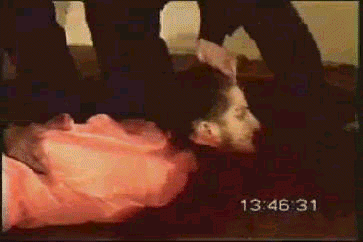
I wonder about Bataille on myth and sacrifice. My thoughts are only half formed and still incoherent.
The image is a still image of a video of the decapitation of Nick Berg, an American civilian in Iraq, by Islamic extremists, reputedly Al Qaeda.
Human sacrifice is what Bataille was talking about in the Acephale society in the late 1930s, but was unable to enact. Well here we have it, enacted for the global media.
What can we say?
I'll start by by reposting this previous post on Bataille to counter the bestiality interpretation--Arab terrorists as as vicious animals---to suggest that the beheading of Nick Berg has to do with the sacred.
Here is the old post:
"In this ABC Encounter programme some insightful remarks about Bataille, the sacred and intense erotic mysticism are made by Mark Taylor. Taylor is referring to the period between 1941 and 1944, when Bataille's wrote Madame Edwarda and Inner Experience, Guilty, and On Nietzsche. In a sense Bataille's work at this time was a continuation of the kind of sacred experiment he'd been undertaking with Acephale.
The founding belief of the Acephale was that rational thought wasn't going to be enough to save the world from the catastrophe that appeared to be looming on the horizon. The formation of Acephale was in part a response to the failure of the political groups opposed to Fascism. They tended to become fascistic themselves ---to become obsessed by seizing power. Acephale, being "headless", was an attempt to decapitate any kind of idea of seizing power. The image they chose for Acephale was the sorcerer's apprentice--- what the sorcerer's apprentice does is release forces that he can't control. Acephale was intended to be a kind of detonator to set off an explosion (a human sacrifice) that would destroy both French society and world society.
The war intervened, the group disbanded, Bataille resigned from his job at the Bibliotheque Nationale, left Paris for the countryside, and lost himself in writing. In writing, the above texts Bataille wasn't just trying to describe the sacred, but to unleash its energies. Taylor says:
"He saw in various kinds of literary texts a substitution for that kind of ritual enactment - in other words, one of the kinds of things that happens not just with Bataille but with a lot of these figures, right down to the present day, is that literature comes to play the role that religious ritual had played heretofore. Just as religious ritual can function as a way of displacing social conflict, containing it in a certain sense, by setting it in a ritual context in which it can be controlled, so religious ritual can get displaced into literary texts - so an author like the Marquis de Sade he finds fascinating, for precisely those reasons. But you also see in his texts (e.g. in one of his most interesting texts called Inner Experience), it's a sort of poetic text, but part of what he's trying to do with language is to enact the kind of disarticulation that he sees at work in the sacred. In the kind of text that I'm talking about here, Inner Experience or some of his fictions which are - well, "pornographic" is not right, but they're over the top in terms of transgressive excess. The text is not about the experience, the text is intended to be the occasion for the experience.This is within a whole mystical tradition within the West as well - I mean, St Ignatius' spiritual exercises have as their goal, to occasion the one undergoing them, the experience itself. I mean, the carnality of the experience that Bataille is seeking to trigger, is in a certain sense an incarnation of the word - it is the word made flesh, made carnate in the eroticism of the experience. And if you look back in the history of western mysticism, the texts are often shot through with eroticism."
That is the end of the old post.
I do not see that the human sacrifice of Nick Berg would lead to rebirth of new social values. Maybe we have the rebirth of myth and the touching of an explosion of primitive communal drives of the lower chthonian drives that lead to ever more violence. In this case the chthonian energies are have been unleashed and they are transgressive of Islamic values.
Does this sacrifce indicate the limits of Bataille? Why the turn to myth? We continue to live in a world of myths. As Lars over at Spurious says:
"This is still an age of myths, as if we belonged to the era Herodotus had already left behind - the time of the epic, of great causes and triumphal victories. The mythical age is not over - it lingers yet in the war without end which opened more than two years ago - itself the continuance of what perhaps the word 'war' cannot reach: an unsettled and impersonal struggle that has long spread across all the nations on the globe. Yes, it is still mythic, this war, for as long as Bush pretends to be the conscience of the world."
We in the West are enveloped in the Enlightenment myth of using force to bring reason, democracy and freedom to the world.
Maybe you could say that the video of Nick Berg's decapitation indicates an Islamic society that does not repress sacrifice that forms it, as do the Americans. The video turn sacrifice into a bloody spectacle; as are many of the public executions in Islamic societies.
The Americans do have the institutional structures for sacrifice--their prison system and death row. Their prison system both covers up death and displays it before the eyes of the media.
May 15, 2004
Heidegger: ethical life
Trevor,
as we have seen Heidegger's being-with is what we now call a communitarian ontology. He simply denies the presuppositions of individualism (of Husserl and Sartre following Descartes), in which the solitary individual subsequently bridges the chasm between itself and others through social involvement. We start from a shared public world.
So Trevor in Rostrevor is embedded in a local mode of this public world (his friends, painting, music books etc) and its emotional and ethical connections to others. These come to the fore and achieve prominence as care. Human beings care because they are already involved in the world and its meanings.
I guess you call it Hegel's ethical life, or Sittlichkeit, which means customary morality and refers to a way of living rather than a theory.
Sittlichkeit presupposes that society is just particular beings involved in certain sorts of complex relationships. Of course, Hegel's triadic constitution of ethical life (family, civil society and state) is far more complex than Heidegger's. What they have in common is the way of living in a social order and the critical reflection on that customary morality.
Given the communitarian ontology I find the interpretation of Heidegger as an individualist suprising. This interpretation appears to get its hook from Heidegger's conception of authentic life that resists the perspective of the 'they' which is the predominant mode of being in everydayness. The every day refers what is normal, customary and habitual involved in our day-to-day existence coping. Inauthenticity is a losing of the self into the conventional, ie., the normal routines of social existence.
Authentic existence is a breaking free from the conformism and conventions of the everyday that we are thrown into. Then individualism is up and running.
May not this be a recognition of the truth of Rousseau's - and Kant's - moral position - the concept of an autonomous subject whose essential freedom consists in not being forced to accept anything as valid unless his conscience, will and reason have given consent to it?
May 14, 2004
Heidegger: encountering others
Trevor,
I've been very busy with all that budget stuff these last few days. It is hard to pick up the thread of Division 1 (IV) of Being and Time after all that.
So let me come back to the question I posed in the previous: how do we encounter other people in everydayness? After all, it is only in a world of others that things can be deemed to be useful at all. So how do we encounter others?
In Being and Time Heidegger says that being along is a deficient or defective mode of being. That implies that everydayness a communal world of being with others.
As Heidegger says 'the world is always already the one that I share with the others. The world of Da-sein is a with-world. Being-in is being-with others.' (§26) Heidegger's category of 'das Man' ('the they') defines the average which directs the way each of us lives. It implies that only by having agreed public practices that it is possible to live in the world at all. Without shared average comportment there could be no referential whole, no public world. What Heidegger is arguing against is an individualist conception of society as a collection of individual subjects' worlds.
May 11, 2004
Heidegger: other people
Todays post cannot happen. The server for the material I'm working on is down. So I will just raise a question.
The post was to be about the world of the world as Dasen, or 'the 'public' world of 'the we' or one's 'own'. In this world we see things as useful, relevant and significant to us. Hence the import of instrumental reason.
The question? It's more a series of questions:
How do we encounter other people? How do we see them? How do we relate to them? Are there different ways of relating to other people? Are some ways better than others?
May 10, 2004
everydayness
Trevor,
as you can see, my interpretation of Being and Time is a very pragmatic one. Though the stated intention of the text is to understand the meaning of being in general (a fundamental ontology), I interpret the text as v being concerned with an analysis of human existence.
As we have seen this analysis starts from just the way things are done within a given social setting and are not more than embodied skills, habits and tacit knowledge. Hence we have the idea of 'average everydayness'. The conception of everydayness as an implicit way to be that is embodied in background practices is pretty much what I hang onto.
'Everydayness for Heidegger is not the same thing as primitiveness'. Heidegger says that there is precisely nothing to be gained by turning to primitive cultures when investigating the question of the meaning of being.
I appreciate that Being is a central category in this text and that it is the Being of beings; ie., it is that which makes beings be. I appreciate that there is a transcendentalism at work here around Being, and that it is the site of where a key problem exists in the conception of Being. However, I'm not much bothered by it as I am more interested in everydayness.
May 09, 2004
living being
Trevor,
while you are going gangbusters on Kant & Heidegger I'll plug along on Heidegger. Maybe our paths will criss cross in the forest.
I'm currently reading this in relation to Australian environmental philosophy. It is an account of the early chapters of Being and Time.
I approach being differently to you, namely hermeneutically. As Adorno said somewhere, philosophy is about interpretation. That is a succinct account of what Heidegger worked out in Being and Time. The method is a phenomenological one of returning to the things themselves (eg., Husserl's conception of the return to the things themselves is a return to the life-world). It is a commitment to investigate phenomena as people actually experience and live them.
If we work from the account of Being and Time then we live within a particular understanding of being, yet we are not able to render an account of it. It is very difficult for us to give an account of the technological understanding of being. We do have some sense of this understanding (as it is in what Dreyfus calls 'our everyday background practices'), but it still remains somewhat 'shrouded in darkness'.
That was the point of my earlier post on the plantation forestry industry in Australia. The Routley's had a glimmer of what the technological being that underpinned, or rather was embodied in the background practices of the state forestry ideology they opposed. But that conception of being was very unclear to them. They saw bits and pieces as distinct from the full picture. What they were doing was working up or constructing a theory from our 'average and vague understanding of being. They took our half-known features of ordinary experience which, on closer analysis, furnished the building blocks for thematised inquiry.
Let us call this understanding or how human beings are in the world (Da-sein) an economic utilitarian one. The Routleys situated themselves vis-a-vis the phenomena of interest by presupposing themselves to be standing outside technological being, rather than as being enframed by it and living within the technological understanding of being. the understaning of being they opposed was over there in another space to where they stood in the liberal university. As critical environmental subjects they undersatood themselves as standing outside the particular understanding of the meaning of being in late modernity.
From Heidegger's perspective they were living within the technological understanding of being and resisting that technological understanding from within.
May 06, 2004
Heidegger, Kant and others
Gary,
Here is how I am seeing Heidegger on Kant, in a kind of progressive contrast with Benjamin and Adorno. I would really appreciate being corrected wherever I go wrong. I don’t care about being right or wrong in a debating sense. I want to get it right so that no one can say ‘but that’s not what Heidegger said’.
Heidegger tells a story about the development of metaphysics, which does not exactly culminate in Kant but he is a most significant point along the road. He talks about ontology and I’m taking this to mean the theory of ‘Being’. A big ‘B’ is used with this word for the same reason a big ‘G’ is used with ‘God’ – Being with a capital ‘B’. The object of ontology has not been properly recognised because it has until now always been treated from the perspective of metaphysics, that is any perspective that aims to look beyond what is ultimately ‘empirical experience’. These are my words. In the Foreword to the Kant book, Langan describes it ambiguously as seeking ‘beyond the sum total of things of our experience’, although he means empirical and/or scientific experience, in that he excludes Plato’s ideas and all that is amenable to abstract truth, which is precisely the approach of metaphysics.
Metaphysics means something more than this for Heidegger – it is a theory of timeless truths in which a distinction between the intellect and that which is beyond the intellect also holds. Another way of saying this is that the development of the metaphysical theory of ontology is tied to a conformity theory of truth, the correspondence theory being a classical example – a relation between the things beyond experience and the intellect, a relation of domination by the former over the latter.
According to Langan, ‘Descartes takes the decisive step toward converting the object into the subject’s “representation”’. Kant’s work represents a further advance in this project of explaining ontology because he examines the rules of relating to representation. ‘With this inquiry the whole historical destiny of metaphysics is fulfilled’, a destiny that began from the notion that Being existed before we started cognising about it, to end with the realisation that this Being could not be other than representation. So, after Kant, the metaphysical problem is to explain how representation could ever have meaning or significance.
Given this view of the progressive metaphysical appropriation of ontology as a wrong turn, Heidegger has no choice but go back to the start and take another fork in the road. Hence, we get a theory of being-in-the-world, of anxiety, of forfeiture, of existence, et cetera, with the ultimate idea of Being as self-realisation instead of appropriation.
I chose to call this a story precisely because it is not history. It is a myth – a very popular myth among analysts too, as it turns out – that western philosophy is a kind of seamless development of ideas, a sui generis process, evolving from within itself as the expression of an idea. Heidegger doesn’t even differ from the empiricists and positivists in thinking that it was the wrong idea. There is no argument on that score. Their view, however, is that there is no point pursuing ontology at all, and so they and Heidegger part ways.
For Benjamin and Adorno, Kant is a much more ambiguous figure than he is for Heidegger. Where Fichte in particular was happy to absorb the object into the subject, Kant preferred inconsistency to such a move. Like Kracauer, neither Benjamin nor Adorno regard Kant as an idealist in the way that Heidegger sees him. According to Adorno, Kracauer saw Kant’s philosophy as ‘not simply a system of transcendental idealism… the objective-ontological and subjective-idealist moments warred within it…. From a certain point of view, the fissures and flaws in a philosophy are more essential to it than the continuity of its meaning, which most philosophies emphasize of their own accord.’ Where Heidegger sees Kant as part of the seamless weave of metaphysical development, these other three see a dialectical struggle taking place.
Where Heidegger sees philosophy wandering along happily from Thales to Bertrand Russell, Benjamin et al see the discontinuities of history and metaphysics not as some sort of continuous development in ideas but as something tied to its time, a windowless monad in fact, the epitome of its time. Adorno says of Kant’s work, ‘the enormous impact of the Critique Of Pure Reason has its source in the circumstance that it was in effect the first work to give expression to the element of bourgeois resignation, to that refusal to make any significant statement on the crucial issues.’ And, ‘The crucial feature of the Kantian work … is that it is guided by the conviction that reason is deprived of the right to stray into the realm of the Absolute.’ And, ‘codified in the Critique Of Pure Reason is a theodicy of bourgeois life which is conscious of its own practical activity while despairing of the fulfilment of its own utopia.’ For Benjamin et al, the Kantian development is not some inevitable evolution of a wrong idea but a response to a certain specific way of life, a text the direction of which was tied to historical circumstances.
Where Heidegger wants to overcome or replace metaphysics, Benjamin et al want to restore it after its dissolution since Descartes. Heidegger replaces theology with a Clayton’s theology, the theology you have when you’re not having theology, the idea of Being instead of the idea or God, or the good life, or whatever. Nonetheless, if this theory is not metaphysics, it is something very like it. For a start, like metaphysics Heidegger looks beyond the sum total of empirical experience or any kind of experience of that which is out there and detectable. In Kant’s words, it must be ‘given prior to the synthesis of understanding and independently of it’. It does not draw on ordinary life or day-to-day experience, despite all claims to the contrary, but ‘returns’ to origins, back to Thales and Anaximander and Parmenides.
Getting back to Kant, Heidegger subdivides metaphysics into special metaphysics and general metaphysics. The former is made up of theories about what essentially exists – some translators use the word ‘essent’ to mean roughly ‘what essentially exists’, i.e. God, world and man, as in say The Star Of Redemption. The latter kind of metaphysics is the study of these ‘essents’ in general. James Churchill, who translated Heidegger’s Kant book, describes general metaphysics as ‘ontology – or in Kant’s terminology, “transcendental philosophy”’. Once again in Kant’s own words, transcendental philosophy enquires into the possibility of synthetic a priori judgments. Judgments about God, world and man, about Being, about causality, about subject and object, about space and time, are synthetic a priori judgments. Ontology is an enquiry into their possibility. Heidegger is primarily concerned with ontology in this sense, and existential philosophy is one proposal for a transcendent philosophy.
I’ll return to the point that this transcendent alternative is not derived from existence, in either the mundane or authentic sense. The idea of Being in existential philosophy depends on the notion that because we are less than being we seek completion – put crudely, that we are nothings seeking completion. With exactly the same existential basis, Bataille is able to argue that we are plenitudes – that is, we are not nothings – but we are unhappy plenitudes, and so we seek oblivion. Gombrowicz was at one with Bataille on this, writing:
‘I have been unable to take root in any contemporary existentialism. Existentialism tries to re-establish value, while for me the “undervalue”, the “insufficiency”, the “underdevelopment” are closer to man than any value. I believe the formula “Man wants to be God” expresses very well the nostalgia of existentialism, while I set up another immeasurable formula against it: “Man wants to be young”.
We do not want completion. We want incompletion.
What does this indicate? To me it indicates that the philosophy of existentialism does not flow with by necessity from ordinary day-to-day existence and nor is it the spontaneous metaphysics of ordinary people, because the opposite view is equally implied by this life and the experience of ordinary people. In fact, for me it is more compelling. At least, I cannot see how eroticism can be explained from the perspective of existentialism, other than as some kind of forfeiture. But this sounds moralistic, as if we know the conditions of Being before we experience them.
I’d like to say more but I am running out of puff. I hope I’ll get around to following it up later.
Heidegger & ecology
Trevor,
It is good to see you reading some Heidegger. Most read him in terms of the German philosophical tradition or existentialism.
I read him in terms of the Australian environmental philosophical movement that was inaugrated by the Routley's transgressive Fight for the Forests book of the early 1970s.
Why so? If you read this brief overview you will see that they contested the economic arguments of the utilitarian state forestry industry and they defined the conflict as one of values. There was nothing about metaphysics or ontology, despite the human-centredness and subjectivism of utilitarianism.
What we got was an account of the problems given in terms of the state forestry industry and profession and their ideology of maximising wood production. What was missed was the philosophical framework that the deology was a part of. What we got was the politics about foresty as a captured bureaucracy--but not the ontology of utilitarianism.
With Heidegger you re-read the text with an eye to the ontology. That is an important step in the context of this kind of Australian environmental philosophy that would have instinctively rejected Heidegger.
May 05, 2004
Heidegger and Kant
Gary,
I have been doing a lot of reading on Heidegger and I must say that I am coming to have grave reservations about many of the things you say about him. For instance, on 17 April, I think it’s completely false to say that Heidegger ‘is talking about the “fundaments” of everyday existence and is making public mood a subject of philosophical concern’. You might like to read him that way but it is certainly not what he is doing in Introduction To Metaphysics or indeed any other work, as far as I can see. In fact, the whole of his oeuvre is completely lacking in any real sense of history. There is endless talk about the darkening of the world but this is no substitute at all for history. It has more in keeping with Christian ideas, such as found in the book of Revelation. They both touch on the actual world in more or less the same way.
Anxiety cannot be made into something that characterises the contemporary Australian mood. The mass of people are in a state of forfeiture, in the sense of Being And Time, whereas anxiety or dread is a state of those engaged with Being, the exceptions.
In fact, I think he’s much closer to the analytic philosophers than you suggest. In particular, like them, he is a system-builder. The book on Kant isn’t an analysis of Kant along the lines of Benjamin and Adorno. Rather, it’s Kant read from the perspective of Being And Time. In the forward to the English edition, Langan describes the Kant book as beginning the second aspect of the task began in Being And Time, ‘a rethinking of the whole course of that historical coming to be of “Being” and “Truth”.’ Don’t let this quotation fool you, though – there’s no history in this book. As far as I can see, the historical process was completed with Socrates and Aristotle. Parmenides is a goody and Heraclitus a baddy. Whereas Benjamin and Adorno want to maintain the basic Kantian approach but resurrect metaphysics in the face of the damage done to it by an over-emphasis on empirical experience, Heidegger had no such intention.
On my reading, it is also doubtful that the distinction between the early and the late works are as you describe them. They certainly don’t save him from accusations of existentialism, and existentialism isn’t neither here nor there, as you suggest. It relies on a rudimentary and thus unstated metaphysics, in much the same way as empiricism and positivism. Unless you consider what is at stake in existentialism you will not understand Bataille’s position. In one of your entries last week you suggested that Bataille was an example of someone who remained tied to subject-object metaphysics. This is wrong. There is something close to Benjamin in Bataille’s notion of inner experience if it is seen as an attempt to break the dominance of empirical experience that bedevils the Kantian system. Bataille acknowledges the sets of ‘relations that enframe and shape us’. Dissolution is a response to them. Bataille is much closer to Plato than Descartes. Indeed, he can profitably be seen in relation to, and in contrast with, the tradition of neo-Platonism.
Point me to the sections where the environment becomes an issue. I can’t find any. And its’ pretty hard to see how it could have a place. It’s got nothing to do with what Heidegger is after, as far as I read him. He’s concerned with ontology, not the environment.
May 04, 2004
Heidegger: useful activity
Trevor,
a quick summary and a query.
Heidegger's concept of everydayness breaks with the view of an isolated subject related to discrete objects. In contrast, Dasein is immersed in a world which is experienced as a significant whole: Trevor in his garden at Rostrevor or living at Rostrevor. In Heidegger's language Dasein is already familiar with the world and on this basis, always already concernfully involved in its projects. This is a world that scientific analytic philosophy refers to as common sense.
What is problematic about Heidgger's conception of everyday is the way that he equating the everyday with useful activity.
Rudi Hayward says that this comes from the idea of ready-to-hand. This category implies that useful things (gardening tools) always exist within an equipmental totality in which each useful thing can be what it is. A useful thing is essentially something in order to...do something, say pruning. This contextual structure of in order to... is referential because each equipment essentially belongs to, and therefore refers to, a totality of equipment.
So early Heidegger tacitly accepts instrumental reason as useful activity that sees tools as instruments to manipulate the resources of the earth. So we can have forestry in which foresters have agri-silviculture skills that are used to clear the public native forest estate for pine plantations and the development of pines and then used for exporting woodchips.
Hence we have the conflict between foresty and environment that is so familar to us in Australia. The totality of equipment in forestry is all about wood production, total ultilisation and the production of maximium quantities of wood.
So how does this account of everyday activity allow for non-growth values such as biodiversity, conservation and ecological considerations. So how does Heidegger's account allow for something that is other to the totality of equipment of the wood-volume maximising intensive industry.
As far as I can see it doesn't. And this is of concern to me because of the debate over the clearfelling of our native forests that started in the 1970s that was begun by Richard and Val Routley in their Fight for the Forests book.
If Heidegger is to be of relevance to us in Australia then his philosophy would to help us with understanding the forest issue of that time; a time when the incumbent native forests were being flattened, windrowed and burnt without any consideration for ecological effects.
May 03, 2004
Heidegger & Kant
Trevor,
I have not read any books by Heidegger on Kant. I presume that such a text would fall within the project overcoming of metaphysics. I suspect that these would have to be after Being and Time, which pretty much finished without seriously venturing into the destruction of the history of western ontology.
I guess the "Kant book" would explore Kant's project in the 3 Critiques as a groundwork for metaphysics, that is, an ontology, rather than the Kant of the First Critique bring forth a theory of knowledge based on science (physics).
Here is a book, Heidegger's Kant and the Problem of Metaphysics
Here is a scholarly link. It looks as if to read read Heidegger on Kant you have to wander through a lot of the Kantian transcendental machinery. Not really my cup of tea.
I presume that Heidegger would be destructuring the traditional approach approach in which the question of the meaning of being is addressed from the perspective of the logic of propositional statements. Implicit in this traditional approach is the thesis that theoretical knowledge represents the most fundamental relation between the human individual and the beings in her surrounding world. It would be argued that theoretical knowledge represents only one kind of intentional conduct, and that it is founded on more fundamental modes of practical engagement with the surrounding world.
That's the approach of Being and Time. I guess a key concern from a philosophical heremenutics position is to try and understand why and how theoretical knowledge came to seem like the most fundamental relation to being. This would take the form of a destructuring (Destruktion) of the philosophical tradition:--in Being and Time it is briefly undertaken in relation to the philosophy of Descartes.Presumably the later texts would destructure the philosophies of Aristotle, Kant, Hegel, and Plato.
As an aside this approach exerted an influence on Derrida ---eg., the deconstructive approach. Of course, there are important differences between the two approaches since Derrida is destructuring Heidegger.
Since I basically accept Heidegger's shift to the everyday, practical knowing and concern I do not have much interest in the epistemologcal concerns of the philosophical tradition. I'm more interested in the way that Division I of Being and Time provides a phenomenology of average everydayness and the way that account is revised in the light of the authentic way of being described in Division II. It seems to me that is here that Heidegger makes a significant difference in how we see the world and ourselves.
As Dreyfus spells it out in his commentary on Division 1 Heidegger’s basic theses are that:
*people have skills for coping with equipment, other people and themselves;
*their shared everyday coping practices conform to norms;
*the interrelated totality of equipment, norms and social roles form a whole which Heidegger calls “significance.”
*Significance is the basis of average intelligibility, and
*this average intelligibility can be further articulated in language.
May 02, 2004
Heidegger and Benjamin
Gary, I have quite a few questions and points for discussion but before I turn to them, I’d very much like you to answer the following question for me. Benjamin thought that the solution to the problem of the inadequate subject-object metaphysics was to return to Kant. In his words, Kant’s system, ‘by virtue of its brilliant exploration of the certainty and justification of knowledge, derived and developed a depth that will prove adequate for a new and higher kind of experience that is yet to come’. Where does Heidegger stand on Kant?
Heidegger & the everyday.
Trevor,
This dissertation about Heidegger's understanding of the everyday in Being and Time may be of interest. He displaces the concern with epistemology in the analytic philosophy we were schooled in to explore our comportment within the everyday life we find ourselves living. The everyday was my pathway into Heidegger.
The category of the everyday is important. It means that we no longer have the schzoid split of analytic philosophy, where its practitioners live in the everyday common life, and then go up to the university to write about themselves as machines in terms of a systematic, abstract theory. Their being is one of an isolated subject somehow detached from, yet extrinsically related to, the world,
With Heideger we work on understanding the concrete everyday life we live. That makes philosophy relevant. The implied ontological point is that we are involved in, rather than detached from, our own world.
Rudi has the starting point of phenomenology spot on. He says that for Heidegger:
"We must start with the everyday because this is where we are. As Heidegger develops his phenomenology of the "where we are" called Da-sein (Being-there), it becomes apparent that our being-there-in-the-world has a complex structure....Heidegger's preliminary description of the everyday highlights the contextual nature of our world. By showing how this characterizes our normal experience it becomes apparent that theory, as abstractive, presupposes this experience from which it de-contextualizes."
So being or Dasein is a distinctive and definitive characteristic of the way we conduct our activities. An understanding of Dasein is implicit in everything we do, everything we talk about, everything we have in view, everything towards which we comport ourselves in any way. What we are is being; and how we are is being. Hence we have a metaphysics of everyday life that is embodied in us living our daily lives.
Rudi goes to make another crucial point, one that has caused you come concern--the subject/object issue. he says:
"By starting with the everyday Heidegger is determined to do justice to the unity of the interwoven multiplicity of human experience. It is this unity that Heidegger seeks to capture by describing Dasein as Being-in-the-world, and which is missed in the long honoured distinction between subject and object. .....As Dreyfus has made clear, to claim that Heidegger has broken with an overemphasis on the theoretical by emphasising the practical is to miss Heidegger's more fundamental break with the philosophical tradition by questioning the primacy of the subject-object distinction."
This is a rupture with Descartes's dualism in which the "I think" stands in opposition to a world of physical objects. Our being-in the-world is more akin to dwelling in a place (eg your living at Rostrevor all your life).Your existential mode of being-in there is dwelling in relation to the world in an intrinsic sense (not extrinsic--it's Hegel again). By intrinsic it is meant that your relationships to the world of Rostrevor are part of what it means to be. They constitute your being or worldhood.
In Heidegger's language Dasein is always already in the world, always already involved. This involvement is one of practices as it involves a handling, using, a taking care of things, a concern about These practices have their own kind of knowledge: a tacit, embodied knowledge. It is knowledge that is both practical---like playing an instrument or building a garden--- and concernful towards about others (people) and things (the garden) we have relationships with.Our human world is a meaningful, significant and intelligible whole.
That sketches what attracted me to Heidegger: it is a radical rupture with analytic philosophy's concerns with science, epistemology and machines. By explaining things in terms of the natural sciences, analytic philosophers (scientifc materialists) abstract from the richness of everyday experience. True, theory is rightly abstractiveand it decontextualises what it takes as its object for the purpose of analysis. However, these analytic philosophers illegitimately take their abstract, naturalscientific view as revealing the truth of things. So they interpret the richness of human experience in a reductive manner. and trreat it a mere colour and ornamentation.
Seeondly, Heidegger's rupture enables philosophy to have its own voice--not that of science--- and to reconnect with our common life.
May 01, 2004
Heidegger: shuffling towards everyday life
Trevor,
This article by Patrick Heelan may be of some help in coming to grips with Heidegger's hermeneutics in Division I of Being and Time. What is of interest is less the philosophy of science stuff than the hermeneutics of everyday life.
Heelan does point to how Heidegger understood modern natural science in the late text, The Question Concerning Technology and Other Essays. Heelan says:
"....Heidegger saw the scientific culture of modernity as the 'Age of the World Picture' in which the 'real' is constituted by the theoretical representations of modern science rather than as a revelation of what constitutes the foundational structure of what is, or what Heidegger called, 'ontology' (Heidegger, 1977a, 115-154). In later criticism, Heidegger came to see modern science as essentially entangled with technology in the constitution of objective frameworks of 'standing reserves' ('Bestand') or 'mere value-neutral resources for human action' ('Ge-stell') (Heidegger, 1977a, 3-35)."
This pathway leads to an account of the technological understanding of being.
But we also have the hermeneutical account of the everyday world of our own activities and individual things in our lifeworld, such as a workshop. Heelan says that Heidegger begins:
"....begins with a worker engaged in a building project, using a hammer. The hammer unexpectedly breaks. Let us suppose that a replacement can't be found and that he has to have one made. He asks: what are the specifications of a hammer (of the kind he needs to finish the job)? The answer to this question will be a theory (about hammers) that explains a hammer's ability to do the hammer's job. What is a hammer's job? It is the 'meaning' of a hammer. In this case it is a cultural praxis-laden meaning dwelling within the context, let us say, of the building trade.Note that without a specification of context, the question is relatively indeterminate. In the context of the 'received view,' however, the hammer is a physical entity specified by its specifications, it is a theory-laden meaning that lays out the physical conditions under which it can become the host of the cultural meaning of a hammer. But whether or not it is assigned this cultural function is a separate and contingent matter. The two meanings are not independent. The theory-laden meaning makes sense only if a local contingent existential condition is fulfilled, namely that the hammer-referent is praxis-laden in the conventional sense."
You can do the same with cooking at home or writing papers on a computer in the university. It is a world of praxis, tacit embodied knowledge and prudent action (or phronesis). This is what Gadamer picks up on and develops through a rereading of Aristotle.