November 30, 2003
Bataille: On Nietzsche#2: What about evil?
As we have seen Bataille's conception of sovereignty means that intellectual, artistic, or religious activity should aim at the annihilation of the rational individual in a violent, transcendental act of communion. It is about the experience of the edge, living at the very limits of life, at the extreme, at the borderline of possibilities. Sexually it means to have been scared and to have surrendered.
I've been continuing with my reading of the 'Preface' to Bataille's On Nietzsche. After making his remarks about experiencing Nietzsche means pouring out one's life blood Bataille indicates how he interprets Nietzsche's texts. These remarks are directed at Heidegger's Nietzsche. Bataille says that:
"There exists an idea of Nietzsche as the philosopher of the "will to power," the idea that this is how he saw himself and he was accepted. I think of him more as a philosopher of evil. for him the attraction and value of evil, it seems to me, gave significance to what the intended when he spoke of power."
Bataille is known as the "metaphysician of evil". Evil is a very old religious term that describes what is morally bad, corrupt, wantonly destructive, selfish, and wicked. In a casual or derogatory use, the word "evil" can characterize people and behaviours that are painful, ruinous, or disastrous.
Does Bataille's use of evil refer to his interest in sex, death, degradation, and the power and potentialities of obscene? Not quite. Just after the above passage Bataille mentions what he understands by evil:
"...I am opposed to all forms of coercion---but this doesn't keep me from seeing evil as an object of moral exploration. Because evil is the opposite of a constraint that on principle is practiced with a view towards good. Of course evil isn't what a hypocritical series of misunderstandings make it out to be: isn't it essentially a concrete freedom, the uneasy breaking of a taboo?
Evil is about transgressing taboos.
In Literature and Evil Bataille argues that literature is "guilty" in that literature is complicit with evil and that it must admit this. Only through acknowledging its complicity with the knowledge of evil can literature communicate fully. Bataille explores this idea through a series of remarkable studies on the work of eight outstanding authors: Emily Bronte, Baudelaire, Blake, Michelet, Kafka, Proust, Genêt and De Sade.
Bataille "eroticises" literary creativity thrrough arguing that literture is anti-utilitiarian and embedded in desire and pleasure. He contends that the modernist notion of "Art for art's sake", which emerged as a reaction to a fragmented and reified social world dominated by utilitarianism and commodity fetishism, is actually a subterfuge. It is literature masquerading as innocent under the mantle of "pure art". What literature does is to rechannel the forces that are dammed up owing to the repressions imposed by a liberal capitalist culture.
From a critical philosophical perspective Bataille, in putting his finger on the pulse of evil, is alert to madness, violence, hatred and humiliation which were about to rock Western civilization, and unleashed atrocities on an unprecedented scale. These are experiences (eg., the of Holocaust & the Gulag) that are unimaginable and impossible to communicate. These experiences of horror are the unspeakable.
Have you noticed how silent academic analytic philosophy is about these atrocities? It avoids addressing them. This abstract instrumental reason retreats into systematic theory about science and language and dismisses all attmepts to articulate the horror of the 20th century as irrationality. Such a philosophy stands condemned of irrelevancy.
November 29, 2003
Bukowski: poem#5
Bluebird
there's a bluebird in my heart that
wants to get out
but I'm too tough for him,
I say, stay in there, I'm not going
to let anybody see
you.
there's a bluebird in my heart that
wants to get out
but I pour whiskey on him and inhale
cigarette smoke
and the whores and the bartenders
and the grocery clerks
never know that
he's
in there.
there's a bluebird in my heart that
wants to get out
but I'm too tough for him,
I say,
stay down, do you want to mess
me up?
you want to screw up the
works?
you want to blow my book sales in
Europe?
there's a bluebird in my heart that
wants to get out
but I'm too clever, I only let him out
at night sometimes
when everybody's asleep.
I say, I know that you're there,
so don't be
sad.
then I put him back,
but he's singing a little
in there, I haven't quite let him
die
and we sleep together like
that
with our
secret pact
and it's nice enough to
make a man
weep, but I don't
weep, do
you?
Charles Bukowski
November 28, 2003
Bataille: sovereignty
Trevor,
further to yesterday's post, people are also saying that they find Bataille's category of sovereignty difficult to grasp, or get a hold of. As you know I've experienced this difficulty myself, given my background in Hegel and Nietzsche. It is hard to shift from philosophy to surrealism that is concerned to subvert reason to investigate the workings of the human subconscious and explore what is usually called the irrational.
The readers want some explication of the categories Bataille uses, and they would like some links to online material that they can read.
It would appear that Bataille has primarily entered Australian culture through the art world under the sign of the obscene without this transgression being linked to sovereignty. This kind of art work can be linked back to the 1930's surrealist, Hans Bellmer and his dolls:
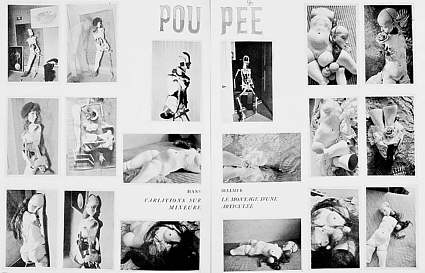
Hans Bellmer. "Poupée, variations sur le montage d'une mineure articulée," Minotaure 6 (Winter, 1934–35), pp. 30–31.
There is more on Bellmer's dolls here at The Art Institute of Chicago. There is a post on Bellmer's dolls over at Junk for Code. It connects these to contemporary issues. There does seem not seem to be much leakage of Bataille from the art institution to the philosophy one. The leakage that has occurred is what has flowed from Freud’s theories about dreams, the unconscious, and sexuality in art, drama, and literature. Though this is old hat to us today, it was unquestionably avant-garde, controversial, and groundbreaking in the 1930s.
So let us start from European surrealism from the 1930's to open up a pathway to a working understanding of sovereignty. Two images. First an image created by Andre Masson for the Acephale days. 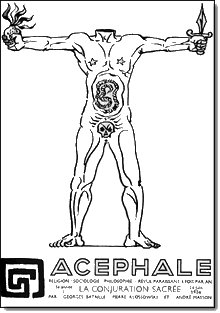
This image give us a headless human being.
The emphasis is on the body and bodily desire.
Reason (the head ) is placed to one side. It is about the body.
It is not about the fantastic or the immediate world of dreams, nor is it obscure. But it does seek through a therapy of shock and surprise to liberate our conventional vision from its obscurity.
This is made more obvious in the image called The Lovers created by Rene Magritte.
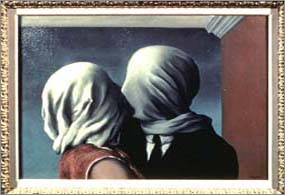 A related image is held at the National Gallery of Australia. It is less the expression of personal fantasy or private neurosis and more an image designed to express the darker side of subjectivity.
This headless body is unconcious sexual desire; physical intensity; bodily pleasure; amoral desire. The hooded body links to contemporary bondage play sessions in which a leather hood is used to enclose the subject in isolation; the submissive body is used for pleasure by the Dominator in whatever way the Dom desires; and the consciousness of the submissive body is the sensations of physical intensity. This is very much within Bataille's understanding of exploring the boundaries of sexual taboos in his The Story of the Eye, where a young a young couple, play with eggs, milk and all bodily fluids. Bataille's understanding of pornograpahy is different from the standard one: it is ultimately about death not sex.
So what is the link from bodily pleasure to Bataille's category of sovereignty?
Sexual union causes a momentary indistinguishability between otherwise distinct objects. The secret of eroticism opened visions into unknowable continuity of being, the death. (Poetry has similar dimensions when it dissolves the reader "into the strange." )
A good place to start is Literature and Evil, where Bataille says:
"Death alone -- or, at least, the ruin of the isolated individual in search of happiness in time -- introduces the break without which nothing reaches the state of ecstasy. And what we thereby regain is always both innocence and the intoxication of existence. The isolated being loses himself in something other than himself. What the 'other thing' represents is of no importance. It is still a reality that transcends the common limitations. So unlimited is it that it is not even a thing: it is nothing."
What we have here is a pushing the physical limits for the sake of experiencing pleasure through a surrendering of control and becoming submissive.
This loss of self to the sacred is freedom, or what Bataille often calls sovereignty.
More on Bataille's conception of sovereignty can be found here.
Sovereignty is a complex category in Bataille. It needs working at to grasp it. What we can say us that sexuality allows for the momentary loss of self, and it is this loss which Bataille equates with religious ecstasy, with immersion in the sacred.
Sovereignty then is not a kind of Hegelian or Nietzschean lordship which still works within the traditional understanding of sovereignty: one is sovereign when one has right or force of command over oneself or one's dominions. Sovereignty is used predominantly to define a form of political power, whether manifested in an individual. Bataille turns away from approaching sovereignty from the point of view of political theory.
For Bataille sovereignty refers to the properties of the inner relation of man to the objects of his desire. For Bataille, sovereignty is the collapse of the dualism that grounds Western thought -- subject/object, good/evil, body/spirit. Sovereignty depends on the loss of self. and, as soon as I say: "I am sovereign," I am not. As soon as I realize that my self has fallen away, it has returned. Sovereignty is not something I can have; it is not something I can be. It is not something at all.
And so sovereignty is an impossibility, unrealizable. “Sovereignty,” Bataille writes, “is the object which eludes us all, which nobody has seized and which nobody can seize for this reason: we cannot possess it, like an object, but we are doomed to seek it.” [Literature and Evil, pp. 193-194]
What Bataille posits, then, is a philosophy of impossibility, a thinking without resolution, an eternal striving without a definable or achievable goal.
Sexuality allows for the momentary loss of self, and it is this loss which Bataille equates with religious ecstasy, with immersion in the sacred. It is this momentary loss of self that takes us across the threshold of sovereignty.
If we look at Bataille through the eyes of Nietzsche, then Bataille's philosophy is what Nietzsche calls a "transvaluation of all values." For Bataille, access to the sacred is possible not for those who behave themselves and faithfully observe prohibitions and taboos; it is for those who fully acknowledge the force of the moral taboos in everyday life and yet willingfully transgress them. The values that are being revalued are those embodied in what is tabooed.
November 27, 2003
Bataille: the sacred
Trevor, some people who have been reading this weblog have commented on the difficulty they are experiencing in understanding Bataille They have asked for a bit of help in terms of links.
In this post I will spell out Bataille's conception of the sacred. Here is a link to discussion on Bataille and the sacred on the ABC's Encounter program. That program explores the connections between religion and life. The link gives some background to the way Bataille has been received in Australia. The connections between Chritianity, the sacred and continental philosophy are briefly explored here.
Bataille's conception of the sacred is part of his critique of modernity. This is an the larger cultural framework through which market capitalism debases the world by means of the commodification of the individual's relation to the spiritual and the physical. This commodification of life separates the physical from the spiritual and constructs the very categories that constrict us as subjects.
The philosophical context is provided by Hegel's Phenomenology of Spirit which charts the historical disappearance of the Sacred as the condition of the possibility of modern reason that is increasingly conceived of as a mere means-purpose relation. So we have the loss of a whole range of human experiences that do not fit into the categories of an instrumental reason that is concerned with utility.
On Bataille's account transgressing this modern enframing of our mode of life by instrumental reason involves a sense of the sacred that is tied to the sacrificial. The sacrificial (eg., van Gogh's act of cutting off his ear) transgresses the clearly marked line of utility within modern European culture. It goes beyond the rational, the scientific, the normal; and points to a beyond of modern liberal culture. This is both beyond Europe and beyond modernity, as it points to a more primal and primary state before modernity. Sacrifice points to, or opens up, a pathway to the spiritual.
So Bataille’s philosophical relationship to Hegel's philosophical narrative of modernity is to reveal the ‘impossible’ and ‘unthinkable’ ‘Other’ of Hegel’s spirit of modernity. In his Theory of Religion (1948), he argues for a ‘return to the Sacred’ by withdrawing the ‘thing’ from the sphere of profane objectivity of instrumental reason and restoring it to its sacred origin. This restitution, according to Bataille, is the meaning of ritual sacrifice as a religious practice, as we encounter it in archaic religions. It is an interruption of the profane secular production process, in which suddenly and violently, the Sacred reappears.
It is transgression of taboos which gives human beings access to the sacred itself. If the profane world is the world of taboos, then the sacred world depends on limited acts of transgression. It is the world of celebrations, sovereign rulers, and God. Acts that would be unthinkable in the everyday world, (such as adultery, homosexuality and other forms of non-reproductive sexuality, drug use, cannibalism, incest, human sacrifice) are permitted and even required in the realm of the sacred.
Bataille would argue that what is declared to be taboo is prohibited precisely because it offers, as it were, a doorway to the sacred.
November 26, 2003
The Cave of a Thousand Batailles
Well, Gary, I guess you’ll think what you like and nothing I can say will change that, so I’m not even going to try. But I will say this: there is no difference between the poetic Bataille of the Acephale and mystical ecstatic experience and the one of the College of Sociologie in the late 1930s. The College of Sociologie was the public front for the Acephale group. They existed at the same time. One did not follow the other or in any way reflect a change in perspective.
Habermas’s views on Bataille are about as adequate as his views on Adorno – in the same book, for that matter. As far as I’m concerned, what he says is a load of crap. And as for Derrida, well, his stuff just reflects the post-modern domestication of Bataille. These post-war post-moderns were a bunch of academics looking for a new line on which to build a career – perhaps I’m being harsh, unreasonable even, but I cannot help noticing how their ‘theorising’ has provided a convenient justification for the current fascist-corporatist attack on discipline and more generally standards in the universities. These places were never too great but they were never as low as they are now. And this isn’t just a piece of misprision, a convenient misreading of Derrida, Deleuze, Foucault, Baudrillard and Lyotard. It’s not necessary to misread them. All the present barbarians have to do is read them as they are.
The left Hegelian Bataille wasn’t elided in the honours course in European Studies at Adelaide University because of his associations with Marxism. I provided the material for the seminars on Bataille and I’ve got no problems with Marxism – at least, I don’t think I have. As far as I’m concerned, corporatism is the highest form of imperialism and imperialism is the political consciousness of the bourgeoisie. Okay, so this last part is form Hannah Arendt but it’s more Marxist than most people have a stomach for.
Having said all this, I’ve got no problem with you trying to extract a ethic from this if that is your want. From my perspective, that’s what you are doing with Nietzsche, perhaps with more justification. There seem to be as many Nietzsches as there are interpreters so I’m not going to press the point.
The Bataille that wrote Guilty postdates the College Bataille and this is what he had to say about philosophy:
‘philosophy takes on a strange dignity from the fact that it supposes infinite questioning. It's not that results gain philosophy some glamour, but only that it responds to the human desire that asks for a questioning of all that is. No one doubts that philosophy is often pointless, an unpleasant way of employing minor talents. But whatever the legitimate biases on this subject, however erroneous (contemptible, even heinous) the "results," its abolition runs into this difficulty - that exactly this lack of real results is its greatness. Its whole value is in the absence of rest that it fosters.’
Perhaps this is in keeping with your Bataille. It’s also in keeping with mine.
Your stuff on pornography is good. You ask, ‘What would these transgressions be today. Porn? Or the S & M practices of today?’ I think it’s just an escape valve. I suspect there aren’t too many sovereigns among its devotees. Maybe I’m wrong but I doubt it. Hey, the Adelaide Advertiser regularly uses female bodies to help sell its Saturday magazine section. I don’t think they’re interested in promoting sovereignty.
Try sex and drugs and rock’n’roll.
No need to try to save your soul.
In the end, perhaps we’re not as far apart as you think.
November 24, 2003
Bataille as a sexual critic
Trevor, I had worked up a post on the dark side of sexuality ----S&M and rape---- and the difficulties of expressing the excess, violence and terror of these experiences in language. It was to be about Bataille as a critic of morality in the light of your remarks about intensities, exploding machines, the dissolution of being subjects in a world of objects, being beyond all identity and realityand entering into a state of muteness.
It picked up from this post. Alas, I lost it all when my Internet access gave out yesterday.
This post is different to the one lost. It will try and connect the beyond language and moral critic.
I will deal with a minor point of interpretation, then explore the excess and terror of people's experiences of S&M and rape as a way to consider Bataille as a critic of morality .
I do think that you give a one sided interpretation of Bataille. Your Bataille is the surrealist poet who is concerned with the radicality of individual experience and who gestures to what cannot be said in language. This is the poetic Bataille of the Acephale and mystical ecstatic experience. It is the romantic poet who is beyond philosophical reason and discursive knowledge: one who speaks about losing language to express our wounds in the deafening night. So we continue to bleed in the interminable silence.
This is the Bataille that Jurgen Habermas guns for in his attacks on French postmodernism in his Philosophical Discourses of Modernity.
There are other Bataille's. One is the left Hegelian (as interpreted by Kojeve), who worked in the College of Sociologie in the late 1930s to develop a theory of society and history based around the category of expenditure without utility. The College was a meeting ground between the avant garde literary and artistic intellectuals, social scientists and philosophers. It worked in terms of biweekly lectures and debate to explore the category of the sacred as it was understood by the French anthropologists. This Bataille worked within reason.
This left Hegelian Bataille is elided in the honours course you help teach in European Studies at Adelaide University because of his associations with Marxism. This Bataille is the one Jacques Derrida mentions in his essay on Bataille called "From Restricted to General Economy: A Hegelianism without Reserve", that is in his Margins of Philosophy. This is a Hegelianism that explores the master slave relationship, and sees the close connections between desire and death.
It does not take much jigging for it to become relevant to this sexual Dom/sub relationship:
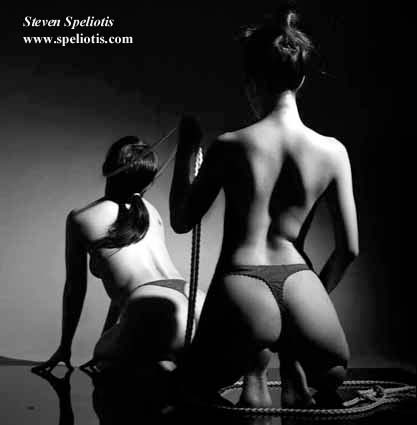
Steven Speliotis Asia Bondage
More one the sexual dom/sub relationship here and here.
There are many Bataille's. That was the interpretative point I wanted to make.
With that minor point out of the way I can turn to the significance for sovereignty of the experience of excess and terror of S&M and rape.
The Bataille I was probing in my earlier post was the Nietzschean concerned with moral discipline, taboo and its rupture. This Bataille, who operates in terms of the dialectic of taboo/prohibition and transgression, sees the similarity betweeen religious and erotic experience. Both of these modes of experience intimately connect, and interwine, desire and terror, intense pleasure and anxiety, loathing and rapture.
But God is dead as Nietzsche proclaimed. The basic categories of (Christian) religion have been moralized and its ethos secularized through the historical process of ethical rationalization. So the moral discipline of religion becomes a moral consciousness, which, in its conservative form, sees sexuality outside marriage as promiscuous and sinful and rails against the flesh. This is a punitive moral consciousness disconnected from the sacred.
That leaves sexuality, or the erotic, as the realm of the experience of excess through its risky experimental transgressions of what is taboo or prohibited. What would these transgressions be today. Porn? Or the S & M practices of today?
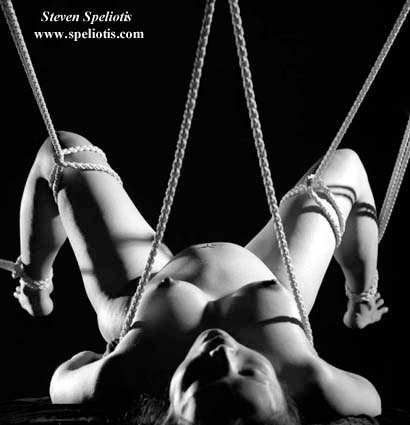
Steven Speliotis Asia Bondage
Can this bondage be considered an excess that transgresses moral limits?
Does this transgression of what is taboo lead to the frenzy of desire, rapture and ecstatic self-transcendence?
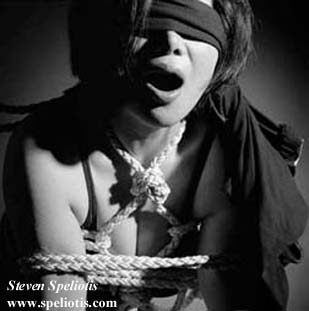
Is this outpouring, which leaves the body spent from excess, a pathway to sovereignty?
Or is this S & M transgression too domesticated? Do we have to keep pushing the limits to achieve excess? Is it about the ego evaporating with pain?
Is it here that we find Bataille the moral critic. This is not someone who wants to liberate life from that which crushes it. Bataille was no sexual libertarian of the 1970s variety, since he accepted limits. He explored a world exposed by the experience of limits; limits that we make and unmake by the excess that transgresses them.
Bataille the Nietzschean moral critic is someone who sees the sovereign waste in the erotic and religious forms of excess. He sees this expenditure surplus sexual energy as life-enhancing and exalting, and so contrasted with the squandering of the surplus energy and wealth in the distorted forms of the sacrifices of imperialistic wars, ecological pollution and nuclear destruction. The former is the pathway to sovereignty.
Do we have a language of sexual transgression?
November 23, 2003
Bataille and Poetry
Gary, I haven't been quiet for a week because I've lost interest. It's just that I've been buried under a mountain of marking and I've only just dug my way out. Amid the masses of mediocrity there was some real rubbish and one or two gems. Two of the honours essays were of particular interest to our conversation because they dealt with Bataille. One compared Bataille with Ficino, a neo-Platonic Christian mystic from the Renaissance. The other essay was on Bataille's poetics, if that's an adequate way of describing it (I don't think it is).
To deal with sovereignty Bataille needed to get away from utilitarian reason, which pretty much excluded philosophy from his endeavour. One can do a philosophical reconstruction if one wants but the outcome will be something other than Bataille. Bataille often wrote as if he was presenting a system but the system is a fake aimed at giving readers a sense of familiarity while he attempted to drag them into the abyss without their knowledge. He aims to demonstrate how to obtain the abyss, not enlightenment.
Poetry provided his path. Indeed, the universe is composed of poetry, a poetry that can only be reached through non-poetry and unreason. Sovereignty equals the self beyond itself. It is ecstasy, the fusion of the subject and the object. Poetry is the only method of attaining sovereignty, which requires the negation of poetry. Poetry must be negated through poetry, which presents an imitation of the abyss. Strictly speaking, evocation is not enough to attain sovereignty, which also requires experience, and moreover the co-operation of evocation and experience in their mutual dissolution.
Does this make any sense? I guess Bataille would say that it shouldn't. It can't be reducible to reason because reason leads away from sovereignty.
The writer analysed a couple of poems by Bataille, such as:
I leaning on the trunk
I feel
my desire to vomit desire
o collapse
ecstasy from which I fall
asleep
when I cry out
you who are and will be
when I will be no more
deaf X
giant mallet
crushing my head
(from Marie-Christine Lala, "The Hatred Of Poetry In Georges Bataille's Writing'. Bailey, C (ed) Bataille: Writing The Sacred. London: Routledge, 1995.)
According to the analysis in the essay, the first lines deal with the subject's yearning for the object, followed by an expression of their relation, which is also the relation between poetry and non-poetry. It is a poem of desire for the object, 'you who are and will be when I will be no more'
I don't know Lala's article and I can't find the poem in the Spitzer book of the Collected Poems Of Georges Bataille.
November 22, 2003
the erotic and the sacred
What is forbidden is enticing. Porn is a classic example.
Hence we have the profound intimacy beween the moral law and the taboo on certain sexual practices and their transgression.
That dialectical relationship seems to be what Bataille is saying.
And yet he says something more than this. He seems to be also saying that in our secular world the transgression of what is prohibited opens up a door to the sacred.
How?
I'm not really sure.
I suspect it has something to do with those intensities of lived experience, which are beyond knowledge and outside communication?
An intensity such as the ecstasy of terror and horror?
What would that be?
Would it be the horror and terror of the lived experience of being raped, as described in Dirty Whore Diary? (you need to scroll down to October 4th as it is Blogger).
Or is that horrific experience that is beyond language, even poetic language?
November 21, 2003
the sacred
I have been thinking about the sacred and the mystical in Bataille and the connections he makes to sexuality and the erotic. Why the sacred? Is this his pathway into the moral concerns that I noted in an earlier post.
Since I am susceptible to economic explanations of the dynamics of social life, I am wary of Bataille's emphasis on the sacred. So I decided to explore this new terrain--Bataille the anthropologist----a bit. Trevor can pick it up and develop various pathways through this territory, if he so desires.
From what I can make out Bataille's entry into the sacred is through Nietzsche's idea of human beings being shaped by ethical regulation, constraints and codes as a way of making sense of the raw terrifying chaos of life. For Bataille this moral regulation takes the form of the prohibition of murder, burial rites, incest taboo etc. What is prohibited is the excess of violence associated with death and sexuality; so this excess is tamed by festivals and religious sacrifices. These are the normative or ethical foundations of social life.
Why do these norms, prohibitions and codes have such obligatory force? According to Bataille these norms etc are not derived from preserving the system of labour in the market economy, as economists sometimes suggest. Rather, these norms owe their binding force----they say what is forbidden--- to the authority of the sacred, which is connected to, and constrains, the irruptive forces of terror and desire.
November 19, 2003
Bukowski: Poem#4
Be Kind
we are always asked
to understand the other person's
viewpoint
no matter how
out-dated
foolish or
obnoxious.
one is asked
to view
their total error
their life-waste
with
kindliness,
especially if they are
aged.
but age is the total of
our doing.
they have aged
badly
because they have
lived
out of focus,
they have refused to
see.
not their fault?
whose fault?
mine?
I am asked to hide
my viewpoint
from them
for fear of their
fear.
age is no crime
but the shame
of a deliberately
wasted
life
among so many
deliberately
wasted
lives
is.
Charles Bukowski
November 18, 2003
Deleuze on 'conversation'
It is very hot in Adelaide tonight. There is little wind to cool things down. I am in despair and yearn for the crashing thunderstorms and the cooling rain. All I have is the flow of the warm north wind through the shutters on my windows I am too tired to deal with the heat of my blood rage.
I'm finding it very hard to concentrate working through Bataille's 'Preface' in his On Nietzsche.
What I am able to discern through the debilitating heat is that Bataille sees Nietzsche's texts as his companions. Nietzsche speaks to him as he uses the word 'we'. He understands himself as engaged in a conversation with Nietzsche's texts.
I come across this passage from the Preface which indicates how Bataille understands this 'conversing.'
"I want to be very clear about this: not a word of Nietzsche's work can be understood without experiencing that dazzling dissolution into totality, without living it out. Beyond that this philosophy is just a maze of contradictions."
I have no idea what Bataille means by totality at this stage. So let me come back to 'conversation'.
Gilles Deleuze in Dialogues 11 says that conversation is a rupture from the traditional idea of philosophy inventing problem positions, finding solutions, responding to objections and getting out of the difficulties. Conversations, in contrast, are about becomings and these are about "orientations, directions, entries and exits." Conversations are an outline of a becoming.
Deleuze connects this with new and good ways of reading and writing. He says:
"....the good ways of reading today would succeed in treating a book as you would treat a record you listen to, a film or a TV programme you watch;any treatment of the book which claims for it a special respect---an attention of another kind----comes from another era and definitely condemns the book."
It is just a note.
November 17, 2003
Bataille: On Nietzsche#1: poetic thinking
I've just started reading Bataille's On Nietzsche. Suprisingly, given the reputation of his immoralism, the text is about morality, moral concerns and value---as seen through the eyes of Nietzsche of course. On first appearances it a chaotic, fragmentary book. It is all over the place and it is difficult to know what is going on. The style of On Nietzsche looks as if it were some kind of surrealist journal.
Digging deeper into the Preface I can see that the text has its own rhythms, figures and thought-paths. Bataille understands Nietzsche to be writing with his blood and he is concerned to experience Nietzsche. By this Bataille "means pouring out one's lifeblood." Bataille understands that phrase to mean "being ablaze with ardour."
It's an example of what Heidegger in his essay, "What are Poets For?, called poetic thinking in a destitute time after the completion of Western metaphysics by Nietzsche. It is a thinking that has "poetically experienced and endured the unconcealedness of beings which was shaped by that completion." This is relevant to Bataille, even though he is not a poet like Rilke, because Heidegger says that:
"To be a poet in a destitute time means: to attend, signing, to the trace of the fugitive gods. This is why the poet in the time of the world's night utters the holy."
Heidegger then goes on to say that:
"The time is destitute because it lacks the unconcealedness of the nature of pain, death and love. Thsi destitutiin is is itself destitute because that realm of being withdraws within which pain, death and love belong together."
What then is the concern of Bataille's poetic thinking? He says that:
"The basic problem tackled in this chaotic book (chaotic because it has to be) is the same one Nietzsche experienced and attempted to resolve in his work---the problem of the whole human being."
This refers to the Bk 4 of Nietzsche's The Will to Power This is about discipline and breeding of human beings. Nietzsche presupposes that a high culture created by exception human beings stands on a broad base, upon a a stong and healthy mediocrity.(para 864) His concern is how to enhance the strong aristocratic individual or overman.
Bataille's specific link is to para 881:
Order of rank: "....Most men represent pieces and fragments of man: one has to add them up for a complete man to appear. Whole ages, whole peoples are in this sense somewhat fragmentary; it is perhaps part of the economy of human evolution that man should evolve piece by piece. But that should not make one forget for moment that the real issue is the production of the synthetic man; that lower men, the tremendous majority, are merely preludes and rehearsals out of whose medley the whole man appears here and there, the milestone man who indicates how far humanity has advanced so far."
Bataille sidesteps Nietzsche's concerns about rank, breeding and social order. He says that life is whole when it isn't subordinated to a specific object that exceeds it. He identifes this with freedom. It is the positive practice of freedom, not the negative struggle against a particular oppression that lifts us human beings above the mutilated existence of a damaged life.
November 15, 2003
Bukowski and Nietzsche
Gary, you are setting such a cracking pace that I don’t think I’ll ever catch up, so excuse me if you add things to the conversation that never receive a reply from me.
I think it’s really good that you’ve so far added three Bukowski poems to the conversation. At least one of them seems to have become meaningful to you because of your own vicissitudes. That’s good too. It shows the power of Bukowski’s poetry even for someone who doesn’t connect with poetry. You’re living proof of what I’ve been arguing.
Some time back you suggested that Bukowski’s bar talk has poetic qualities and you introduced the poem ‘Cause And Effect’ in so doing. Once again, I was overjoyed. ‘Cause And Effect’ was also one of my favourite poems as I began to read Bukowski. I learnt it by heart I loved it so much. I think it’s a masterpiece: bar language, critical philosophy, and a powerful truth about life all in one – and in thirty words.
I’ll paste it again so any new readers can see immediately what we’re talking about:
the best often die by their own hand
just to get away,
and those left behind
can never quite understand
why anybody
would ever want to
get away
from
them
The poem uses the traditional rhyming device to create its rhythm – hand and understand. Also, the length of the lines gives emphasis not only to certain words but also the ideas underlying them.
One book of poems that particularly impresses me is What Matters Most Is How Well You Walk Through The Fire. It seems to me to combine verse with autobiography more powerfully than others I’ve looked at, and I’d love to know whether he put it together or whether somebody else did it. Many of Bukowski’s books of poems were assembled by others – he used to write them and throw them into a cupboard. Editors came and pillaged the cupboard. If we happen to attract say an American reader out there somewhere who knows the answer to my question I’d love to hear from you. Who put the Fire book together?
A couple of nights ago Wayne and I spoke to the Goethe Society about Nietzsche. Given that good old Nietzsche is the guy whose ideas set this conversation rolling, I thought I might briefly report on what we said.
The talk was called ‘Fascist and Anti-fascist appropriations of Nietzsche’. Wayne began by saying that perhaps a better name for the talk would be ‘what is living and what is dead in Nietzsche’. I then briefly recounted Salome’s tripartite division of the intellectual life, setting the scene for what I would say later, before Wayne talked about several fascists and how they made use of Nietzsche.
There are lots of anti-fascist appropriations. In a sense the whole of the twentieth century has been influenced by Nietzsche, but what I talked about was Klossowski’s book, Nietzsche And The Vicious Circle.
The theme of the text and the key to much of Klossowski’s writing is the opposition between culture (identity & reality) and the tonality of the soul. I discussed Klossowski’s idea of the soul, that impenetrable depth that is trans-subjective in that it continues as long as one human being continues to exist. In its individual form, the soul is characterised by its tonality and its phantasms. The soul is an intensity without intention and its tonality and moods are its particular configurations – he’s a bubbly guy, he’s sombre, she’s thoughtful, she nocturnal. Tonalities are not determined by the environment. Phantasms, instinctual compulsions, are dependent on lived experience, although they remain intensities rather than intentions. Simulacra are simulations of the phantasms, their expression. The only thing we can know are the simulacra but we cannot know the phantasms that produce them. In a strict sense, simulacra are intersubjectively meaningless. They take on meaning when they become detached from their phantasms and become part of the code of everyday signs. They may even become stereotypes, taking on a symbolic function. Culture, which is the intention to teach and learn (the idea goes back to Kant) is built out of the code of everyday signs and its stereotypes. Intensities, on the other hand, cannot be taught or learnt.
As Ansell Pearson points out, Nietzsche’s thought-experiments are simulations of a ‘conspiracy’, that of an isolated individual ‘who uses the means of his class not only against his own class, but also against the existing forms of the human species as a whole’. Nietzsche challenges both the identity principle (the authority of language, of the code, of the institution) and the reality principle (consciousness, the subject, the ego, substance). In the face of this double challenge, there is only the ‘tonality of the soul’. Demonstration is supplanted. Thought and life become ‘mute’. The limits of the principles of identity and reality are reached. The Sils-Maria experience in August 1881 ‘6000 feet beyond man and time’, which provides access to the tonality of the soul and the intensities of lived experience that are beyond knowledge and outside communication.
Nietzsche’s project becomes one of evaluating language, intentions, and willing ‘in a different manner than … hitherto evaluated … namely, as subject to the “law” of the vicious Circle’. The law of this circle has a specific non-sense to it, which is to do with the liquidation of meaning and goal. This is how Klossowski brings together the thought-experiments of the later Nietzsche:
The ‘overman’ becomes the name of the subject of the will to power, both the meaning and the goal of the Eternal Return. The will to power is only a humanized term for the soul of the Vicious Circle, whereas the latter is a pure intensity without intention… the Vicious Circle … is presented as a chain of existences that forms the individuality of the doctrine’s adherent, who knows that he has pre-existed otherwise than he now exists, and that he will yet exist differently, from ‘one eternity to another’.
Pearson notes that ‘this articulation of the doctrine reveals the enormous influence of Bataille’.
Pearson discussed how one fortuitous soul is dissolved in order to give way to another equally fortuitous soul. The experience of return is one of intensity… which ‘emits of a series of infinite vibrations of being’. The promise of this new teaching is the promise of a new creature coming into being, one that has gone beyond the established gregarious conditions of life and which no longer lives according to the ‘durable fixity of species’… ‘The day human beings learn how to behave as phenomena devoid of intention … on that day, a new creature [will] declare the integrity of existence’.
Klossowski sets up a kind of a priori antagonism between intensity and institution as an irreconciliability between ‘becoming’ and ‘knowledge’, within which eternal return is bound up with the ecstatic experience of intensity that escapes any attempt to fix and determine its meaning or significance.
‘For Klossowski, Nietzsche is not someone who thinks beyond the human condition but an exploding machine who dissolves this condition and who feels the dissolution of all identity and reality, and so is, in some quasi-mystical sense, beyond truth and knowledge, beyond metaphysics and science.’
‘The disjunction between life and knowledge condemns Nietzsche to isolation and solitude as his irrevocable destiny, playing the role of a simulator of thought, the supreme conspirator-actor in Klossowski’s stage production of the filthy lessons of philosophy, one who teaches the unteachable, thinks the unthinkable and who attempts to unthink thought and then falls, unsurprisingly, into complete … muteness and madness.’
Trevor's Story
This is Trevor's story. It is the one he mentioned was rejected by Overland in the previous post.
The Same Old Story by T.H. Maddock
Did I tell you? I gave a talk on Adorno for the in-the-pub show. They were all there, the old faces: the man in charge, Rollo, Vicki, the Padre, et cetera, et cetera, even Stravinsky. Dee was overseas. I asked Jürgen but he didn’t show up.
And one of the bastards had a go at me – I can’t remember which one now, maybe it was the man in charge, or was it Rollo? Let me see… Anyway, it doesn’t matter.
The thing is, they got me on the hop. I hadn’t really boned up. Instead I relied on my cultural capital to get me through. You know an academic is bludging when he’s relying on his cultural capital. I was bludging.
‘I don’t know. I don’t know.’
He repeats himself for effect. He’s playing to the audience. It’s straight out of the academics’ song-and-dance book, gesture for gesture, ploy for ploy.
‘I’ve read shitloads of Hegel and this stuff just doesn’t seem right to me.’
He’s got me off guard. I hadn’t expected anything of this kind. What did I expect? Who knows? I know I didn’t expect that angle and I wasn’t prepared.
On the hop I say, ‘I’m talking about Adorno. I don’t care whether he’s got Hegel right or not.’
But already I’ve lost the game. Everybody was hearing that Adorno wasn’t very good. Shit, he got Hegel wrong! Who cares what he thinks? QED.
He’s got the cheek to follow this up with a diatribe on Hegel. And listen to the shit, will you?
‘Hegel knew the value of institutions. We owe it to institutions for the way we live.’
Some people owe more than others, I thought, but I didn’t say anything.
He was trotting out The Philosophy Of Right, I thought, Hegel’s most died-in-the-wool conservative reactionary book. (You might look at the preface one day, all the same. It contains one of his most famous sayings. I can’t remember which one, but have a look sometime.)
‘Because of what the state does for us we’ve got a moral obligation to support it.’
Still I didn’t say anything. I thought it through and next day I knew all the answers, but by then it was too late.
I knew that what I was hearing was just Hobbes and reaction. Thirty years had taught me that much. This was nothing like the Hegel I knew, the one who said that once we were at one with the world and somehow we lost this identity, and as soon as we lost it we put all our attention into getting it back again. It’s the usual liberal wank, I know, except that Hegel said it better than anybody else. That’s the difference.
And what he said – that we return to this oneness through frustration – I like that. Every time we try to put one of our ideas into action, my Hegel said, it only ever makes matters worse.
But here’s the rub: Hegel thought that the process of making things worse would go on until it reached the point where it made everything right. It’s a hard one to follow, I know. And Adorno? Well, he knew that was a load of crap.
As we walked away at the end of the night Stravinsky said, ‘He’s just a reactionary conservative.’
He could have been talking about Hegel but he wasn’t. He was talking about the man in charge – or whoever it was who made the speech.
Changing the subject I said, ‘The Padre was acting funny. During the break he just sat there smirking at me. Didn’t say a word, like.’
‘Don’t forget,’ said Stravinsky. ‘He’s become a Buddhist.’
That’s right. I forgot to tell you. The Padre has given up on Christianity and he’s headed east, well, north if you’re in Australia, but you know what I mean when I say ‘east’, don’t you? In fact, the Padre wasn’t just heading east metaphorically. He was heading to the Indian high country for real – and that is high country! – going there to study with some American guru who’s set up base in the hills, the modern conveniences and an escape from the grind rolled into one contradictory package, all booked on the Web or through Wally-World Travel, for those who still like to see other faces when they do business. There’s one for Hegel, that’s for sure!
‘Yeh, but there was something funny about him, his manner – I don’t know.’
‘Yes, well. Hasn’t anyone told you?’
Stravinsky stopped walking and looked at me.
‘The thing is, he’s not going alone.’
Somehow I knew Stravinsky wasn’t talking about the Padre taking his missus along.
‘Fuck me! The Padre!’
‘He’s always been a pants man. Haven’t you noticed? What the fuck do you look at when you go out? I mean!’
‘But the Padre! THE PADRE!’
‘Yeh, he’s bonking some Buddhist shiela he met while he was on retreat in that old place on the main road going into Embee, you know, the road from the freeway. Haunted house type place. You know! Yeh, the Padre went on some retreat there but spent his time finding a place to keep his pecker warm. I think it came back with scorch-marks on it. He told his missus that he caught it in his zipper and that unfortunately he won’t be able to bonk for a few days.’
‘From what I hear, she wouldn’t mind,’ I added.
Stravinsky always likes to have one over on me.
After a moment he added, ‘It’s the talk of the town. I thought everybody knew.’
‘Well nobody told me.’
That’s the trouble with being a hermit. Of course, there is the phone and the internet. We can keep in touch. We need never see each-other again. But just because you don’t see me it doesn’t mean we can’t keep in touch.
‘Nobody told me,’ I repeated.
‘The thing is, it’s all over the place because his missus is spreading the story.’
I must have looked incredulous because he added, ‘I kid you not. His missus! What do you think’s going on there?’
‘Shit. I don’t know. I guess she’s had enough. If he’s a swordsman, like you say. I mean, what does she think about it all anyway?’
‘She’s put up with it for years. And now she’s telling everybody the whole story. No wonder he’s heading for the Himalayas. He has to get out of town. You gotta laugh.’
Stravinsky laughed.
So, the Padre was making a run for it. It was all out in the open. He wanted more than just a sore dick on weekends. He wanted a sore dick all the time.
Stravinsky seemed to be reading my thoughts. He said, ‘He’ll get tired of it in a few days. At our age you can’t keep any pace up for long.’
I wasn’t about to get into any conversation of that kind with Stravinsky.
I said, ‘You’re right! He ought’a watch out. He’s in his fifties, like us. He’s getting on.’
‘She’s fifty-six!’ Stravinsky came back at me.
‘Still, what was the name of that politician? He died in a brothel. He was only fifty-something.’
This line was a dead-end.
‘His missus is spreading the story,’ Stravinsky repeated.
‘She obviously doesn’t like it. I mean, fuck!’
‘No. She doesn’t like it.’
‘But she stays?’
‘Yeh, she stays. You know the story.’
We were silent for awhile then he began to sing, quietly, almost to himself, ‘I still get the same old fee-ling, pulling-at-this-heart-a mine.’
‘Picketywitch, er?’
I thought for a moment.
‘Some time in the seventies?’
‘You got it,’ he replied.
He stopped singing.
He mentioned some date but I didn’t take it in.
There was silence.
My mind was ticking over.
I said, ‘There’s one thing I don’t get.’
‘What’s that?’ he asked.
‘Well, who was it that told you he came home with a sore pecker after his retreat? Was it his missus? Or did he tell you?’
‘Ah!’ said Stravinsky. ‘Now that’s another story.’
November 14, 2003
A bit of a winge
Gary, your last entry didn't sound too good. I know the feeling. That's life.
I haven't got anything to add to the discussion as it was before I went away for a few days but when I got back there was the familiar rejection from a publisher waiting for me, so I thought I'd indulge myself and share it with you.
As you can see from the conversation so far, I'm much involved with Bukowski, as well as Céline, Adorno, Bataille, Nietzsche, et cetera, and as well as theorising about it I've been working on some creative writing that reflects these motivations. Four months ago I decided to send off the attached piece to the Melbourne-based literary journal Overland. I chose Overland because it advertised itself as being interested in publishing working class writing and in publishing material that could not get published elsewhere. They sounded like they were what I was after so I gave them a go.
Four months later I got the following rejection:
"Dear Trevor, Our reader found this interesting - the dialogue well paced and the characters recognisable - but they felt that it didn't go anywhere, in the end they wanted more. I hope this helps. Thanks."
There's some unreadable squiggle where the name should go. The editors are Katherine and Nathan but the squiggle doesn't look like either of those names.
The first thing I'd say about this was that I didn't think wanting more was a bad thing in writing. As I writer what I don't want is for readers to think they've had enough. But I'm being unfair. I think what the reader meant that (s)he wanted more in terms of a story than my piece provided. That's true. It doesn't provide a neat little story with a beginning, an end, and a message. That's precisely the nineteenth century bourgeois crap that I'm trying to break with.
I'm trying to write from a working class perspective about working class life, real working class life, not some romanticised twaddle as thought up by a bunch of pinko labourite left intellectuals who went to private schools and the sandstone universities. I'm writing from experience. I was a baker, my father a bus conductor. Sure I went and got myself an education and now I'm an egg-head, but that's where I came from I know the sort of things that fill working class lives---so did Céline; so did Bukowski. Working life isn't made up of neat little stories with a moral. It's bland and flat, made up of petty jealousies and little meaningless intrigues. The whole thing turns into a story, a biography but the bits and pieces, well, that's not what they're like. I'm just trying to give voice to it how it really is, instead of writing bullshit about kiddies rebelling and shooting smack, or unionists struggling with bosses and crims pushing drugs and making it big. Hey Kath and Nathan, that's just the usual literary crap. That's not working class writing. That's just the stuff that everybody wants to publish.
Have a look at my piece, anyway. Make up your own mind. What my piece is about is that our lives are full of doing the usual things in the usual way, even when they seem like unique events and that we really feel like we're doing something authentic, if I can use that word without sounding too pretentious.
There's nothing so novel about my piece really. It's not so different to the slice-of-life stories such as Katherine Mansfield was writing a hundred years ago, like her story 'At The Bay'. Nothing happens -- that's the whole point.
I was disappointed at my rejection but not really surprised. As the months ticked by it became obvious. If I really want to take some solace, it's the sort of thing that happened to Bukowski, it's the sort of thing that happened to Proust. I'm not saying I'm in the same league as these guys. I'm just saying that I'm copping the same kind of shit from the same kind of people. 's the same old story.
I think I got knocked back because I wasn't part of the club. I'm some guy from out there somewhere who no one knows and to whom no one owes anything, so I have to do it hard. On the other hand, if I was in the club I wouldn't have to jump through so many hoops, I wouldn't get kept on a string for months and then get rejected with a scant, rough little ungrammatical sentence. But this is the essence of academia. It's the same old story. Perhaps they didn't like my story because its about them. Everybody finds that their own shit stinks---that's why they can't wait to flush it away.
Oh well, Karen Blixen wrote for God so I guess I can as well. I don'; think (s)he sends rejection slips.
November 13, 2003
Bataille links
When searching the net with google for the previous posts on sovereignty I came across bits and pieces. One way of coming at sovereignty is to contrast it to the way Carl Schmitt uses it. Schmitt's conception of sovereignty is still grounded in the fiction of a secularized God in the form of a state interposed between the ruler and popular sovereignty. In contrast, Bataille located sovereignty in the heterogeneous forces of a Dionysian, acephalic, "unavow-able" community of living individuals involved in the sacred ritual of dismembering the supreme being.
Now for the bits and pieces.
An international conference on Bataille in Canada in 2000 entitled 'Georges Bataille: Community, Transgression and Excess.' Alas no papers online.
Here are some online texts on Bataille that I found interesting and useful:
Welch Everman
Russell Porter
Richmond Review
Jason deBoer
David LR Kosalka
Reviews
Andrew Wernick
November 12, 2003
Bukowski: poems#3
I'm too tired to work through Bataille on sovereignty tonight. I feel lost in the city; alone, wondering about past romances, and thinking about what might have been. Or what could be in a life stripped of most connections.
Tis time for a poem is it not? Who better than Bukowski?
Arms
out of the arms of one love
and into the arms of another
I have been saved from dying on the cross
by a lady who smokes pot
writes songs and stories
and is much kinder than the last,
much much kinder,
and the sex is just as good or better.
it isn't pleasant to be put on the cross and left there,
it is much more pleasant to forget a love which didn't
work
as all love
finally
doesn't work ...
it is much more pleasant to make love
along the shore in Del Mar
in room 42, and afterwards
sitting up in bed
drinking good wine, talking and touching
smoking
listening to the waves ...
I have died too many times
believing and waiting, waiting
in a room
staring at a cracked ceiling
waiting for the phone, a letter, a knock, a sound ...
going wild inside
while she danced with strangers in nightclubs ...
out of the arms of one love
and into the arms of another
it's not pleasant to die on the cross,
it is much more pleasant to hear your name whispered in
the dark.
Charles Bukowski
November 11, 2003
sovereignty & the economy
Bataille remains a shadowy figure in Anglo-American culture. His presence behind the poststructuralist current of postmodernism (ie., Foucault, Barthes, Derrida, Baudrillard) is barely discernible. Bataille's texts have been translated in the Anglophone world, but his ideas have yet to be received, let alone sorted through and made use of.
Bataille is still seen as a literary figure; an pornographer who is the heir of de Sade and Apollinaire. The literary Bataille is the author of Blue of Noon, Abbe C, Madame Edwarda, The Dead Man, and the Story of the Eye. I do not think that Bataille is taken at all seriously as a philosopher in Australia, even if it is acknowledged that philosophy can be purposely, or even willfully without system; or be anti-systematic and still be philosophy. Philosophically speaking, Bataille can be seen as the mediator between Kojeve's Hegel and the Nietzschean turn taken by French philosophy after the war, as with Foucault and Deleuze.
Whilst Trevor is away I would like to mull over Bataille's idea of sovereignty to further the reception of Bataille as a philosopher. As we have seen sovereignty, for Bataille, is the domain of non-utility and non-objectivity; it is the useless, it disdains use. It chooses the present rather than the future; the transgressive rather than the obedient. It's domain is excess, the realm of the accursed share.
In an earlier post I briefly connected sovereignty to the economy. I said that:
"...sovereignty for Bataille seems to be connected to wasteful expenditure, or more accurately self-sufficient activity performed for its own sake as historically displayed in the the luxury of the ruling classes. Sovereignty stands in oppostion to instrumental reason in the public sphere of politics and economics. As I understand it, the core of sovereignty consists of wasteful consumption."
It is in the first volume of The Accursed Share that Bataille contrasts his idea of sovereignty in relation to consumption and the general economy his idea of servility, production and restrictive economy.
Bataille’s restrictive economy is the contemporary marketplace as we know and live it. In it we are economically servile and a slave to the future. In it we are servile humans who labor in the economy for the sake of the future, to prepare for the future. We servile humans labor to earn money so we can buy goods and consume them. In effect, he is preparing for a temporary sovereignty in the future, as Bataille relates sovereignty to consumption. This restrictive economy is based on scarcity and necessity. Goods are scarce, otherwise we servile humans could just take what we need from an infinite supply. We servile humans need these goods for consumption, otherwise he would have no reason to labor for them. This is the world of classical political economy, which presupposes scarcity and necessity, and obliges us to labors for the future. In this restricted economy we will always be servile.
Now we do attempt to achieve sovereignty in the later consumption of our earnings from the marktplace, such as buying clothes, food and lesiure. But we are really only consuming to survive in order to labor more. So even in our consumption we are servile beings.
Things are quite different in the general economy, which is based on the idea of consumption, of luxurious expenditure. Here sovereignty comes by consuming without producing. The argument is spelt out well in this link I came across. It says that a general economy based on consumption
"....is based on the idea that systems, both natural and economic, have excess energy. This excess energy may be used for growth, but given limits of space--an environment cannot accommodate an infinitely growing system--growth must stop or at least slow down at some point. It is then that the question of how to use excess energy comes into play. In natural systems, excess energy can be given off as heat loss. But in human societies, the expenditure of excess energy is what defines a culture. In terms of individuals, it is those that do the expending that are sovereign. The sovereign individual consumes only, and is not concerned with scarcity, necessity, or utility. He has at his disposal the results of the servile man’s labor, he can consume what he wants, and he is not concerned with profit, for it is his job to waste. The sovereign is completely free of concerns about the future and lives only to consume in the present."
So sovereignty for Bataille is based on the dissipation of excess energy and it involves dedicating ourselves to the expenditure of energy. What he does is flip Marx and the economists on their head. He argues that the question of the economy is not always one of coping with scarcity; it is one of coping with excess or superabundance.
There is an anthropological aspect to this. In Volume 1 of The Accursed Share Bataille explored the crucial role of sacrificing or destroying the "excess" produced in any economy through a series of hsitorical examples. These include the Northwest Coast Indians' potlach; the sacrificial rites of the Maya; the territorial imperative of early Islam, and the massive monasticism of Tibetan Lamaism. Bataille locates the excess, the "accursed share" with the different mode of dispersal in this historical societies. of which these
otherwise widely varying cultures have had to cope. A society can do many things with its excess; it can throw it into refuse pits, it can expend it in endless war, or it can disperse it with a massive movement of non-production as in
Tibetan monasticism.
What of free market consumer capitalism? What is the mode of expenditure in our society? Capitalism re-invest excess in economic growth--that is, in the production of both greater means of production (and consequently a still larger excess).Activities that come under prohibition are those that are interfere with productivity, since in a capitalist economy all effort is to be turned to profit and accumulation, rather than to dissipation and expenditure.
Was the Cold War with the Soviet Union, and the massive expenditure on arms and technology by the US, a way of expending the excess?
Is sovereignty alive in a liberal capitalist society?
One of probing this is to return to Kojeve's reading of Hegel's account of
consciousness and desire in the Phenomenology of Spirit. Kojeve articulates an "end of history" on the grounds that consciousness need no longer be founded upon "slavish" labor, but upon a new possibility. What then is this new possibility? Bataille suggests that it lies in the realm of exchange, giving and receiving.
November 10, 2003
sovereignty again
In this post I will reach behind the recent material on the philosophy/literature relationship and reconnect with the earlier posts on sovereignty. I want to mull over sovereignty because what Bataille means by this concept appears to be so different to Nietzsche's free spirit conception of sovereignty.
For Nietzsche free spirits are the homeless ones who endure suffering, redeem us from the reigning ideals, overcome the great nausea and the will to nothingness in nihilism, and revalue our values. They are the ones who provide a counter to the ascetic ideal through affirming life. It is an ideal, the overman (Ubermensch ideal) whose affirming life involves affirming eternal recurrence reliving one's life eternally and experience joy at the prospect including the most horrible parts.
In para 382 of The Gay Science Nietzsche says that these new nameless ones do not exist. All we have are the premature births of an as yet unproven future; argonauts of the ideal who have suffered shipwreck and damage, who are dissatisfied with present day human beings, and whose eyes are turned towards an as yet undiscovered country whose boundaries nobody has surveyed.
In para 211 of the 'We Scholars' section in Beyond Good and Evil Nietzsche connects these free spirits to a certain kind of philosopher, ones he calls genuine philosophers:
"Actual philosophers, however, are commanders and law givers: they say `thus it shall be!', it is they who determine the Wherefore and Whither of mankind, and they possess for this task the preliminary work of all the philosophical labourers, of all those who have subdued the past; they reach for the future with creative hand, and everything that is or has been becomes for them a means, an instrument, a hammer. Their `knowing' is creating, their creating is a law giving, their will to truth is will to power. Are there such philosophers today? Have there been such philosophers? Must there not be such philosophers?"
These legislators and commanders are people of tomorrow, and the day after tomorow. They find themselves in contradiction to today. Hence they have a great task, which Nietzsche spells out in para 212, in the following way:
"By laying the knife vivisectionally to the bosom of the very virtues of the age they betrayed what was their own secret: to know a new greatness of man, a new untrodden path to his enlargement. Each time they revealed how much hypocrisy, indolence, letting oneself go and letting oneself fall, how much falsehood was concealed under the most honoured type of their contemporary morality, how much virtue was outlived; each time they said: `We have to go thither, out yonder, where you today are least at home.'"
This mode of being of philosophers as educators and shapers of humankind cannot be taught. In para 213 Nietzsche says that:
"What a philosopher is, is hard to learn, because it cannot be taught: one has to 'know' it from experience; or one ought to be sufficiently proud not to know it....Thus, for example, that genuinely philosophical combination of a bold exuberant spirituality which runs presto and a dialectical severity and necessity which never takes a false step is to most thinkers and scholars unknown from experience and consequently, if someone should speak of it in their presence, incredible."
Nietzsche reckons that artists have more sensitive noses in these matters, since
"...they know only too well that it is precisely when they cease to act 'voluntarily' and do everything of necessity that their feeling of freedom, subtlety, fullness of power, creative placing, disposing, shaping reaches its height."
That is a sketch of the Nietzschean background to sovereignty. It is an ideal of a new class of nobility as masters who are capable of tying the knot that forces humankind on a newtrack in response to the nothingness of nihilism. They are powerful educators who mold the character of future generations.
What does Bataille do with the ideas associated with overman? As a creative writer he reshapes the material in terms of his ideas of restrictive and general economy. The world is separated into the servile and the sovereign.
In chapter one of volume 3 of The Accursed Share Bataille writes:
"...we may call sovereign the enjoyment of possibilities that utility doesn't justify (utility being that whose end is productive activity). Life beyond utility is the domain of sovereignty....What is sovereign in fact is to enjoy the present time without having to anything else in view but this present time."
Sovereignty is a savouring of the marvellous abandonment to objects of desire and crucially beyond any calculation of their utility. It is the opposite of servility which is to employ the present time for the sake of the future.
Could sovereignty be as simple as the brief moment of enjoying a glass of wine whilst watching the last rays of the sun play across the sand of the beach? A miraculous sensation of having the world at our disposal? It is a miraculous moment which delights us.
Bataille then connects this moment to knowledge and introduces his idea of 'unknowing.' He says:
"To know is always to strive, to work; is it a servile operation, indefinitely resumed, indefinitely repeated. Knowledge is never sovereign: to be sovereign it would have to occur in a moment. But the moment remains outside, short of, or beyond, all knowledge....Consciousness of the moment is not truly such, is not sovereign, except in unknowing. Only by cancelling, or at least neutralizing, every operation of knowledge within ourselves are we in the moment, without fleeing it. This is possible in the grip of strong emotion that shut off, interrupt, or override the flow of thought."
Unknowing? This seems to have surrealist connotations. But it is a surreal discourse that grows from an historical analysis of social structure or sociology and an account of lived social relations. This is very different to the carnival postmodern world of signs as mirrors (of a Baudrillard) that displaces material social relations, and it offers links for an engagement by social theoriests working within the tradition of the Frankfurt School.
The difference between servility and sovereignty does makes sense in relation to human sexuality. Bataille distinquishes between sexuality and eroticism. Sexuality is servile in that it is a means to an end; the goal of sexuality is reproduction. To have sex to procreate is to be servile to the future. Eroticism, on the other hand, is based entirely in the present. It is the expenditure of all available energy and passion with the only goal being pleasure or fulfillment of desire.
Sovereignty is thus linked to the loss of our own subjectivity as such. This loss of subjectivity is condition of life and the underlying force that drives eroticism, laughter, and writing itself.
November 09, 2003
sundering and dismembering
One of the taken for granted assumptions in our culture is the mutual shunning of our philosophical and literary cultures. Hence the body of Nietzsche's texts is sundered and dismembered because these texts are philosophical and poetic.
There is little point in approaching these texts asking: 'are they philosophy or are they literature'?
They are both and so something different.
November 08, 2003
a question
Trevor is away so I can play around a bit with the literature/philosophy relationship.
Could not literature be seen as providing the most telling response to some of philosophy's concerns?
I put this on the table to counter the common view that neither criticism as practiced in the literary institution nor philosophy can answer the other's concerns. Such a view was held by Paul de Man. That seems to me to be the standard view of the philosophy/literature relationship.
As a literary critic de Man highlights the literariness of philosophy and its roots in rhetoric. Philosophy he argues orginates in literature. Hence you can bring sophisticate techniques of of literary analysis to bear on philosophical writings. -This is the approach de Man takes to Nietzsche's texts in his Allegories of Reading: Figural Language in Rousseau, Nietzsche, Rilke and Proust.
Fine. Nietzeche's texts are very literary, especially Thus Spake Zarathustra Nietzsche was certainly poetic with a good eye for the one liner--eg., Chriatianity is the metaphysics of the hangman. But Nietzsche was also a philosopher engaged with, and contributing to, the philosophical tradition., eg.the apparent world is all we have. Paul de Man has nothing to say about that philosophical side of things.
We do not read Nietzsche the poet philosopher just because of his literariness.
November 07, 2003
Bukowski: poems#2
Trevor I agree with you about Bukowski's writing. It is like bar talk. But it is bar talk with poetics built in. So I have posted another piece of writing that you sent me.
Cause And Effect
the best often die by their own hand
just to get away,
and those left behind
can never quite understand
why anybody
would ever want to
get away
from
them
Charles Bukowski
November 06, 2003
More on Literature
Yesterday I said that Screams From The Balcony was a book of Bukowski’s poems. It’s not. It’s a book of letters. Never mind. I thought I ought to set the record straight.
Sartre wrote novels like Nausea in order to preach philosophy. Literature was a pedagogical tool for him. Musil, Broch, Gombrowicz, et al, saw literature as a way of going where philosophy couldn’t follow. Whether this is right or wrong, at least they didn’t reduce literature to an instrument, a tool for extraneous purposes. We might get social or philosophical insights from creative writing but we are frequently doing it a disservice if we try to determine some argument it is presenting.
I think that creative writing and mysticism have this in common: they both stand in the same relation to philosophy, they both aim to fill a lacuna. Moses de Leon, the purported writer of the Zohar should occupy a similar place in literary history to the one he occupies in the cabala. The Zohar did something different from all previous pseudepigraphic writings in the mystical tradition, something very modern: it revelled in fictional artifice and in the play of literary forms. Here creative writing and mysticism were inseparable.
In the first volume of his Diary, Gombrowicz included an essay called ‘Against Poets’. Perhaps you feel as he does. He writes of the still venerated ‘cult of Poetry and Poets’, ‘the only deity which we are not ashamed to worship with great pomp, deep bows, and inflated voice.’ He attacks them with the same anger that ‘all errors of style, all distortion, all flights from reality arouse in us… almost no one likes poems and … the world of verse is a fiction and a falsehood.’
This is pretty much true. Poetry in general is an acquired taste, like Wagner and caviar. Sports radio has taken to encouraging verses about football that are in the style of Banjo Paterson. They’re pretty simple rhyming verses. The television-watching masses can understand them. They give them a laugh while they’re waiting for the game to start. The anachronistic rhyming stuff seems to have a largely propagandist purpose. The Beats, on the other hand, well, their verses are for beatniks on smack and strong coffee. It goes with Miles Davis (or perhaps it should be free jazz – who knows?).
Bukowski is interesting because ordinary people who don’t like poetry don’t mind reading his verses. On the other hand, in his correspondence he talks of one publisher who didn’t like it as poetry for precisely this reason. To one publisher who wouldn’t publish his verses he wrote, ‘it has always been curious to me that my writing has been attacked for portraying others as I have seen them, but my writing has never been criticized when I ended up as the jacknape. This could be art, they say, he is calling himself a fucking fool. They like that, it takes the heat off of their frightened asses.’ To Jon Webb, one of his first publishers, he wrote, ‘It appears from many rejections that I do not write poetry at all. Or as a dear friend told me the other day: "You do not understand the true meaning of poetry. You are not lyrical. You do not sing! You write bar talk. The type of thing you write I can hear in a bar on any day."’ That’s the difference between Bukowski’s poetry and the stuff Gombrowicz is criticising – people will read the verses Bukowski writes.
Hegel thought that poetry was the highest form of art. After that thought became prosaic and philosophical. But that isn’t much use if it is only when dusk sets on a way of life that the Owl of Minerva takes to the wing. The nineteenth century abandoned Hegel’s idealism and turned prose into an art-form. The twentieth century is the century in which art became critical. With the novel cast in this critical light, twentieth century literature leapfrogged the nineteenth century in search of that realm touched by poetry, the realm of the hairy parts that are kept out of sight. The Marquis de Sade became the main inspiration. Twentieth century literature became poetic – what else do you call the profuse onomatopoeia of for instance Céline’s books? – but it became poetic in an unprecedented way. The connoisseurs continued to indulge themselves in the old poetic forms while the new poetry took on the voice of the lumpenproletariat. Goodbye metaphor, hallow bar talk. Go back to Bukowski’s poem, ‘History’, which was included a few entries ago and read it with all this in mind.
I’m going to be away until next Thursday and probably I won’t be able to make any contributions to the discussion, so keep the home fires burning. Meanwhile I’ll still be working away at the conversation.
poetics/philosophy/writing
Trevor I have taken this from my old philosophy.com weblog. It is a passage from Heidegger's essay, 'What are Poets For?' in Poetry, Language, Thought.
Heidegger's passage is this:
"What is deadly is not the much-discussed atomic bomb as this particular death-dealing machine. What has long been threatening man with death, and indeed with the death of his own nature, is the unconditioned character of mere willing in the sense of purposeful self-assertion in everything. What threatens man in his very nature is the willed view that man, by the peaceful release, transformation, storage, and channelling of the energies of physical nature, could render the human condition, man's being, tolerable for everybody and happy in all respects. But the peace of this peacefulness is merely the undisturbed continuing restlessness of the fury of self-assertion which is resolutely self-reliant. What threatens man in his very nature is the view that this imposition of production can be ventured into without any danger, as long as other interests besides----such as, perhaps the interests of faith------ retain their currency....What threatens man in his very nature is the view that technological production puts the world in order, while in fact this ordering is precisely what levels every order, every rank, down the uniformity of production, and thus from the outset destroys the realm from which any rank and recognition could possibly arise." M. Heidgger, Poetry, Language, Thought (pp. 116-7)
Basically, Heidegger is arguing that human willing, in the form of purposeful self-assertion, is what is dangerous. When coupled to the system of technology we are threatened with a single endless winter----darkness----or a destitute time. He then adds:
"But where there is danger, there grows also what saves us."
These lines, which are from the German poet Holderin, signpost the way from the abyss. That is what poets are for in a destitute time.
In the earlier post, which was written during the Iraqi war, I asked:
"Do we encounter such poets today when the talk of our politicians is about war? Does not the purposeful self-assertion coupled to the war machine threaten us with danger?"
I was wondering what the poets were doing. (I'd given up on the philosophers.)
The academic reception of these texts of Heidegger's on the poets is usually treated in terms of romantic poetry. Or Heidegger is treated as a philosopher who influenced French existentialism. They can be more properly seen as Heidegger mediating on Holderins' poems without engaging in literary criticism or aesthetics.
In the context of the discussion here about poetry, philosophy and experimental writing I would suggest that these late texts of Heidegger's are an example of a poetic philosophical writing. In these texts we have a mixing of the thinking poet and the poetic thinker and an increasing turn to the poetic quality of the language. They point to, and practice a new kind of poetic thinking that responds to the destitute time we live.
If you like, these texts are an example from the side of philosophy of the new kind of writing that you suggest Bukowski practices.
November 05, 2003
Philosophy and Literature
Gary, I'm not particularly interested in sticking to the disciplines myself. Among other things, I am interested in Bataille because of his contribution to the liberation of (particularly) written language. From the perspectives of the disciplines of philosophy and literature this is equally important. Bataille's own writings are, of course, pretty difficult to fit snugly into established disciplines.
Bataille isn't merely after a way of discussing the things that are excluded by philosophy. He also wants to go beyond literature---the stuff read in literature departments and also the gear you can only read out on the balcony, the parapet, the veranda. One of Bukowski's books of poems is called 'Screams From The Balcony'.
This makes his writing a little more like philosophy.
For example, in Madame Edwarda (ME) there is an attempt to abandon all literary style, and by this I guess I mean seductive style, writing that aims to get you in.
An honours student objected to various critics who have suggested that ME was the best novella of the twentieth century because the style was so bloody awful, he thought, so flat, so lacking in style. Bataille would have been pleased to have heard his work described thus. That was what he was after--- straight unadorned, and simple, description---the best way of getting to sovereignty.
The problem is the same for philosophy. Wittgenstein pointed out that some things cannot be said but can only be shown. The last pages of the Tractatus deal with this region. (e-text here).Where philosophy cannot go there is mysticism. [scroll down to the last line on the last page--Gary] For Bataille as for Wittgenstein. What should we call the area where literature cannot go? Bataille calls it 'sovereignty'.
November 04, 2003
language and writing
Trevor, I'm going to briefly connect poetics to philosophy in order to break down the old barriers between them that have been there since Plato. I want to open up a space that we can call experimental writing in order to blend the writing of philosophy and literature.
I'm going to be brief as it is Melbourne Cup day and Australia is in a carnivalesque mood.
Do not poets, novelists and philosophers in one way or another deal with language? Do they not, as writers, have a particular use of, or attitude towards language, that connects them and excludes others. Should we not then look at the way we use language?
Some remarks on junk for code provide a useful starting point. The relevant passage says:
"So a gap opens up between our photographic language, the structure of our lived experience and social reality in a nihilistic modernity. What becomes significant is the difference between sign and thing, the difference between language and reality and the difference between meaning and experience."
If we accept that this has happened (the example of the Melbourne Cup is explored here), then this means that we need to reject the dominant model of writing and reception today. This model of communication is one in which the writer (a self-present subject) transmits a particular message (of lived experience, emotion or idea) to a reader (another self-present subject) through a language that is neutral, transparent and natural.
That seems to me to be the model of language assumed by most analytic philosophers in their actual writing practice. They do even think in terms of the problem of style. They are in deep bondage to the scientific picture of textual production and interpretation structured around axiomatic deductive systems stated in mathematical terms. We get the voice of impersonal, disemboded reason with its dream for universality and neutrality. We end up with a philosophical formalism that is disconnected from life.
I recall Hegel's acid remarks against a schematizing formalism in the Preface to the Phenomenology of Spirit They are well worth reading. Hegel says
'The instrument for producing this monotonous formalism is no more difficult to handle than the palette of a painter, on which lie only two colours, [110] say red and green, the former for colouring the surface when we want a historical piece, the latter when we want a bit of landscape. It would be difficult to settle which is greater in all this, the agreeable ease with which everything in heaven and earth and under the earth is plastered with that botch of colour, or the conceit that prides itself on the excellence of its means for every conceivable purpose; the one lends support to the other. What results from the use of this method of sticking on to everything in heaven and earth, to every kind of shape and form, natural and spiritual, the pair of determinations from the general schema, and filing everything in this manner, is no less than an "account as clear as noonday" of the organized whole of the universe. It is, that is to say, a synoptic index, like a skeleton with tickets stuck all over it, or like the rows of boxes kept shut and labelled in a grocer's stall; and is as intelligible as either the one or the other. It has lost hold of the living nature of concrete fact; just as in the former case we have merely dry bones with flesh and blood all gone, and in the latter, there is shut away in those boxes something equally lifeless too.' (para 111)
We end up with a text marked by what Nietzsche called "a dance of the bloodless categories."
The mirror model of language also appears to be the concern of the Language poets in relation to the way it is presupposed by the voice poets.
Hence the need for experimental kind of writing.
Such as?
The above linked article by George Hartley offers this paragraph by William Carlos Williams from Kora in Hell:
"How smoothly the car runs. This must be the road. Queer how a road juts in. How the dark catches among those trees! How the light clings to the canal! Yes, there's one table taken, we'll not be alone. This place has possibilities. Will you bring her here? Perhaps---and when we meet on the stair, shall we speak, say it is some acquaintance---or pass silent? Well, a jest's a jest but how poor this tea is. Think of a life in this place, here in these hills by these truck farms. Whose life? Why there, back of you. if a woman laughs a little loudly one always thinks that way of her. But how she bedizens the country-side. Quite an old world glamour. if it were not for-but one cannot have everything. What poor tea it was. How cold it's grown. Cheering, a light is that way among the trees. That heavy laugh! How it will rattle these branches in six weeks' time." (Imaginations, 37)
Does this have its roots in the European avant garde of the Cubists, Dadaists Surrealists?
Does not this concern with style and the body of the text connect us back to Georges Bataille and Walter Benjamin? And to Nietzsche's style with its hyperbole, undeciderability of meaning, resistance to paraphrase etc? Does it not also connect us to Derrida and his concerns about philosophical writing qua writing?
November 03, 2003
the avant garde in Adelaide?
Trevor, I forget to mention that I went down to down to Dark Horsey bookshop at the Experimental Art Foundation (EAF) yesterday and spoke to Ken Bolton about the literature questions you introduced.
Why Ken? Well, I'd recoiled from an autonomous modernist poetics disconected from lived experience in everyday life. I'd found the turn to Literature by liberal humanist philosophers, such as Richard Rorty and Martha Nussbaum, too culturally conservative. I accepted their main points. Rorty says that the novel represents the world of appearances in opposition to a materialist science. Nussbaum says that the novel (eg., Dickens) deals with our emotional life and the ethical questions about human beings living flourishing lives.
Fine. I'd always accepted that literature is, and should be, oppositional to the new ascetic priests who wear the mask of utilitarian economics, and worship utility as a deity. Romanticism was alive and well and more than inward-looking subjectivity. Fair enough.
I was looking for connections to more radical material online that I could introduce into this conversation. A form of writing that breaks the old distinctions of poetry and prose, the old conventions of language and functions in terms of a critique of society. It would be a poetics that would challenge the glossy surface commodity language of the society of the spectacle. And, I guess, we should now add the increasingly militarized language of the national security state.
However, I'm not even a tourist in the literary institution these days and I do not know which avant garde sites to visit for a quick look and see.
I had heard of John Trantor's online Jacket, but I'd never got around to reading it. I had started to read Adorno's essay, 'On Lyric Poetry and Society', but I did not even know what the label 'lyric poetry' meant.
Hence my turn to Ken Bolton. Ken is the editor of Otis Rush and a poet. There is some writing from the back issues online
Ken recommended looking at Ron Silliman's Blog. One of his poems is here
Silliman's blog discloses a whole other world that I did not even know about. Ken also mentioned Charles Bernstein and Lyn Hejimian. So Ken has pointed me---us---to a pathway that leads to Language School of contemporary poetry/writing. Ken talked this "school" as a network that is largely independent of the defining process of academic criticism that operates in terms of what Hegel called the understanding. So we have the dead academic hand standing above the individual existence of what it is talking about, does not see it, and only labels it.
That was my signpost as sketched by Ken. The sketch implies that this network is concerned with the politics of the use of language.
November 02, 2003
Bukowski: poems#1
History
he came to the door one night wet thin beaten and
terrorized
a white cross-eyed tailless cat
I took him in and fed him and he stayed
grew to trust me until a friend drove up the driveway
and ran him over
I took what was left to a vet who said, ‘not much
chance...give him these pills...his backbone
is crushed, but is was crushed before and somehow
mended, if he lives he’ll never walk, look at
these x-rays, he’s been shot, look here, the pellets
are still there...also, he once had a tail, somebody
cut it off...’
I took the cat back, it was a hot summer, one of the
hottest in decades, I put him on the bathroom
floor, gave him water and pills, he wouldn’t eat, he
wouldn’t touch the water, I dipped my finger into it
and wet his mouth and I talked to him, I didn’t go any-
where, I put in a lot of bathroom time and talked to
him and gently touched him and he looked back at
me with those pale blue crossed eyes and as the days went
by he made his first move
dragging himself forward by his front legs
(the rear ones wouldn’t work)
he made it to the litter box
crawled over and in,
it was like the trumpet of possible victory
blowing in that bathroom and into the city, I
related to that cat – I’d had it bad, not that
bad but bad enough
one morning he got up, stood up, fell back down and
just looked at me.
‘you can make it,’ I said to him.
he kept trying, getting up falling down, finally
he walked a few steps, he was like a drunk, the
rear legs just didn’t want to do it and he fell again, rested,
then got up.
you know the rest: now he’s better than ever, cross-eyed
almost toothless, but the grace is back, and that look in
his eyes never left...
and now sometimes I’m interviewed, they want to hear about
life and literature and I get drunk and hold up my cross-eyed,
shot, run over de-tailed cat and I say, ‘look, look
at this!’
but they don’t understand, they say something like, ‘you
say you've been influenced by Céline?’
‘no,’ I hold the cat up, ‘by what happens, by
things like this, by this, by this!’
I shake the cat, hold him up in
the smoky and drunken light, he’s relaxed he knows...
it’s then that the interviews end
although I am proud sometimes when I see the pictures
later and there I am and there is the cat and we are photo-
graphed together.
he too knows it’s bullshit but that somehow it all helps.
Bukowski links and Bio
Photo
at a bit of a loss
Trevor, I'm at a bit of a loss here with your turn to literature, as I do not have much in the way of literary knowledge. Nor have I read the literary texts you mention. So I'm not sure how this literature theme of philosophical conversations is going to develop. Maybe some form of collaboration?
I never really connected to poetry. Somehow this literary form did not really speak to me. The novel did, for a while. Then I stopped reading novels in the 1980s. I got bored by the narrative. I feel alienated from the literary institution. Nor do have I much desire to return to the literary institution even though it has a big presence in our public culture. Though I do relate to the way that Heidegger read the German poets, expecially Holderin, I have not followed Richard Rorty's pathway of weaving the tapestries of life by reading more novels.
I am more interested writing that breaks down the old genres-- a sort of combination of aesthetics, philosophy, writing and images that I am exploring in junk for code within the context of our visual culture.
I do find Bataille very innovative in terms of the form of his writing. I find the writings in the various magazines he was involved in, such as Documents, Critical Dictionary, Da Costa, (now collected in the Encyclopedia Acephalica) very appealing.
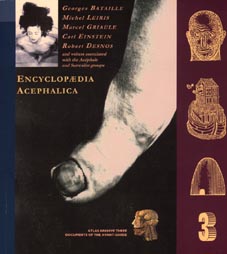
What initially attracts me is the way Bataille experimentally mixed up text and image within the context of French visual culture of the 1930s.
What also attracts me is the way Bataille brought together artists, authors, sociologists and ethnologists in a literary and philosophical project.
From what I can discover from this link here this is a photograph taken by Bataille:
 You do not hear much about Bataille as a visual artist.
The photo is very much in the style of Eugene Atget.
Atget walked the streets of the Paris with his 18 X 24 glass plate camera in a wheelbarrow documenting its buildings and people during the late 19th and early 20th century.
Atget built up a huge archive and the photos were then sold them to the Parsian artistic community.
Rue des Ursins
This photo of a store window indicates why Atget's work was picked up the surrealists:
 Atget was a deeply embedded in 19th-century French literature and he sought to recreate the Paris of the past. Hence his "photographing buildings and areas marked for demolition in the hope of preserving the ineffable imprint of time and usage on stone, iron, and vegetation. A series of tree and park images, made in the outlying sections to the south of Paris, suggest a compulsion to preserve natural environments from the destruction already visible in the industrialized northern districts of the city, and, in the same way, images of working individuals may have been made to record distinctive trades before the changes in social and economic relationships already taking place swept them away."
I do not know how Documents is related to André Breton’s surrealist journals given Breton's attack on Bataille. I interpret the 'strangeness' of this writing in the context of contemporary visual culture and the popular tabloid journals. I read them in terms of what some are doing with their image/writing weblogs.
It seems to me that the computer technology provides the weblog form to do this kind of cultural writing outside of academia, without the need to find a financial backer to defray the costs for a print journal of culture that would never make any money.
Bataille's On Nietzsche is relevant here. It appears to be a book on and about Nietzsche---say, in the style of current academic writing. But it is nothing like that at all. The text takes Nietzsche's conception of philosophy as way of life and then practices it. The writing consists of a series of short entries---up to half a page-- that are written on a regular basis. These fragments, aphorisms, journal entries and quotes don't really hold together. They are more reflections on daily life that are linked to passages in Nietzsche's texts--presumably the texts Bataille was reading during his wartime sojourn in the French countryside between 1941-1944.
It is what I was starting to do on my old a heap of junk for code weblog; but then stopped keeping Nietzsche company.
It is what the weblog allows you do today. But I know of no one currently using weblogs writing in this experimental Nietzschean style of Bataille. Perhaps the literary ones? (See Resources.) Perhaps the cyberpoets who take their inspiration from the futurists?
In the light of these remarks I will publish Bukowski's poems that you sent me as I read them, and also explore the world of poetics disclosed by Ron Silliman's blog.