October 31, 2003
Literary Interlude
This isn't the reply to your other two points as I promised, Gary. You'll remember that I bent the conversation towards Bataille with the intention of taking it in a literary direction. Since then it has seemed to swing back towards philosophy, which is okay, but I'd like to say a few things about literature and how Bataille fits into the picture for me.
Basically, I see the whole modernist project---i.e., twentieth century literature--- to break or go beyond both the novel form and the nineteenth century realist tradition in general. This advance occurred along two main paths: twentieth century realism (cubism) and surrealism (don't ask me to define these developments because I'm making this up as I go along). There are any number of antecedents, of course, but as far as I see it this literary project begins with Proust and concludes with Bukowski---not that Bukowski wrapped things up or anything like that, but rather that's where it had reached by the end of the century. In my view, Bukowski is our immediate antecedent as we look into the black abyss of the twenty-first century.
They keep giving Nobel Prizes to novelists but why should we respect a prize handed out by arms manufacturers in any case? It's all a part of them seeing to it that the world works in the way they want, and that's got nothing to do with literature. With one or two exceptions they seem to have missed the point in distributing the prizes, which are generally indistinguishable from Booker Prizes, i.e., something created to help sell books.
Why didn't Bataille win a Nobel Prize? Why didn't Karen Blixen? Or Carson McCullers? Or Céline? My God, how could he be left out? And why not Bukowski? Since Patrick White, with the exception of Canetti, who else among the winners has written anything even half as significant as Bukowski? Nobody.
Bukowski transformed the novel, the novella, the poem and journalism into something that, while not formless, is different from any of the previous forms. His poems abandon metaphor. Other than in terms of line structure, they are indistinguishable from aphorisms, observations, and pieces of short fiction. The larger texts are episodic and are composed of short pieces. Somehow, in the end, some of these aggregations look like books of poems while others seem like novels, if I can use the term loosely.
Bukowski's antecedents: Proust is there in the fictionalised autobiography, as is Céline. Indeed, in the case of all three writers, their oeuvres can be seen as one big work rather than a collection of independent texts. This says something about the twentieth century needs and the reality that required expression.
At this point fiction goes closest to Bataille's uncategorisable trilogy, Summa Atheologica, consisting of the texts Inner Experience, Guilty and On Nietzsche. As with Madame Edwarda, Bataille is attempting to abandon style in these books. After all, what is style but literary trickery, seduction?
In the end his books suffer the fate of most surrealist works---they don't reach a wide audience. Céline is undoubtedly the main figure of the century in dealing with this impasse. His books grab hold of you and don't let you go. As Benjamin noted, he adopted the language of the lumpenproletariat, which is essentially a non-metaphorical poetic language. Céline made a trademark of one of the most powerful but also under-utilised literary devices: onomatopoeia. With onomatopoeia words go beyond the language of reason and become absolutely evocative. They are more like what Walter Benjamin calls 'language as such' rather than the 'languages of man'
Enough of this---you are probably starting to get my picture. I'm interested in Bataille in terms of this kind of literary development. Don't get me wrong: the philosophical stuff is also interesting, but Bataille has something else to offer that goes beyond philosophy. Indeed that is the whole point of the exercise I'm trying to describe.
previous next
October 28, 2003
An Answer
Gary, sorry I haven't replied to your last three entries but last week was hell, with extra teaching at Adelaide that kept me on the hop. I'll try to reply to everything. I'll start with your last entry.
Yes, sovereignty is connected to wasteful expenditure but not in the way you desribe in your first paragraph. It is self-sufficient activity performed for its own sake but not as historically displayed in the luxury of the ruling classes. This luxury is a substitute for sovereignty, not an example of it. Luxury is compensation. 'The sovereign is a king no more,' wrote Bataille,'it dwells low-hiding in big cities. It knits itself up in silence, obscuring its sorrow. Crouching thick-wrapped, there it waits, lies waiting for the advent of him who shall strike a general terror; but meanwhile and even so its sorrow scornfully mocks at all that comes to pass, at all there is' (Bataille, Madame Edwarda: 147). The passage, which is really a prose-poem, begins, 'Anguish only is sovereign absolute.' Where is the anguish of the ruling classes as displayed in their luxury? You are right that sovereignty stands in opposition to instrumental reason but not just in the public sphere of politics and economics. It is in opposition to utility everywhere. Wasteful consumption, as far as it is practised in the public sphere and by the ruling classes, is compensation.
The ritual sacrifice of the Aztecs is compensation. It is like religion, it is like fireworks displays on New Years Eve and every other fucking performance they can think of having them at. Wherever this crap goes on it is a sign of a lack of sovereignty. Get A Ma Soeur out on video and watch it. It is a film about sovereignty. I'll put the essay Ivan and I have just written in the library.
What Bataille calls 'general economics' is in essence an history of compensation that identifies different epochs or social formations based on the way they waste. Perverted monsters like Gilles de Rais are also cases of compensation. Perhaps it could be called an history of seeking after sovereignty. Yes, you are right: art belongs within this schema. We do have religion, art and eroticism built into a mode of expenditure.
The bunch in charge in Australia love fireworks and grand games but you are right that we are largely ruled by productive economic activity, but they'd rather waste it than redistribute any surplus. What has happened to the sacred? you ask. It has become associated with paedophilia but perhaps we shouldn't be too surprised about that. It's about compensation, about seeking after sovereignty, isn't it? South Australia has people who like killing their acquaintances with chainsaws, who like cutting up young boy's bottoms, who get off on murdering hitchhikers, toddlers, et cetera. This isn't organised by the state, of course, although it is related to state activity. We're a pretty sick bunch here in Australia. No atrocity is out of the question.
Meanwhile the general economy is marked by its absence. Capitalism is close to complete rationalisation. For Bataille, socialism a la Stalin et al was its apotheosis, the complete elimination of childishness, reason completed---see the chapter on Kafka in Literature and Evil.
October 23, 2003
posing a question
Trevor, a question. It will help to ease my puzzlements about sovereignty.
You wrote in a previous post here that a key theme in Bataille is sovereignty. Sovereignty is one way to access Bataille's thought paths.
From what I have been able to make out sovereignty for Bataille seems to be connected to wasteful expenditure, or more accurately self-sufficient activity performed for its own sake as historically displayed in the luxury of the ruling classes. Sovereignty stands in oppostion to instrumental reason in the public sphere of politics and economics. As I understand it, the core of sovereignty consists of wasteful consumption.
Bataille gives a historical account of sovereignty: ritual sacrifice of the Aztecs; the sacral power of priests and the building of the pyramids in Egypt or the cathedrals in feudal Europe; the military power of the nobility; and the absolute power of the monarch and his court at Versailles. In this excess that disposes of surplus through different modes of expenditure we have something----what is sacrificed--- that is radically opposed to the the rational utilitarian vision of the capitalist economy.
Hence we have religion, art and eroticism built into a mode of expenditure. That is a powerful counterpoint. It is much more more than an ethical reason that is concerned with a flourishing lives.
What Bataille gives us is a general economy founded on the expenditure of excess, on the unproductive and ecstatic consumption of the surplus. I can see that this is a different economy to the restricted economy of capitalist utility that we know live in.
Here is my question.
Does contemporary Australian society have a general economy equivalent to building the pyramids? It seems to me that productive economic activity completely rules our lives in Australia. What has happened to the sacred? Eroticism is a part of the consumer economy. Where is the universality of spending as pure loss in Australia? Where is the general economy as distinct from the restricted economy that reinvests surplus in productive activity?
I pose these questions because I do not see that the great opposition between the sacred and the profane in consumer capitalism that continually creates new desires. Has not this opposition been eased?
What I do see in consumer capitalism are a lot of goodies in the department stores and supermarkets that are there to tempt us----organized to seduce us---to buy what we don't really need.
Around our holiday shack at Victor Harbor sit many many homes built on spec by builders. They sit empty waiting for buyers. The builders are taking a chance here and they could quite easily take a loss if the market turns down.
Is this a capitalism of abundance based on gamblers who make sacrifices?
October 19, 2003
a criticism
Let me try and put a political criticism on the table that I think will be directed against us for looking at, and exploring, Bataille's ideas. It sort of ties together a number of things I've been probing in my two posts on philosophy and politics.
The criticism is this. We accept that history is a tragedy in that a cold, instrumental and uninspired rationalism has conquered and disenchanted the world. Our conception of modernity (and Webers, Kojeve's, Bataille's, Heidegger's and Adorno's) is one in which there is the fateful triumph of an instrumental rationality.
The dominant form of instrumental rationality today is an enlightening economic reason that maximizes utility. This rules the world of public policy.
Kojeve's and Bataille's "picture" of modernity is that it gives birth to a dark romanticism that manifests itself in a profound nostalgia for what reason has banished-- myth, madness, disorder, spontaneity, instinct, passion, and virility. These ideas romanticize the gratuitous violence and irrationalism that characterize the postmodern world.
It is this criticism that is directed at postmodernism and poststructuralism. The critics see the roots of postmodernism (ie., what poststructuralism becomes when it is domesticated in an Anglo-American culture) in the Paris of 1930s.
I do not accept this criticism----given my reading of an ethical reason concerned with a flourishing human life that is a counter to an instrumental reason. It is far to broadbrushed and ignores the differences between a number of philosophers dumped into container marked irrationalists.
But how would Bataille respond to the criticism? He is susceptible to the criticism, given Contre-Attaque and Acephale.
October 18, 2003
between two political tendencies
From what I can gather by dipping into the aphoristic, fragmentary writings of Bataille, his conception of politics and political activity was deeply shaped by the events of 1930s. Crudely put, Bataille stands in the historical space between fascism and Stalinist communism, where he endeavours to create enough wriggle room to rethink the revolutionary moment.
He rejects fascism as part of the rescuing of Nietzsche's texts from their appropriation by the Fascists. He sees that once God is dead, then facism becomes almost inescapable. It shapes and directs the affective force of the powerful crowds and in doing so, it re-establishes a new political hierarchy.
What does Bataille as a surrealist do in response? As a part of the political and literary avant garde in the 1930s he helps to form an anti-fascist political group (Contre-Attaque) with Andre Breton. Bataille advocates force, agitation and violence in his essay, 'Popular Front in the Street.'
This politics/political activity was at a time Kojeve was giving his very influential lectures on Hegel's Phenomenology of Spirit that yoked together History, Desire and Death.
These themes are still with us today especially the end of history thesis in the work of Fukuyama.
Others are tracing the roots of postmodern politics back to the explosion of ideas arising from Kojeve's reading of Hegel.
The academic reading situates Bataille and his ideas into a pre-determined framework of “postmodern” thought currently in play within the academy to the intense dislike of the conservatives. The academic reading situates Bataille in this way either through the systematic embellishment of Bataille's role as an intellectual influence on Foucault, Derrida etc; or his role as an intermediary figure, and link, between Nietzsche and the French postmodernists.
From what I can make out Bataille is not considered in his own right. There is not much academic effort expended in exploring his ideas in the corporate university. They slided over his texts.
Why? Too embarrasing? Too radical? Too fragmentary?
The big philosophical idea in Kojeve's Hegel was negativity: it is what drove history along as it were. Bataille radically reworks the Marxist conception of negativity as class struggle into the destructive orgiastic drive or need that is expressed in expenditure. There are different modes of expenditure: potlach, gambling, ritual destruction, perverse sexuality. The true form of expenditure is a bloody revolution by the base classes at the bottom of society against the noble rulers.
Bataille needs lots of wriggle here because force, agitation and violence brings forth a very real danger: the embrace of the subversive violent tendency in a nihilist world at the end of history can easily turn to fascism. Hence the collapse of Contre-Attaque. It seems that he counters this with the formation of small secret society called Acephale, which invoked Nietzsche rather than Marx.
The avant garde becomes a marginalized group on the edge of French society, that is outside the mainstream of political life and is without a head. It appears that the sect (?) was concerned with a rebirth of social values that Bataille had been espousing in his texts on expenditure, risk, loss, sexuality and death. This revaluation was connected to the rebirth of myth and the explosion of primitive communal drives leading to sacrifice. It is the only way left to open up things after the failure of art, science and politics. It is myth that links into, or reconnects, with the orgiastic (Dionysian?) human drives. Hence we have the image of the subject without a head (sovereignty?) and the valourising of mystical experiences in relation to madness, war and death.
What continues to suprise me is that, in spite of the deep questioning that has been happening in Australian universities since the 1970s that has included the way we talk about philosophy, this kind of neo-Nietzscheanism has had little impact. Somewhow it falls into the holes between the reception of continental philosophy in the philosophy institution, the reception of French philosophy in the French studies disciplines and the postmodernism in the visual arts departments. This Australian avant garde (philosophical and artistic) has excised the 1930s from their memory, even though we now stand in the same space between fascism and communism.
Politically speaking, that space is liberalism and liberal democracy. In the 1930s that space between fascism and communism was shaped by the social democracy of the Popular Front. Today that space is shaped by a hegemonic neo-liberalism. So what Bataille means for us today is to think against the free market and its ethos of utility.
October 16, 2003
Literary style
Yes, I agree that Nietzsche is as important in terms of literary style as he is in philosophy. Indeed, his literary style displays the roots of modernism while the conditions under which he wrote epitomises the modern writer. He was impotent, in a literary sense, and marginalized. Nietzsche's writing represents an emerging social voice. That is why, in literary terms, his writing is close to, say, Knut Hamsun, who again was trying to find a voice for the writer that breaks with nineteenth century forms. Proust was another to express this concern, as was Karen Blixen, Robert Musil and others. I am not saying that anybody was necessarily influenced by anybody else. I am saying that, working away at their task, these people produced monads, 'windowless monads' Adorno called them.
They gave voice to their time without trying to, by turning inward and concerning themselves with literature. The same happened in painting. As Gertrude Stein noted, flying high above the US, there was the vision of the cubists, their realism, although none of them had ever been up in a plane. Then she realised that the twentieth century saw the world in a completely new and unprecedented way.
Nietzsche's contribution to the literary equivalent of this twentieth century vision makes him a foundational figure of modernism. Through Karl Kraus he brought the twentieth century German aphoristic tradition into being. Minima Moralia, which you have already mentioned, is an outstanding example of this genre, as are several books be Elias Canetti, and Walter Benjamin, of course, not to mention Kafka. Bataille's Summa Atheologica, the books Inner Experience, Guilty and On Nietzsche, are examples of the same imperative that drove Nietzsche.
I wrote a report on last Tuesday's Philosophy Jammm, which is relevant to the current discussion, so I thought I might append it.
Peter Poiana spoke at the October Philosophy Jammm, held on Tuesday 14th at Jah'z Café. Peter's topic was Marcel Proust. He focused on Proust's great work In Search Of Lost Time, describing how it expanded from a single volume that was initially rejected by publishers. Because of this, the beginning and the end of the book were established in advance but they were steadily and relentlessly pushed further apart as he author added huge masses of material to the text in between. It became his life's work.
The book has an autobiographical theme even though it is fictionalised, this being the explanation of how the writer came to be, a decidedly twentieth century preoccupation. The social milieu of the author is idle and pretentious higher bourgeoisie at the end of an era. This social group appears ridiculous because it pretends to something it can never possess: the cultural superiority of the by then defunct and impotent aristocracy. Pursuing phantoms this group loses time, which is something like authentic experience, and so the narrator's task is to redeem the situation, to regain time.
Much of the discussion following the talk focused on the purported 'greatness' of In Search Of Lost Time and in what this might consist. Someone suggested that certain ideological assumptions underlie the concept of 'greatness'. At one point the significance of the work in relation to the western literary tradition was raised, and it was suggested that it marked a formal innovation transmogrifying established genres. Joyce, Céline, Musil, Bukowski, and others were suggested as furthering or contributing to this development. One participant compared Proust's book to the 'great Australian novel', which is always an attempt to say something not previously said. Perhaps Proust's conscious drive as a writer could be seen in this context.
October 15, 2003
politics and philosophy
I can see that Bataille his essay, "Nietzsche and the Fascists", does a good job in disengaging Nietzsche from the Fascist (Italian and German) appropriation of his work. It was a betrayal of Nietzsche by his relatives. Nietzsche's wings cannot be clipped through servility to a political movement. His texts addressed free spirits who are incapable of letting themselves be used. Bataille sees the movement of Nietzsche's texts as constituting a labyrinth, the very opposite of the directives of that political systems demand.
So Fascism is pushed to one side.
However, I do not see that Bataille shows that a political perspective does not stand in the middle of Nietzsche's philosophy; a political perspective that arises out of Nietzsche's diagnosis of Europen nihilism. The politics has been interpreted in terms of Nietzsche being the great destroyer of all that is sacred in European culture: he is the great destroyer who dethrones that which is falling; the annihilator par exellence who tears things apart with his philosophical hammer. That is pretty much the current American conservative understanding of Nietzsche.
continued here
October 14, 2003
Let us not forget
Trevor I'm quite happy to turn the conversation to Bataille.
But before we do I would like to say that we should not forget Nietzsche. We should let him slip into the background a bit and bring his texts forward when we need them.
Why the refusal to forget? The context you mention is an interview with Marguerite Duras. Duras is a writer of fiction who abandoned the standard (realist) novel form and established the nouveau roman or new novel, sometimes called the antinovel. This dispensed with previous notions of plot, character, style, theme, psychology, chronology, and message and by the latter part of the century it had created a tradition of its own. So the context is one of experimental literary form.
Nietzsche is historically important in terms of literary style as well as philosophical content. He creates a middle way between the austere academic style that few can read and the popular journalism style of mass culture that lacks content. He creates in the sense of a new way of writing. He takes issues that are of concern to us in every day life, develops an essay/aphorism/diary form, and writes in a way that is easily understood. Hence his popularity.
No one was writing like that in the nineteenth century in either the philosophy or the literary institutions. In more philosophical terms it represented a rupture from the traditional (Platonic) philosophical contempt for poetry and literature's resentment about the way it was treated by an arrogant philosophy that saw itself as the master discpline that looked over and criticized all of the other disciplines. In Beyond Good and Evil Nietzsche's conception of philosophy as a way life reconnects philosophy to the personal confession of the author and to the emergence of a literary style as a kind of unconscious memoir.
That hybrid literary/philosophical form was picked up by the surrealists such as Bataille in France in the 1930s. Bataille more than anyone else understood this revolutionary Nietzsche. He picks up and plays with this Nietzschean style of writing through surealism.
Others have pickedup, and explored, Nietzsche's literary style. There is (perhaps) Heidegger's engagement with the German poets. Definitely the bricolage of Walter Benjamin of the Arcades Project, who uses the bits and pieces of older artifacts to produce a new, work that blurs the traditional distinctions between the old and the new and between high and low art. And the Adorno of Minima Moralia in Germany in the 1940s. Then the beat writers, including Charles Bukowski in the US in the 1950s and 1960s.
If you like, the new literary form is philosophy as/and literature. This literary-philosophical form then opens out into many anabranches that are still being explored.
Why is this form important for us? It offers a way to address the current crisis of the humanities in the corporate university. Philosophy is being marginalized, and apart from a few super heroes (Deleuze, Derrida etc) it has become lifeless and dried up as an academic discipline.
Consider the academic literary style: the scholarly academic book, the lecture, the academic paper, or the book review. These forms are designed for a specific pupose: establishing the creditionals necessary for academic career advancement and cultural authority. The work is not very creative or innovative. Most of the work produced is high-priced trash. You would only buy most of this if you were an academic and wanting to keep up to date with the commentary on the big names by other academics.
The corporate university is utterly indifferent to fostering new ways of writing. It will simply buy in a big name for prestige reasons. Utility rules. The new kinds of writing are outside, or exterior to the university, and as ways of writing, they remain foreign, excluded or repelled.
You sense the boundaries when you step from writing philosophy online from home into the inside of the university to teach. The boundaries may be porous---eg., philosophy jammm and this cafe philosophy may represent an intersection of the two series. Who knows what the jamming effects are? Will they produce new things? Will they insert a hesitation or pause with the habitual academic ways of working? Will the effects of this jammm allow some creative desires, which are currently buried in academia, to surface and become philosophy as a process of creative making?
The frozen boundaries still exist in Adelaide, and they continue to structure the possibilities of the becoming of new and transforming ways of writing that point to hypertext and the decentred electronic book. This discloses possibilities of unbounded tissue or networrk of connections and associations, paraphrases and fragments, texts and non-texts.
"Nietzsche's" new literary form offers a way to do philosophy differently. The form can be connected to the new online technology of the weblog. The weblog offers up a way to explore the possibilities of a different and more fragmentary kind of writing It is designed to write longer and shorter fragments each day in the confessional mode. These fragments can then be montaged together into a loose assemblages.
Thats what I understood Bataille to be up too with his conception of philosophy as a way of life.
So let us not forget Nietzsche. He is too important to be left to the academic commentators.
October 10, 2003
Bataille
I am tiring of the discussion of Nietzsche. I think I'll move on to Bataille. The main thing about Bataille, which all the Nietzsche stuff points to, is sovereignty. What follows is largely a condensation of the discussion arising from Bataille's interview with Marguerite Duras, which appears in her long out of print book, Outside. The interview with Duras took place a few years before Bataille's death.
Bataille intended that the posthumously published third volume of The Accursed Share would deal with the question of sovereignty and Nietzsche was to be a central focus, despite what Bataille called his 'prefascist errors'. He remained significant to Bataille because of his search for the sovereign value. If being a moral philosopher is being concerned with value, then Bataille saw Nietzsche as a moral philosopher. But he also thought that Nietzsche was incomprehensible if he was seen as in any way upholding the kinds of values upheld in fascist societies, which are essentially military values. Sovereignty is opposed to military values. The latter are not authentically sovereign because their aim is to achieve a precise goal. A sovereign attitude is the antithesis of a work ethic. We work to gain an advantage. If our attitude is sovereign we no longer worry about anything. Generals and politicians are like travelling salesmen. 'Nietzsche, on the other hand, defined himself in terms of his refusal to calculate political advantages.' He understood that a sovereign goal could not be subordinated. A cow in a pasture is a better manifestation of sovereignty than a king.
For Bataille, this did not signify political inaction, a simple inner retreat. Indeed, for him, communism is in accord with sovereignty as the supreme human value, because communism cannot allow any principle that is above human life. The problem is that almost all roads to communism traversed thus far, which are basically 'socialist', have led to the subordination of the individual to something transcendent and alienating. Bataille was thinking in particular of subordination to production. Subordination to something which the individual is not limits that individual's needs-satisfactions. In the Kafka essay in Literature And Evil Bataille sees socialism as the most advanced stage of the process of subordination advanced in the Enlightenment. This is in accord with Nietzsche's evaluation of socialism in The Antichrist.
Sovereignty leads to privation rather than privilege. Even in a socialist society workers would have had more rights and greater means than intellectuals. Privation is the means by which intellectuals have more immediate access to sovereignty than manual labourers. Duras remarked that for both Nietzsche and Bataille sovereignty is 'both an open road and a dead end'. Bataille merely replied that it is about not setting limits.
He suggested that as soon as one moves towards sovereignty 'one encounters God'. The idea of unlimitedness is associated with God. To experience sovereignty is to 'place oneself in the position of God'; which is 'equivalent to being tortured'. Being God means being in harmony with all that is, including the worst. Indeed, all that exists is willed by God, including the worst. Bataille finds this idea comic.
The need to accept and respect the existence of others is the major obstacle to the pursuit of sovereignty. Social existence is on the whole satisfying to us, still we can't resist a fit of temper. 'An individual in the grip of his temper is a madman. One might even say that a madman is the perfect image of the sovereign.' Even if we choose not to generally behave like a madman, we have to give madness its due.
There is sovereignty as an experience and there is the artistic expression of sovereignty, the topic of Bataille's book, Literature And Evil. Bataille's approach to artistic expression is essentially surrealist. He writes at random until the process leads to the point where he can do nothing but make a book. It is a process that is close to automatic writing.
Bataille did not live in hope but took satisfaction in understanding. This was why he could not be a communist, for to be a communist meant investing hope in the world. 'I lack the vocation of those who feel responsible for the world' he remarked. 'I believe that the demands of the workers are unanswerable by their adversaries...but...I am not even a communist.' Communism is desirable for Bataille but he finds in himself just an ordinary person, thinking 'more or less what other people think', not a political activist. In this respect he is more like a sovereign, or someone waiting for the advent of sovereignty and writing about it.
October 08, 2003
existentialism?
Trevor I'm rather suprised that you suggest my position in the debate is an existentialist one, given this and this. Your suggestion of an existentialist interpretation seems to be based on my understanding of Nietzsche's revaluation of values in a nihilist world and the existentialist re-establish value in a mechanical world. Both are about values hence they are the same. This ethical concern is to be opposed to the aesthetic.
I do think that the Nietzschean background to the French reception of Nietzsche is important in terms of the concerns it raises. The mood that is picked up can be seen in Nietzsche's essay 'Schopanhauer as an Educator' from his Untimely Meditations:
"Now, how does the philosopher view the culture of our time? Very differently, to be sure, from how it is viewed by those professors of philosophy who are so well contented with their new state. When he thinks of the haste and hurry now universal, or the increasing velocity of life, of the cessation of all contemplativeness and simplicity, he almost thinks that what he is seeing are the symptoms of a total extermination and uprooting of culture. The waters of religion are ebbing away and leaving behind swamps or stagnant pools; the nations are again drawing away from one another in the most hostile fashion and long to tear one another to pieces. The sciences, pursued without any restraint and in a spirit of the blindest laissez faire, are shattering and dissolving all firmly held belief; the educated classes and states are being swept along by a hugely contemptible money economy. The world has never been more worldly, never poorer in love and goodness. The educated classes are no longer lighthouses or refuges in the midst of this turmoil of secularization; they themselves grow daily more restless, thoughtless and loveless. Everything, contemporary art and science included, serves the coming barbarism."
True, that nihilistic mood of living in a crisis is very European and it hardly resonates as a cultural predicament in Adelaide Australia. Australian culture is firmly ensconced in the calculative thinking of the instrumental liberal Enlightenment. What we mostly have is the kneejerk political reaction against nihilism in modernity, on the grounds that it's radical destruction of the western heritage and its decisionism leads to an authoritarian politics. This existential philosophy, responds to, and reflects upon, both the European crisis of 1914-1918 and it senseless self-destruction, and then the 1930s and WW 11. The legacy of this existential philosophy has been repudiated in Australia.
The closest that I can find to the existential mood of angst in an Anglo-Ameican culture is Francis Bacon:
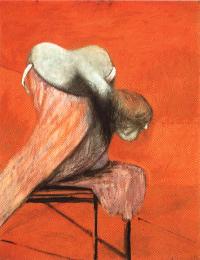
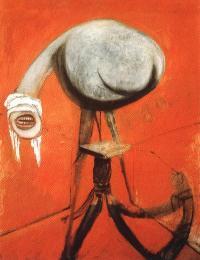
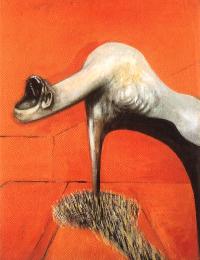
Three Studies for Figures at the Base of a Crucifixion, 1944
Bacon's work also overlaps with surrealism. It signifies the mutilation of the dignity of human body to bestiality and meat, as well as existential horror and the meaninglessness of death. There is an overlapping here not just an out and out opposition.
So we have resonances of the self-critique of European reason lying behind the French existentialism; resonances that circulated through Paris in the 1930s and then again in the 1970s. Maybe these resonances can also be found in the America of the 1950s with the Beat movement? I suspect that the self-critique of European reason more strongly resonated in a deeply disquieted America in the 1980s and 1990s.
I can see that existentialism is a useful pathway to finding our way into the French culture in the 1930s and 1940s. As a philosophical movement, existentialism emphasizes individual existence, freedom, and choice. It holds that human beings define themselves and the world in their own subjectivity; and they wander between choice, freedom, and existential angst. This arises because the existentialists accept Nietzsche's God is Dead; the nihilism of the possibility of finding values disappearing along with God's non-existence;and that if God does not exist, then we are are forlorn, because everything is permissable and there is nothing to cling to. Hence nothingness.
So it is the recognition of one's absolute freedom of choice that is the necessary condition for authentic human existence. Sartre's plays and novels, for instance, express the belief that freedom and acceptance of personal responsibility are the main values in life, and that individuals must rely on their creative powers rather than on social or religious authority.
So existentialism is useful pathway. However, the French existentialism of Sartre, Camus etc is something that I remain on the margins of.
Both Nietzsche and Sartre (existentialist) presuppose freedom as a form of self-mastery: Nietzsche as a Stoic self-mastery that entails a disciplined scupturing of character; or in the existentialist case as a subjective, willful ethical choosing. Heidegger's anxiety and resoluteness in the face of death in Being and Time can also be interpreted as the early Heidegger working within freedom as self-mastery. Hence the frequent charges of 'decisionism' about Heidegger's existential ontology.
On this existential reading we are what we can become. Hence Kierkegaard's Either/Or, the Nietzsche/Foucault/postmodern conception of freedom as self-invention grounded in the mastery of the creative artistic subject; and Heidegger's reworking of a Kierkegardian existential loneliness confronting death as a way to establish meaning and value in Being and Time. I take it that this existential analytic, with its coupling of the individual categories of authenticity, resolve, fate to the political categories of Division 11 of destiny, historicity and das Volk, supports the existential reading. The picture conveyed is of a represssive social world that is full of fear and frustration; a joyless existence overshadowed by death and anxiety.
One can, with the latter the Heidegger, reject the wilful mastery in favour of a caretaking, disclosure and letting be that opens up into an environmental ethics in a technological world. Here caretaking is a saving power that is capable of redeeming a rationalistic, modernizing and nihilistic world.
The shift of the latter Heidegger is a moving away from individualism; away from a radical subjectivism of the sovereign individual that creates a moral world to a letting things be as a counter to the technological mode of being-in-the-world.
The turn away from the existential humanism of freedom being rooted in our subjectivity can be found in Heidegger's Letter on Humanism, which explicitly rejects the Sartrean conception of subjectivity being the starting point and its presupposition of a Cartesian subject/object ontology. The Letter is an attempt by Heidegger to disentangle himself from Sartre's existentialism that owed so much to Heidegger. The point of departure is the individual in the centre of the universe. Such an individual through a complicated process of reflection----called resolve or decisiveness---establishes meaning, value and direction. Sartre remains imprisoned in the categories of Western metaphysics. Heidegger's destruction of these categories involves a movement away from Sartre's Existentialism is a Humanism towards an anti-humanism; away from the individualism of a Kierkegard or Sartre hanging in the air towards a more collectivist readng of Dasein of the people.
So you can have the search for meaning, value and order without embracing existentialism.
October 02, 2003
The dispute so far
Gary,
On interpretation, I agree with you and I disagree. Let me explain. I will start with a matter that concerns me:
John Cumming translates a phrase from The Dialectic Of Enlightenment as "through laughter blind nature becomes aware of itself as it is, and thereby surrenders itself to the power of destruction". Hullot-Kentor translates the bit after "...as it is" as "...and thereby forgoes its destructive power". Two different interpretations; is one right and one wrong or are they just different? I would like to be able to say to Cumming, "You misunderstand Adorno." He does misunderstand Adorno. Perhaps Hullot-Kentor doesn't get him right either. Who knows? But I am pretty sure Cumming is wrong.
I think you are also saying this when you demand textual sources for the position on Nietzsche that I have been advocating during the proceeding discussion, advocating and attributing it to Klossowski and Salome.
What is the point of protocols if there is just difference, if there is no truth?
Apart from this worry, I think I agree with you about the diversity of interpretation.
I think it comes down to this: if someone suggests forgetting Adorno because he thinks only destruction, then it becomes important whether or not that is what he thinks. If someone else thinks that there is an aspect of Nietzsche that manifests itself most clearly in his last writings, and that is the drive to self-disintegration, he's not saying forget Nietzsche but let's follow this line of inquiry, let's explore this idea some more. Scepticism towards this approach, hasty judgment, only serves to close off the line.
I think that there is something at stake here and it is the struggle between existentialism and surrealism. I will quote Gombrowicz:
"Existentialism tries to re-establish value, while for me the 'undervalue', 'insufficiency', the 'underdevelopment' closer to man than any value. I believe the formula 'Man wants to be God' expresses very well the nostalgia of existentialism, while I set up another immeasurable formula against it: 'Man wants to be young'".
Gombrowicz's writing is about man's struggle with form. That is why I continually associate it with the ideas of Bataille and Klossowski, and why I associate all three with what I call a broadly surrealist orientation. The approach to Nietzsche as a moralist makes sense in terms of the existentialist project, to find form, value, to become a being of value, a God.
For Sartre we are vacuums seeking existence, for Bataille we are plenitudes seeking oblivion. And Bataille also says that God is a point on the road to oblivion. Perhaps this is why there always seems to be a basic atmosphere of agreement that underlies any disagreements in our discussion so far.
The translator of Nietzsche And The Vicious Circle says:
"Klossowski himself provides no references for the sources of his citations...he simply appends the following note: 'All the citations from Nietzsche are taken from the posthumous fragments---and in particular, from those of his final decade (1880-1888)'"
Klossowski was Nietzsche's translator into French, as he was Heidegger's, Wittgenstein's and Rilke's, so whatever one may think of him it cannot be said that he didn't know Nietzsche well enough. He chose his course with deliberation. I think the whole issue is not a matter of adequacy of Nietzsche interpretation but of the existentialist-surrealist dispute.
I am for surrealism and you are against it. I don't know whether or not you would want to call yourself an existentialist.
October 01, 2003
On Scholarship
Gary,
You redescribe scholarship as certain way of doing philosophy. Perhaps that is the case. I don’t know. I think that it is getting up every morning and starting on the books, reading, rereading, puzzling over passages, taking notes, and so on. It doesn’t have to happen in the morning but you get my general drift. A religious hermit might also do this so I am not sure if it should be called philosophy, but if you insist on it then okay.
I am not sure I get your next point: the assumption that scholarship as a way of life is not part of a whole tradition of philosophy as a way of life. I don’t think I think that but perhaps it is some hidden consequence of which I am currently unaware. Nothing would surprise me. I think a philosopher is like a religious hermit: they do the same thing but to different sets of books.
I do think that the scholarship is different to the current practice, not just in academic philosophy but in academia generally. In fact there really is no such thing as philosophy in the modern university. To the extent that it exists it is merely a ghost of another era lurking in some shadowy dead-end corridor.
The University of South Australia doesn’t have a philosophy department and there is no grouping of particular staff because they are philosophers. The smallest administrative unit is larger than the department and it is not based on discipline. It is interdisciplinary, indeed it is non-disciplinary, it is post-modern. Although philosophers may occasionally still group together in the other two universities in South Australia, similar administrative moves are under way in them as well. I know philosophers up at Flinders who hang around with lawyers or people in the medical school as much as other philosophers.
The work loads of individual academics have significantly changed. They have much more teaching and many more students. This has to be coupled with a breakdown in disciplinary support. You can’t behave like a religious hermit under these circumstances. You’re no longer even certain of what books to read, that is if you still have much choice in the matter.
Some of the corridor ghosts still think of themselves as philosophers. By and large, they’re grouped together in clubs, which offer some collective support and control curricula. If you’re lucky you can be a scholar within the constraints they set and get paid for it. Whoopee!
I am not trying to argue for a philosophical position but just tell it as it is. There are some crazies out there in suburbia, shut away in their bedrooms, who still do the scholarship thing. If anybody ever again wants to know all the stories that constituted us, these are the people who know the scripts. The rest is archaeology, sifting through remains no one really understands any longer.