September 29, 2003
some puzzles
Trevor, I've been laid very low with the flu since Friday so I have not been able to repond to what you have written. This will be quick response.
You wrote here:
"I can agree that we will read these texts [of Nietzsche's] in the light of our own concerns but that does not mean that we can read them in any way we like. What Salome says about Nietzsche wasn't just true in 1894. Either she is right or she is wrong. This will never change.It seems to me that you are not addressing the points Salome raises. She would not have disagreed that Human, All Too Human is a recoil from Nietzsche's earlier Schopenhauerian position... Yes, this is a long way from the death-orientated, romantic surrealist interpretation; just as it is also a long way from the final phase in Nietzsche's system identified by Salome. She doesn't call this final phase beyond will and representation; but I will. Bataille's position, and that of surrealism in general, is just as far from Schopenhauerian romanticism as the final position in Nietzsche's system Salome identifies. You want to stop at the critical free-thinker. Bataille and Klossowski want to go all the way."
We have common ground on your point that it is true that interpreting texts in the light of our own concerns and that this does not mean that we can read them in any way we like. After all the text is not empty, there are protocols for interpreting texts, and there are better and worse interpretations.
However, I disagree with the next point you make:
"What Salome says about Nietzsche wasn't just true in 1894. Either she is right or she is wrong. This will never change."
I disagree with that to the extent that that sentence implies there is a right and wrong interpretations. Are there?
Interpretation of Nietzsche's texts are much looser and more fluid than that sentence implies, as there are many different interpratations of Nietzsche's---Salome's, the fascist's, the surrealists, Heidegger's, Kaufman's, the analytic philosophers, Derrida and Foucault's, poststructuralist feminists, American postmodernists. These are very different interpretations and they arise because the reception of the Nietzsche texts has been so very different; and these texts have meant different things to poeple. Even amongst the French Nietzscheans there are differences ---say between Bataille, Deleuze and Irigarary. Which are right and wrong here? Which of these will never change?
So I'm not saying that Salome's 3 stage interpretation is wrong. Far from it. I am happy to explore it and see what it opens up. I do concur with her second free spirit/negative critique period, which I suggested started from Human, All too Human. What I was pointing out was that Salome's kind Nietzsche with his revaluation of values by the new kind of philosopher as a free spirit does not figure in the Bataille/surrealist interpretation. The revaluation of a values of the middle texts------The Gay Science, Beyond Good and Evil and Thus Spake Zarathustra----is outside their horizons.
But I do not have Klossowski's book so I cannot see what is done with these texts.
My concerns are not about scholarship here. Scholarship is the ethos of the liberal university. I am more at home with Derridean style readings. So I'm not saying that the surrealists do not understand Nitzesche as a philosopher. That is something an academic would do inside the philosophy institution. This weblog is centred outside academia even though it overlaps the boundaries of academia.
I'm trying to get a handle on the surrealist interpretation and what they are using Nietzsche's texts for. I accept that Bataille is telling his own story about modernity, and that Nietzsche plays a pivotal role in that. Bataille---like Heidegger---wants to escape the prison house of modernity, displace instrumental reason and utility and overcome individual subjectivity. He launches an attack on the pre-eminence of the philosophical subject.
Yet, I would now add, that one can read Bataille as a moral critic of modernity, and more particularly of the French morality of the 1930s. Does he not concentrate on ethical rationalization of social life that had been structured by utility and capital accummulation. The whole attack on utility and success-orientated utilitarian action is a moral critique in the Nietzschean tradition. We have the self-dissolution of the individualist/monadic subject and the reconnecting with life from which the subject had been cut off. The reconnection with life comes through the spontaneity of the repressed bodily desires.
Is this not an interpretation of Nietzsche's revaluation of values? Is this not an affirmation and enhancement of life?
This brings me to the second point I want to address. I'll be brief here because I'm getting tired. You write in response to one of my earlier posts:
"You want to stop at the critical free-thinker. Bataille and Klossowski want to go all the way."
All the way? What is that?
I presume this 'all the way' is linked back to Salome's third period of the aesthetic Nietzsche who turns against his embrace of an enlightening scientific reason in Human, All too Human. I presume because I don't have the Salome and Klossowski books. Salome marks the turn back to the aesthetic in Beyond Good and Evil and Thus Spake Zarathustra.
So which of Nietzsche's texts does "all the way" refer to? I have referred to The Will to Power, in my instincts as the body post. The Will to Power text is very much the one that Heidegger uses for his construction of a metaphysically more systematic Nietzsche who revolts against Platonism, embraces becoming and wants to enhance life.
My puzzle is: Is The Will to Power the final position of Nietzsche? If so, then it's hardly the final position of the surrealists given your reading of them as engaged in poetics, and not being philosophers or doing philosophy.
So what texts constitute Nietzsche's final position for the surrealists 'all the way'?
Is it Twilight of the Idols?
The AntiChrist?
Ecce Homo?
Nietzsche Contra Wagner?
I'm puzzled because, when I read these late texts, I more or less do so in terms of both the revaluation of all values as a response to the advent of nihilism, and the revaluation that is part of the philosophy of the future. Those middle period concerns continue to run through these texts.
Or have the surrealists displaced these texts in favour of Nietzsche the person going mad. Going mad is "the going all the way"? Or do they read the texts in the light of Nietzsche going mad?
I will re read the Salome text in the Library again.
September 26, 2003
Scholarship & philosophy as a way of life
Trevor, I've been busy on a job and so I've had little time to address the issues you raise here. I do want to sort out the differences between us over the French Nietzscheans, (Bataille, Klossowski, Derrida, Irigaray, Foucault, Deleuze) but not now.
In the meantime I will put my third concern about scholarship as a way of life on the table. I have no problem with that statement per se. I accept that scholarship is a certain kind of life. What I would want to add to that, is to redescribe the practice of scholarship as certain way of doing philosophy. Therefore, this kind of practice of philosophy as scholarship is a part of the tradition of philosophy as a way of life.
What I do have problems with your tacit assumption that scholarship as a way of life is not part of a whole tradition of philosophy as a way of life that is quite different to the current practice of academic philosophy. The principle scholarly exercise of this philosophy as a discourse is the explication of a text in the form of a constructing an argument as a stepping stone in the building of a system. In this academic tradition---both analytic and continental-- the teaching, training and research is about the discipline; it is a theoretical discourse not the art of living.
The tradition of philosophy as a way of life has been written out of the history of philosophy by academic historians of philosophy who describe philosophy in modern terms of building a system. You interpret Nietzsche this way:
"Yes, this is a long way from the death-orientated, romantic surrealist interpretation; just as it is also a long way from the final phase in Nietzsche's system identified by Salome. She doesn't call this final phase beyond will and representation; but I will. Bataille's position, and that of surrealism in general, is just as far from Schopenhauerian romanticism as the final position in Nietzsche's system Salome identifies." (my emphasis).
I know that you would acknowledge that there are philosophers who are anti-system---eg., the Adorno of Notes on Literature--- but this insight is not tied to a philosophical tradition, even though many philosophers wrote essays, letters, aphorisms and meditations etc. These (mostly) ancient authors are dismissed as failing to construct systematic philosophical treatises.
There is a tradition of the conception of philosophy as a way of life that has its roots in classical Greek and Roman philosophy. I have briefly referred to it before in relation to Nietzsche.
To take one known to both of us, Michel Foucault. I interpret the (late) Foucault (eg., texts such as The Use of Pleasure and The Care of the Self) as self-reflexively working within the tradition of philosophy as a way of life. This tradition is concerned with taking care of oneself, knowing oneself, forming people and transforming our subjectivity. It is a cultivation of the self to orient ourselves in the life of the city.
Foucault reflects on the Greco-Roman Epicurean and Stoic ethics, and redescribes these practices as the arts of existence and techniques of self, and gives them an aesthetic Nietzchean twist for the 20th century. Hence we have reventing or recreating ourselves through the transgression of norms, conventions and living experimentally. What Focuault fails to do is link this cultivation of self to being-in the-world and hence it is too subjectivist.
And the point of all this? That scholarship as a way of life is one way of articulating the diverse understandings of philosophy as way of life. There are many different kinds eg. Seneca, Marcus Aurelius, Nietzsche, Bataille and Foucault. Your earlier post had a tendency to close out these other ways of understanding philosophy as a way of life.
This leads to difficulties as encountered by the students you mention doing Wayne's course. They interpreted Bataille in terms of the conventions of academic philosophy and end up in all sorts of difficulties. Your response, that Bataille is not a philosopher, is undercut by studying Bataille within a university course on philosophy and Bataille's own very self-conscious discussion of philosophical texts.
More On Nietzsche
Gary, as you know, I've been attending Wayne Cristaudo's honours seminars at Adelaide Uni and yesterday the discussion was closely related to our electronic conversation. Most of the people in the seminar were familiar with a fair bit of Nietzsche's writings and everybody read the selection by Lou Salome that is in the library. They also read a discussion between Marguerite Duras and Georges Bataille, mostly on sovereignty, a brief note on Bataille by Duras, Bataille's Madam Edwarda, including the preface, and Pearson's review of Klossowski's book on Nietzsche that is also in the library.
The general feeling among these people was that Bataille and co have a particular, even idiosyncratic, reading of Nietzsche, even given Salome's discussion. In particular, all of the material that has been made most use of by fascists is absent from Bataille's Nietzsche. That is okay: Bataille is not a Nietzsche scholar. He is telling his own story and a bit of Nietzsche just happens to play a pivotal role. Superman becomes a cow standing in the meadow in Bataille's story.
The recurring objection that is raised to Bataille's approach is that it does not provide any practical guidance. There's nothing to do to change society for the better. But that is just it: for philosophy it is the questioning and not the answering that is important. Bataille is trying to avoid giving answers. There is none of; Do this, or This is the correct thing to do. It is because of this kind of thing that the reality, dark and dirty, that Bataille focuses on comes about in the first place. Perversion is the expression of repressed intensity.
"Man, tortured by his mask, fabricates secretly, for his own usage, a sort of 'subculture'; a world made out of the refuse of a higher world of culture, a domain of trash, immature myths, inadmissible passions; a secondary domain of compensation. That is where a certain shameful poetry is born, a certain compromising beauty.
Are we not close to Pornografia?"
Witold Gombrowicz, Preface to Pornografia, (New York, Grove, 1978).
September 24, 2003
Bataille, Surrealism And Nietzsche
Gary, you had three concerns with the material I have been presenting, a problem with surrealism, with the interpretation of Nietzsche, and with scholarship as a way of life. At the time of writing I haven't read your views on scholarship so this is a reply to your first two points.
Your view of twentieth century art is rather Hegelian, which is regressive in my view. From this perspective, Dada represents the negative spirit. It is anti-art deliberately defying reason. Surrealism, as synthesis, is a critique of Dada's one-sided negativity and reflects a desire to seek an alternative, creative force in its place. Its emphasis is not solely on negation but on positive expression, the desire to reunite the conscious and unconscious realms of experience so that the world of dream and fantasy would be joined to the everyday rational world; surreality as reconciliation.
I would argue that surrealism is not an alternative practical philosophy in this sense, with a vision for a future reconciled state of affairs. In fact, it is not a philosophy at all, even if it leads to certain philosophical pronouncements. It stands in essentially the same relation to reason as does poetry. Hegel's view of art came from his systematic theory, rather than from observing the character of actual art. If any story is out of date according to our current sensibilities it is Hegel's. Max Weber's view is much closer to our own.
You call this reconciliatory surrealism Bretonian surrealism. You may be right. I have not given enough thought to Breton to say one way or another. Perhaps we could pursue the matter further in the near future.
You sense a danger in Bataille's more radical version of surrealism because of his appeal to all that is offensive and despicable, to a base materialism. The danger in Bataille's approach is that the subject ends up outside reason, that the subject ceases to be a subject. This is true. Like Deleuze and Guattari, Bataille sees the subject for what it is, an historical construct, the me that represses intensity. You say that there is little room in the visions of excess for the active critical role of the subject in the interpretative process. This is not completely correct, nonetheless. Bataille says:
"Anguish only is sovereign absolute. The sovereign is a king no more: it dwells low-hiding in big cities. It knits itself up in silence, obscuring its sorrow. Crouching thick-wrapped, there it waits, lies waiting for the advent of him who shall strike a general terror; but meanwhile and even so its sorrow scornfully mocks at all that comes to pass, at all there is." (Madam Edwarda).
Bataillean surrealism is absolute negation, an unhappy consciousness that will never experience rest. As Blanchot describes it, imagine the end of history in an Hegelian sense has been reached and dialectical negation has ceased to be. There Hegel's greatest fear is realised: there is still a negative spirit that scornfully, relentlessly mocks everything. It all goes back to the existentialist notion of freedom and to the idealist conception in general. For both these freedom is realised through the perfection of the system. For Bataille, like Adorno, freedom lies in non-identity.
In Guilty, Bataille writes:
“...philosophy takes on a strange dignity from the fact that it supposes infinite questioning. It is not that results gain philosophy some glamour, but only that it responds to the human desire that asks for a questioning of all that is. No one doubts that philosophy is often pointless, an unpleasant way of employing minor talents. But whatever the legitimate biases on this subject, however erroneous (contemptible, even heinous) the results, its abolition runs into this difficulty; that exactly this lack of real results is its greatness. Its whole value is in the absence of rest that it fosters."
You are correct that this approach points beyond the expression of thought but, arguably, not beyond artistic expression. Indeed, artistic expression is its very spirit, its essence, its life-blood. Art is the voice of self-dissolution, as you say, a dissolution akin to a river losing itself in the sea, or in Bataille's words, like water in water. Sure this is a problematic place for philosophy. But as Adorno suggests, philosophy continues to exist only because we are still waiting.
You suggest that the surrealists did not understand Nietzsche as a philosopher because they lived in different century and country to ours. It is quite correct that we came to Nietzsche through the poststructuralists and Critical Theory, rather than through Hegel's Phenomenology Of Spirit, and I can agree that we will read these texts in the light of our own concerns but that does not mean that we can read them in any way we like. What Salome says about Nietzsche wasn't just true in 1894. Either she is right or she is wrong. This will never change.
It seems to me that you are not addressing the points Salome raises. She would not have disagreed that Human, All Too Human is a recoil from Nietzsche's earlier Schopenhauerian position. However, you have assumed, rather than shown, that this early position is also Bataille's. HATH reflects the critical free-spirit that Salome identifies as the second position. Yes, this is a long way from the death-orientated, romantic surrealist interpretation; just as it is also a long way from the final phase in Nietzsche's system identified by Salome. She doesn't call this final phase beyond will and representation; but I will. Bataille's position, and that of surrealism in general, is just as far from Schopenhauerian romanticism as the final position in Nietzsche's system Salome identifies. You want to stop at the critical free-thinker. Bataille and Klossowski want to go all the way.
Interpreting Nietzsche
Trevor, my second concern is about the interpretation of Nietzsche's texts. There is a disjuncture between the French surrealist one and my own reading of Nietzsche's texts. And I'm not sure that we should just acknowledge the differences in interpretations and move on.
The differences raise concerns about the French reading---what I would call the death-orientated, romantic, surrealist interpretation of Nietzsche.
Let me table something and see what you make of it.
The Nietzsche of Human, All Too Human, was in recoil from the death-bearing romanticism of the Birth of Tragedy and Untimely Meditations. He was in recoil from Wagner and Schopenhauer. Since Bataille's kind of surrealism represents the return of the death-bearing romanticism, then we have Nietzsche contra this kind of surrealism.
The common ground is the Nietzsche who is critical of culture. He was still in search for meaning and joy as a free spirit through a critique of all the old erroneous ways of thinking including the demystification of art as represented by Wagner.
In Book 5 para 245 of Human, All Too Human Nietzsche says:
"Casting the bell of culture. Culture came into being like a bell inside a mold of cruder, more common material, a mold of untruth, violence, an unbounded aggrandizement of all distinct egos, and all distinct peoples. Is it now time to remove this mold? Has the fluid solidified? Have the good, useful drives, the habits of nobler hearts, become so sure and universal that there is no longer any need to depend on metaphysics and the errors of religion, on harsh and violent acts, as the most powerful bond between man and man, people and people?
No sign from a god can help us any longer to answer this question: our own insight must decide. The earthly government of man as a whole must be taken into man's own hands; his "omniscience" must watch with a sharp eye over the future fate of culture."
And in para. 248 of the same book Nietzsche says:
Consolation of a desperate progress. "Our age gives the impression of being an interim; the old views on life, the old cultures are still evident in part, the new ones not yet sure and habitual, and therefore lacking in unity and consistency. It looks as if everything were becoming chaotic, the old dying out, the new not worth much and growing ever weaker. But this is what happens to the soldier who learns to march; for a time he is more uncertain and clumsy than ever because his muscles move, now to the old system, now to the new, and neither has yet decisively claimed the victory. We waver, but we must not become anxious about it, or surrender what has been newly won. Besides, we cannot go back to the old system; we have burned our bridges behind us. All that remains is to be brave, whatever may result.
Let us step forward, let's get going! Perhaps our behavior will indeed look like progress; but if it does not, may we take consolation in the words of Frederick the Great: "My dear Sulzer, you know too little this accursed race to which we belong."'
So what hangs on this?
If BK 5 can be read as a series of Stoic mediations on the way of life as a free spirit, then in these short paragraphs Nietzsche both embraces reason and knowledge and connects them to our passions and biases. This assemblage is then used to enable our sight to become good enough to see the bottom in the dark well of our being and knowing, and also see in its mirror the distant constellations of future cultures. (para. 292)
This strikes me as a long way from the death-orientated, romantic surrealist interpretation. Does anything hang on this?
September 23, 2003
visions of excess
Trevor, okay I can see that the scholarship is important for you. Unlike your reviewer I accept Bataille as a surrealist. It makes more sense to me as I slowly read his texts. So we can thankfully displace existentialism into the background.
As usual, I have some concerns. These are about surrealism, the interpretation of Nietzsche and scholarship as a way of life. I will put them on the table. In this post I state my first concern----the implications of surrealism for philosophy--- and leave the other concerns for latter.
To surrealism. As I naively understand it, the European Dada movement before World War I produced works of anti-art that deliberately defied reason. Hence we have a critique of Dada as a purely negating force, and the subsequent desire to seek an alternative, creative force in its place. Thus French surrealism.
The emphasis of surrealism was not on negation per se, but on positive expression. Sure, surrealism was a negation, in that it represented an ongoing reaction against the destruction wrought by the rationalism (instrumental reason, science & progress?), which had guided European culture and politics in the nineteenth century and culminated in the horrors of World War I.
The positive expression in surrealism was its desire to reunite the conscious and unconscious realms of experience so that the world of dream and fantasy would be joined to the everyday rational world. This joining was a surreality.
From what I understand this Breton kind of surrealism drew on the work of Sigmund Freud. Thus Breton saw the unconscious as the wellspring of the imagination and he defined artistic genius in terms of accessibility to untapped, unconscious subjective realm.
Of course, this surrealism was not psychoanlysis, since Freud's therapeutic aim was to make the unconscious conscious. Freud stood for European rationalism. Surrealism, in contrast, stressed the unconscious or non-rational significance of imagery arrived at by either automatism or the exploitation of chance effects, unexpected juxtapositions, etc.
This understanding of surrealism is that it is a revolt against reason, a liberation from the pathology of social morality and a rejection of moral abnomalities. I sense is a danger here, which lies in the appeal to what is offensive and despicable--a base materialism. The danger is that the subjectivity of the rebellious body, which refuses the inscription of reason in the name of eros, intense emotion and ecstasy, ends up outside reason. There is little room in the visions of excess here for the active critical role of the subject in the interpretative process. Hence we have the image of the headless human being--- the Acephale figure. This is beyond the expression of thought and art; a self-dissolution akin to a river loses itself in the sea.
Now the non-rational maybe an okay place for art, as we can have the interplay of imagery and symbolism from dreams and raw bodily existence. But it is a problematic place for philosophy, which has some connection to a critical interpretative reason that is represented by Nietzsche.
No problem you say. The French surrealists do not understand Nietsche to be a philosopher. He is shrill frenzy in revolt against the prisonhouse of European bourgeois life. Their Nietzsche stands for vital and vigourous instincts. Okay that is the surrealist's interpretation of Nietzsche. But we live in different century and country and we have made contact with Nitzsche through reading the French poststructuralists and Critical Theory, not through Hegel's Phenomenology of Spirit. Our reception of Nietzche's text's in Australia in 2003 is going to be different to the French reception of these texts in the 1930s. We will read these texts in the light of our concerns.
And that brings me to my second concern, the interpretation of Nietzsche's texts. That's another post.
September 22, 2003
Scholarship
Gary, you ask if it matters whether academic reviewers thought that Bataille and Klossowski weren't surrealists. Yes it does matter. Let me say why.
Firstly, I don't know that I agree with you that Studies in French Cinema, is closed to the public domain and the intellectual commons. If it is, it's closed in exactly the same way that books are restricted. If you want to know what is in one you've got to go and buy it or borrow it from a library. The good old photocopier has also been a tool for infringing copyright laws. Basically, ideas are commodities, goods produced for exchange, and while we are governed by commodity production there will always be such restrictions. The success of commodity production depends on restriction. This isn't the fault of academia.
Basically, academia is peopled by déclassés, people cut free by the productive arrangements but for some reason permitted to survive. Most of them have a private education but not all of them. Lots of them have shares but not all of them. Theirs is really a culture of nihilism. They don't believe in anything. As Adorno said, it's on their shoulders that the guilt for the outcomes of production has fallen. They're used and disposed of, like Hitler and Saddam Hussein. The problem with academia is that people who are not scholars are permitted to be academics. Some of these people, philosophers in particular, are excellent at being non-scholars.
But this is not the point. The point is that whoever my anonymous reviewer is, he, she or it has thought about the issues I am raising to the extent that disagreement with me is possible. I seek this disagreement. I have a phantasm that makes me do it. God knows why but it won't leave me alone. So, I need people like this reviewer.
I had a look at what Michael over at Two Blowhards had to say. I was pleased that he also liked Catherine Breillat's cinema but I didn't really get much else from his writing. It was chat. Michael hadn't thought about Breillat in the way that my anonymous reviewer had and he couldn't articulate what he thought so that I could start to have a serious conversation with him.
This is not especially a criticism of Michael but of the Internet in general. I know it's got wonderful potential but it's also a curse. It's overburdened with low-level chat. Perhaps this is all right, but I need more. That's why I went to Studies In French Cinema.
The pace of internet contributes to the curse. I can talk to people everyday and still be a scholar but I can't write to them everyday and still be a scholar. It's easier to talk than write. It takes less time. If I had to write everyday my writing would degenerate to chat too. Perhaps this is not true for everyone but it is true for me, and it is true for most people out there. Most of us aren't geniuses, we're plodders. A scholar isn't a genius, it is a certain way of life.
Those people who write everyday on the internet may very well be geniuses but a different phantasm has got hold of them than mine. I want to write too, we have that much in common. But I want my writing to knock you dead. And because I'm a plodder it is going to take some time. Perhaps I will not even make it. But that ghost inside is insisting that I try. Indeed, it is wrong to talk of me in this context because I am an intensity of a certain kind, not me at all. Me is something that has been created to try to control the intensity.
This is an answer to Gary's questions about Nietzsche and surrealism as well. Nietzsche is not a moral philosopher. In fact, he is not a philosopher at all. He is a pursuer after intensity, a liberator of intensity, this at least is how Bataille and Klossowski see it. And this is how surrealism sees it, as distinct from say existentialism. Existentialism is a philosophy, a rationalisation. Surrealism is an attempt to get beyond rationalisation.
To try to give an example for purposes of clarification, in relation to Hegel, if Kierkegaard offers a rational rejection, what is it that William Blake offers? Blake was not offering an alternative philosophy, even if he often said things that are very philosophical. He's looking for the same thing all poets are after.
Bataille said of surrealism:
"The profound difference between surrealism and the existentialism of Jean-Paul Sartre hangs on the character of the existence of liberty. If I do not seek to dominate it, liberty will exist: it is poetry; words, no longer striving to serve some useful purpose, set themselves free and so unleash the image of free existence, which is never bestowed except in the instant. This seizure of the instant -- in which the will is relinquished at the same time -- certainly has a decisive value. It is true that the operation is not without difficulties, which surrealism has revealed but not resolved. The possibilities brought into play go further than they seem. If we were genuinely to break the servitude by which the existence of the instant is submitted to useful activity, the essence would suddenly be revealed in us with an unbearable clarity. At least, everything leads one to believe so. The seizure of the instant cannot differ from ecstasy (reciprocally one must define ecstasy as the seizure of the instant -- nothing else -- operating despite the concerns of the mystics)."
Bataille and Breton both thought this. That is why they are both surrealists for me. This is the issue between me and my anonymous reviewer.
September 21, 2003
forget the academics
Trevor I do hope your article on Catherine Breillat's film For My Sister gets published in Studies in French Cinema.
Does it matter what the academic reviewers thought about your article in terms of whether Bataille and Klossowski were or weren't surrealists.The journal, ie., Studies in French Cinema, is closed to the public domain and the intellectual commons of civil society. It is for experts to talk to one another behind closed doors about their scholarly investigations. Nothing in the journal is online. Same for the editor's homepages. There is nothing online over at Susan Hayward's homepage. Same with Phil Powrie the other editor.
There is a need to probe the issues raised by, but never explored in this review. There is a crossover between literature, film and philosophy that recalls the France of the 1930s.
What can I infer from the above closure? That these nook dwelling scholars are not interested in facilitating a broader online conversation about French culture. In contrast, Michael over at Two Blowhards is, with his brief discussion of Catherine Breillat's films. But again its cinephile responses not philosophy and so the radicality of experience is not explored in depth.
I'm not sure about Bataille and surrealism. I do not know enough about surrealism. Did not Andre Breton recoil from Bataille's emphasis on the impure: animality, dirt, excrement, ruptured eyes, rotten suns? He saw it as unreason replacing reason. Did not Breton also reject Bataille's attempts to reason about what is unreasonable? Breton, from what I can gather, did not accept Bataille's thesis of the interpenetration of reason and animality. I could not find Breton's Second Surrealist Manifesto online to check out his criticisms of Bataille.
Nor am I sure about the seeking self-dissolution. What does that mean? The Impure? Perversion? Sacrifice? Orgasm? Death? Ecstasy? Excess? Visions?
From what I can gather Bataille accepts Nietzsche's claim that God is Dead and then argues that this nihilistic void leads to a world of parody, burlesque, perverse and morbid sexuality, stinking decomposition, destruction, unharnessed violence, sacrifical violence, and the destabilization of signification.
Is this a surreal world? A world of parody? Once God is dead we live in a surrealist world? A headless world of nihilistic emptiness? Is that the philosophical argument?
September 20, 2003
What is Surrealism?
Have you had a chance to look at the article by Keith Ansell Pearson that is in the Library? I'd like to raise a point from the article.
Pearson sees in Klossowski's book what he describes as a superior existentialism. This being the authenticity of self-dissolution as opposed to the inferior existentialism that is concerned with the authenticity of self-completion. He is completely correct in seeing Klossowski as concerned with self-dissolution. After a paper Bataille gave on sin during the Second World War, Sartre demanded of him that he could not have it both ways, either we were vacuums seeking completion or we were plenitudes seeking dissolution. Bataille replied that he preferred the latter alternative.
In a recent paper Ivan Krisjansen and I published in the journal Studies in French Cinema on Catherine Breillat's film Romance we described the position Pearson calls superior existentialism as surrealism. The article survived the review process and was published without the designation ever being questioned. More recently we sent the same journal a follow-up article on Breillat's next film, A ma soeur, (For My Sister). Again we emphasized that the film was surrealist, relying on the previous paper as textual support, but one of the reviewers wrote back that that this wasn't surrealism and that Bataille and Klossowski weren't surrealists. We stuck to our guns, redrafting the paper to explain what we meant and sent it back to the editors. Were currently waiting to hear back from them.
In the meantime, what do you think? This idea of dissolution is found in Nietzsche, recognised by Salome, and taken up by Bataille and Klossowski. But is it at least part of what is meant by surrealism? That is the question. Is it surrealism or superior existentialism? What's the difference? Does it matter?
September 19, 2003
Nietzsche and immoralism
Trevor one thing that is beginning to concern me about the French reception of Nietzsche in the 1930s is that it appears to interpret Nietzsche as an immoralist. This seems to be the cultural backgound that shapes their reception of their interpretation of Nietzsche's texts.
By immoralist I do not mean that Nietzsche is just a severe critic of morality as an everyday code by one which one lives;eg., a Christian morality. Or that he is deeply critical of a particular ethical system of a philosopher, such as Kant, or a system of philosophy such as utilitarianism.
I mean immoral as something like the view that Nietzsche is outside morality in the sense that he rejects morality and embraces aesthetics. This means that life, ways of life, and human conduct should be judged or evaluated on non-moral, that is aesthetic grounds or in terms of power. He rejects the ethical way of distinquishing between good and bad right and wrong in human conduct and ways of life.
Many analytic philosophers have interpreted Nietzsche as an immoralist; one who lets the passions run free; one who is a master who celebrates power, lacks pity and compassion for the vulnerable and is cruel to the weak.
The French reading of the 1930s appears to hold that Nietzsche dumps Christianity as a moral code in favour of aesthetics. Is this a fair interpretation of the French reception of Nietzsche?
If so, then it displaces a core part of Nietzsche: Nietzsche the ethicist. And I would add a Stoic ethicist concerned with character, virtue and living flourishing lives. In this tradition of philosophy as a way of life the goal is to transform ourselves. And I would argue, Schopenhauer works with this understanding of philosophy as a way or form of life. You get glimmers of this here
It seems to me that the existential/surrealist forebears of poststructuralism (Sade, Bataille, Blanchot and Klossowski) are devoid of ethics, or else they ignore ethics altogether. If there is an ethics here it is what the latter Foucault articulated as an aesthetics of self. An aesthetics of the self without any ethics.
Thsi is not to reject what the existential/surrealist forebears did with Nietzsche. They made very creative use of his texts and opened up new areas to explore. They are far more interesting than the analytic philosophers in the 1930s who were obsessed with science. They continually acted in terms of closure and exclusion. To be very crude, science was everything and non-science was just plain nonsense. They were the new ascetic priests who made us miserable and unhappy.
September 18, 2003
prejudiced reception
Just a note in passing.
I came across this comment by Brian Micklethwait late last night. Brian runs Brian's Culture Blog and the post is about the Anglo-Saxon reading/reception of French "postmodern" writing. Brian links to this entry at Two Blowhards.
Both blogs are good, informed, and interesting. So why mention this particular post?
I'm struck by the prejudice to French 20th century culture that sits beneath the civilized surface.
At the Two Blowhards we discover that postmodernism means Lyotard, Baudrillard, Foucault, and Derrida---what we philosophers call poststructuralism. The question asked is: Why do we in the Anglo-American world read the French? Since we are reading them here in Australia the answers given refer to us.
Friedrich over at Two Blowhards says:
"I guess the real question is not why the French see something of themselves and their situation in Postmodern thought, but rather what American academics see in it? Whatever our own issues are, America clearly lacks that peculiarly French culture-schizophrenia. Is it possible that our academics miss it, or do they perhaps actually long for it? Or have they simply not read enough history--either French or American?"
This is a negative image of us. We are reading the French texts because we are ignorant because we don't know enough history, or we are longing for schizophrenia. That is pretty dismissive.
And the ideas? What about the ideas? What has happened to them? Could we not be reading this material (Bataille and Klossowski) because the poststructuralist thinking owes so much to Bataille? Could not Bataille be a key signpost?
Brian, who lives in England, doesn't buy into Friedrich's account of the American reception of French poststructuralism. He comments on this passage thus:
"No I think it's simpler than that Friedrich. I think that American academia (at any rate the bit of it that worships Postmodernism) is a little slice of La France in America".
I know this is the voice of cultural conservatism. But Brian is critical of the stark left right duality that is so pervasive in our culture.
So why do I make the charge of prejudice?
Because French poststructuralism is dismissed by both Friedrich and Brian without an evaluation of its ideas; or an attempt to dig into its roots through trying to uunderstanding the French reception of German philosophy (Hegel and Nietzsche) in the 1930s and 1940s. Hence our reading of Pierre Klossowski
And the effect of prejudice? Cultural conservatism is blind to the ideas of the French philosophers, cultural critics and writers. It has decided that there are no good ideas there and so there is nothing worthwhile to discuss. Hence there is something wrong with those in Anglo-American culture who do read it and discuss it. You put a question mark over the lefties in the academy by implying that these Europhiles worship the false gods.
The Anglo Saxon prejudice used to be directed at the Germans (Hegel, Nietzsche and Heidegger). Now it is the French who are the object of cultural disdain.
As I said, there is no consideration that we read the French postructuralists and their existential forebears because some of their ideas are good ones and well worth the effort to understand them.
Well, folks, that is why we are reading the French at philosophical conversations. It has nothing to do with us living in a little slice of La France in Australia, longing for schizophrenia, or not having read enough French history. It is about the ideas. So we are misrecognized.
As I said. Just a note in passing.
September 16, 2003
instincts as the body
Trevor a passage from your Nietzsche and Klossowski post jarrred. My response to the jarring is a desire to open things up; to probe for what causes my unease.
You were talking about the difference between Nietzsche's early and late aesthetic periods and observed:
"While he was under the influence of Schopenhauer.... [Nietzsche] believed that 'the highest and ultimate things find their answer not through reason but through inspiration and illuminations in the life of the will'. It was the development of a critical attitude to Schopenhauer's metaphysics that led to Nietzsche abandoning a philosophy of the will. When he rejected the metaphysics of reason -I hope I'm not being too crude - he didn't return to the idea of will but reached deeper, into the instincts, some would say, into the soul itself."
I accept 'Nietzsche under the influence of Schopenhauer' bit. It is very clear in the essay Schopenhauer as Educator' in Untimely Meditations. The rejection of will is clear in the Twilight of the Idols where he says:
"Today we no longer believe a word of all this. The "inner world" is full of phantoms and will-o'-the-wisps: the will is one of them. The will no longer moves anything, hence does not explain anything either--it merely accompanies events; it can also be absent. The so-called motive: another error. Merely a surface phenomenon of consciousness, something alongside the deed that is more likely to cover up the antecedents of the deeds than to represent them. And as for the ego! That has become a fable, a fiction, a play on words: it has altogether ceased to think, feel, or will!"(para 3, The Four Great Errors)
Se also beyond para 21 of Beyond Good and Evil (Part One)
However, I'm not convinced by the 'French existential' reading re the will, reason and instincts. Or rather more uneasy than unconvinced. I concur with Klossowski's judgement that Nietzsche shakes modern philosophy to its very roots and is a very radical critic of Western culture. And, I would add, is a critic of the mechanism of the natural and physical sciences. Nietzsche sees the world through the eyes of an artist philosopher.
Let me try and put my unease down. I have two concerns.
First, the embrace of instinct. As I understand it, the early Nietzsche of the Birth of Tragedy distinquished between the Appollinian and Dionysian tendences and identified them with Socratic reason and science (rationalism)+serene sense of proportion (the beautiful?) and what can be called a disruptive unsettling, displacing, transforming tendency: a flood of passion that breaks through all restraint and convention.
Greek tragedy best expressed the "terror and horror of existence". The argument argument of Birth of Tragedy was that life is awful, but art makes it endurable and Greek tragedy was the pinnacle of art. Then Socrates and scientific reason introduced a new, and for Nietzsche destructive, element into the equation which brought the reign of Dionysus to an end. Thus the end of tragedy.
Nietzsche's own assessement of Birth of Tragedy in Ecce Homo can be found here.
The conception of the Dionysian tendency as raw passion was latter modified to a controlled passion; control as in a dance. That is not instinct. It is an artistic shaping.
My other comment has to do with the reaching down into instinct or the soul itself. I would redescribe this as body in line with my interpretation of Nietzsche as the philosopher of the body. It is a redescription not a rejection.
In the The Will to Power (Bk.111, para 492) he says that the body and physiology is the starting point, his perspectivism is embodied, with the entire apparatus of knowledge directed at taking possession of things. (para 503) We impose upon the chaos of life as much regularity and form as our practical needs require. (para 515).
This suggests to me the Darwinian idea of human beings being in the world as dogs do. (Well, Darwin re-interpreted through Hegel's relational organic metaphysics of becoming). Dogs are very much in their bodies: theirs is a bodily existence. Ours are too with proviso that our bodies are socially shaped and formed.
What this means is that consciousness is not the cause of our actions. For Nietzsche (Part One para 3) our conscious thinking and feelings are guided and channelled by our instincts or embodied desires.
My unease? It's the soul stuff. It suggests a mystical language: eg., 'tonality of the soul;' 'intensities of lived experience that can neither be taught or learned'; 'beyond knowledge and outside communication' etc. Maybe this is the impact of Bataille---eg. the ecstasy and agony of the experience of intense passion? But, as it stand it suggests a muteness to me.
I'm not rejecting the French existentialist interpretation as somhow incorrect in favour of say Heidegger's metapahysical one which is correct. Rather, my unease indicates a puzzlement. I fear that the existentialist interpretation seems to connect madness, mysticism and philosophy in a way that gives rise to disquiet about muteness. This metaphysical and poetic upward valuation of the incommunicable strikes me as dangerous.
Can you unpack, open up, the French Existentialist interpretation more? What are they getting at and what are they trying to do with the mystical bit that causes my unease?
Celine's contribution
I'm a bit slow at getting off the mark but I'm responding to something Gary said last week. It was to do with Celine. He said that Celine focused literature's attention on the dark side, in the process creating a new genre. In saying this Gary was inspired by Greg Hainge's talk at the most recent Philosophy Jammm.
I exchanged a couple of emails with Greg after this talk. I asked Greg:
'Last night you said something that I meant to ask you about but forgot. I think it's in the trilogy that I remember reading something to the effect, 'after what I have written, writers who are not influenced by me will be irrelevant.' You said something like this but it was also quite different. I can't read French. I don't know whether Celine actually said this or not but if he didn't he should have, because what it says to me is: 'I've produced an irreversable formal change in creative literature.' I think this is completely true and in no sense bragging. It's like some swimmer saying that he swims at such and such a speed. Celine certainly did this and he certainly knew that he did it. Although he would never talk about it, Bukowski knew that Celine's contribution wasn't essentially stylistic (three dots, etc) but formal. The forms of the poem, the novel and the novella had changed. It was because Bukowski knew this that he is one of the very few recent poets, if not indeed the only one, to find a mass audience.'
Greg replied that Celine said that he rendered other writers unreadable and that's why they hated him. He agreed that he forged an enormous change in literature but pointed that we should also not forget that Celine said much with tongue in cheek.
I emailed him back:
'form and style: yes, I agree with you that they can't really be separated. What I meant was that Celine's contribution wasn't the text full of three dots but a contribution to something probably started by Lautreamont and definitely developed by Proust, and that is the destruction of the nineteenth century novel form. There's no three dots in Bukowski and if you read the two of them together then the artistic construction in Celine's work seems very obvious, whereas Bukowski seems much more the language of the street - this is not meant in any sense to be a devaluation of Celine, heaven forbid. It's just that there isn't really much stylistic similarity between the two writers but when it comes to genre-bending they're of one mind - at least, that's how I see it.
I mentioned two books the other night, 'Hollywood' and 'Pulp'. I'd also recommend 'South of No North' (novellas) and 'What Matters Most is How Well You Walk Through the Fire' (poetry). Bukowski is also like Celine in that everything is autobiography slightly fictionalised, although this may not have come from Louis-Ferdinand. It's a very American thing. Another major influence on Bukowski is John Fante, as well as Knut Hamsun.
I think Miller, Heller and Vonnegut are not in the same class, as you intimated. Bukowski said that Miller was good when he wrote about sex and the street but his persistent philosophising was fucking awful.'
So far I haven't heard from Greg again. If anybody else out there has got any ideas about this it would be great to hear from you.
September 14, 2003
Nietzsche and Klossowski
Salomé identifies three stages in Nietzsche's philosophical development: a Schopenhauerian aesthetic approach, the free-spirited critical approach, and a return to aesthetics. On this basis, she distinguishes between Nietzsche's early and late aphorisms as changing from examples of idiosyncratic preference to a deliberate formlessness.
Let me say what I think is the difference between Nietzsche's early and late aesthetic periods. While he was under the influence of Schopenhauer, in Salomé's words, he believed that 'the highest and ultimate things find their answer not through reason but through inspiration and illuminations in the life of the will'. It was the development of a critical attitude to Schopenhauer's metaphysics that led to Nietzsche abandoning a philosophy of the will. When he rejected the metaphysics of reason -I hope I'm not being too crude - he didn't return to the idea of will but reached deeper, into the instincts, some would say, into the soul itself.
When I say some, I have particularly in mind Pierre Klossowski, whose book, Nietzsche And The Vicious Circle is one of the highlights of twentieth century Nietzsche scholarship. Daniel W. Smith's recent translation has brought this book to the attention of the English-speaking world and Keith Ansell Pearson's review in Pli 9 (2000), 248-56, provides a good introduction to Klossowski's text.
In a not dissimilar manner to Salomé, Klossowski sees Nietzsche's efforts as reaching or giving over to something within him that lay beyond reason and the will. He wasn't seeking a philosophical account of these feelings, even if that is what he produced, but to submit to these inner feelings. When Salomé says that his madness was the outcome of his endeavours, she did not mean that he was driven mad by his thoughts and his intellectual effort. She meant that he found a way of escaping from his thoughts, and this was his ultimate goal.
Klossowski talks in terms of phantasms and simulacra. Phantasms are not moods of the soul, the impenetrable depth, but obsessive dispositions. They give rise to expression, which is in the form of simulacra, expressions of the phantasms. They are not meaningful in themselves, and relate only to instinctual needs, although they can be detached from their sources of origin and take on intersubjective meaning. Artistic expression and communication can be seen in these terms.
Of course, you may argue, Nietzsche's books have an explicit intersubjective meaning. They're not just spurts of the soul. Klossowski explains this as a dual, and in a very real sense contradictory, drive within Nietzsche, on the one hand, to his dissolution as a self, on the other, to teach, a drive to dissolution and a drive to communication - at least, this is how I read him.
Let me know what you think.
September 13, 2003
bringing the body back in
I would like to redescribe Lou Salome's thesis that Nietzsche's philosophy can be seen as a reflection of his psychology and his philosophical development as driven by a series of illnesses and recoveries.
Nietzsche as a materialist in that the root of culture is the human body. In The Gay Science he says that philosophy is connected to the interpretations of the impulses, needs and drives of the body and he criticises the philosophical tradition for its blindness to the body. We are human animals.
His diagnosis of what makes us sick is Christianity as an instinctual structure of the human animal. This tempering, subjection and organizing of the body's
powers is what has broken down in modernity. This is a catastrophe but it opens up new possibilities for a different way to organize the body's powers that can affirm life rather than deny it. We have possibilities to become healthy and joyous animals rather than the sick and miserable animals we were in a Christian culture.
Of course, the 'we' who shape these possibilities are the fearless ones, the free spirits, those sovereign individuals who are capable of acting as commanders and legislators----as spelt out in Bk 5 of The Gay Science (paragraph 343 ff).
September 11, 2003
As if recovering from an illness
Trevor the Library is now up and running. Your selection from Salome's book on Nietzsche has been archived for public access. This is an accesible online introduction to Nietzsche's philosophy.
Some incidentals. A photo of Lou Solome, Paul Ree & Nietzsche:
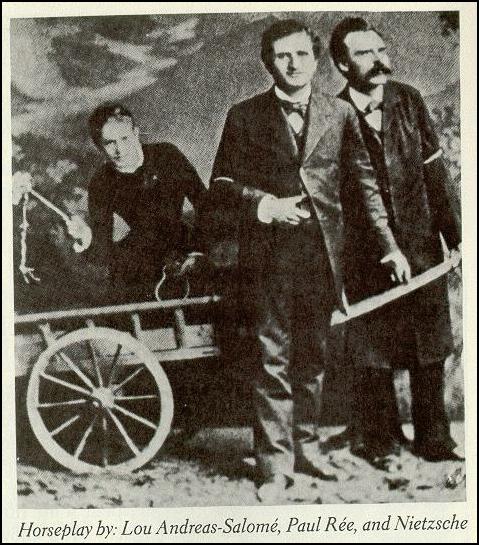
Are Ree and Nietzsche pretending to pull a little cart carrying Salome who has a whip and is posing as a plaything? The photo is very posed. Does it gesture to the paragraph in BK. One of Thus Spake Zarathrustra:
"Of little old and young women",
An old woman says:
"You are going to women?
Do not forget the whip!"
I do not have my copy of this text with me at Victor Harbor to check. An online copy of Thus Spake Zarathrustra is here. The relevant section is 18.
I found the photo courtesy of Fikirbaz over at fikirbaz.com. Fikirbaz lives in Instanbul, Turkey and he had been reading similar material around June of this year. I wonder how many others have been exploring similar material?
On a more philosophical note I would like to turn away from the core thesis of Lou Salome's Nietzsche book, that Nietzsche's madness was the inevitable result of his philosophical views, to the sort of philosophy Nietzsche was working with. I do not doubt that it would be fruitful to explore how Nietzsche's philosophy can be seen as a reflection of his psychology, how his philosophical development as driven by a series of illnesses and recoveries, or how his later philosophy is related to, or is mystical.
What I have in mind is the field of Nietzsche and philosophy that has been explored by Gilles Deleuze and Pierre Klossowski. I want to use this post to my down my own starting point, bias or perspective.
I came across this article by Richard Palmer when writing the post of Gadamer over at philosophy.com Richard Palmer has written a lot of stuff on Hans-Georg Gadamer from within the continental philosophical tradition. The article is from an opening address on postmodern thinking in 2001 and Palmer uses it to briefly outline a tradition of critical thinking about the underside of modernity.
What caught my eye was Palmer's brief remarks on Nietzsche. So I thought that Id'd drop them into our conversation as they offer an interpretation of Nietzsche's understanding of Christianity, its affect on us, and what that situation requires of us.
"Friedrich Nietzsche, another great father of postmodernity, went further back than modernity. He blamed Christianity for the decadence of modern culture. His word for the way beyond the ideology of Christianity is interesting: Verwindung —recovery: We need, he asserts, to “recover” from the debilitating effects of Christianity and the dogmatic claims of science for truth. We will not go into Nietzsche’s thinking here, but it is interesting that he said we do not need a revolution; we need to recover from modernity, as from an illness, this recovery does not mean leaving it totally behind, but recovering from its side-effects. We need to realize the what the undesirable modern structural assumptions are and take steps to outgrow them."
The linkage of 'illness', 'recovery' and 'philosophy' fit very much into the tradition of the classical (Hellenistic) idea of a medical conception of philosophy. This ethical conception of philosophy confronts our most urgent complexities and helps to bring us from misery to some form of flourishing. Rather than philosophy being a detached technique, it addresses the most painful problems of human life as if it were a compassionate physician whose skills could help to ease and heal human suffering.
I understand Nietzsche as having recovered that conception of philosophy from then Greeks, and then deployed it on the underside of modernity. He diagnosed those cultural forms that made us sick---such as the ascetic ideal. This is more interesting that doing a psychonalytic thing of trying to view the persona or person behind the works.
September 10, 2003
Nietzsche: God is dead and we killed him
Trevor your post is a good springboard for discussion. However, it is a bit dense for me to engage with without having the Salome book on Nietzsche to work from. We need to get the Salome text up online (into our virtual library) so that it is accessible to our readers. They will need access to the text if they are to follow or contribute to the discussion. And contributions from others is what we would like to see happen here.
In the meantime let me unpack or try to open up your post. I will do so by putting some issues you raise to one side, and then putting an interpretation of Nietzsche's concerns on the table for you to consider. This strategy is designed to take us into the Salome text.
What I would like to put to one side is the historical metaphysics stuff. It is more background material on the philosophical tradition. I will make two comments in passing.
If Kant stands for a critical metaphysics as you rightly suggest, then that metaphysics was a part of modern natural physical sciences ie., mathematical physics. Hegel's take on this is that it is philosophy's task to critically evaluate the metaphysics of science to see if it does the job. Hegel evaluates this through a criticism of an empiricist account of science, and he finds the mechanism and atomism of the metaphysics of science to be deeply flawed. He argues for a more organic metaphysics of nature. I am sympathetic to that approach in relation to the mechanistic scientific metaphysics currently defended by the materialist analytic philosophers.
The second comment in passing is my interpretation of Nietzsche in relation to the philosophical tradition. Nietzsche shifts philosophy's concerns away from natural science to art and everyday life. He does that by linking philosophy to art, but without reducing philosophy to aesthetics. He looks at the world through the eyes of an art and not as a scientist. That is a big shift in terms of the philosophical tradition.
I then read Nietzsche as an ethical philosopher who is concerned with how we should live our lives. Philosophy should help to affirm life not negate it. Hence we have a conception of philosophy as a way of life.. This is quite different from a philosophy that is content to tweak the axioms. Philosophy as way of life is what I understand Bataille to be working within in his book on Nietzsche.
I would like to put that history of metaphysics aside to concentrate on the importance of Nietszche for us now. Hence, contra Salome, Nietzsche does not need to turn to science to justify his philosophy. I would prefer to read Salome's text from the perspective of an ethical philosophy that is concerned to diagnose our sickness caused by the devaluation of life (eg., the ascetic ideal); and which evaluates the remedies in terms of affirming life. This is value philosophy that promotes what is life preserving and life affirming.
What I got from Greg's very useful talk on Celine at the philosophy jammm last night is that Celine returned literature to expressing the dark side of our everyday existence. And he invented a new literary form in the process. In doing so, Celine turned the novel into an old literary form; a form that has become increasingly irrelevant to expressing what is generally repressed or denied in our lives.
On my interpretation Nietzsche did the same for philosophy. Nietzsche created a cultural form in which philosophy was able to express the horrors of our life. He also had the literary skills to write in a new way and be understood by people without philosophical training in the canonic texts of the tradition.
What then does Nietzsche see?
Nihilism, everywhere.
The quickest way to get to the heart of this concern is through section 125 in BK 3 of the The Gay Science. Here is the well-known section. From Heidegger's perspective this section discloses or opens up a clearing or a new way of understanding the world.
The Madman.
'Have you ever heard of the madman who on a bright morning lighted a lantern and ran to the market-place calling out unceasingly: "I seek God! I seek God!" As there were many people standing about who did not believe in God, he caused a great deal of amusement. Why? is he lost? said one. Has he strayed away like a child? said another. Or does he keep himself hidden? Is he afraid of us? Has he taken a sea voyage? Has he emigrated? - the people cried out laughingly, all in a hubbub.
The insane man jumped into their midst and transfixed them with his glances. "Where is God gone?" he called out. "I mean to tell you! We have killed him, you and I! We are all his murderers!'
I take this to mean that Christianity (what Hegel called the metaphysics of the people) and Nietzsche the ascetic ideal) has collapsed. It is falling into ruins. We no longer believe Christianity to be true. Christianity no longer comforts us. The structure of meaning that we once used to make sense of our existence collapsed. Christianity saved us from a suicidal nihilism, as it provided us with a way to affirm our lives and to understand that our lives were worth living.
With its collapse our future is one of standing naked in the cosmos facing the chaos of existence.
Nietzsche expresses this poetically by asking a lot of rhetorical questions:
"But how have we done it? How were we able to drink up the sea? Who gave us the sponge to wipe away the whole horizon? What did we do when we loosened this earth from its sun? Whither does it now move? Whither do we move? Away from all suns? Do we not dash on unceasingly? Backwards, sideways, forwards, in all directions? Is there still an above and below? Do we not stray, as through infinite nothingness? Does not empty space breathe upon us? Has it not become colder? Does not night come on continually, darker and darker? Shall we not have to light lanterns in the morning? Do we not hear the noise of the grave-diggers who are burying God? Do we not smell the divine putrefaction? - for even Gods putrefy! God is dead! God remains dead! And we have killed him! "
We shiver at confronting the chaos of existence without any comforts, clothes or props. It is living in nothingness. It is too raw for us. Christianity did the comfort job for almost two centuries, but now it no longer does so. So where do we go? What do we do now? Most of us cannot live in nothingness and without meaning.
Nietzsche addresses this consoling ourselves in terms of us experiencing world the decay of Christianity in terms of it being a world historical event:
"How shall we console ourselves, the most murderous of all murderers? The holiest and the mightiest that the world has hitherto possessed, has bled to death under our knife - who will wipe the blood from us? With what water could we cleanse ourselves? What lustrums, what sacred games shall we have to devise? Is not the magnitude of this deed too great for us? Shall we not ourselves have to become Gods, merely to seem worthy of it? There never was a greater event - and on account of it, all who are born after us belong to a higher history than any history hitherto!"
That is the speech of the madman.
Nietzsche says that the madman then realized that he had come to early. His time was not yet. The event of nihilism (the decay of our highest values) was still on its way. It had not yet reached us that the churches were now the tombs and monuments of God. We realize that now. The madman spoke the truth. We late moderns live nihilism.
That is the section. It is the philosophical core of Nietzsche. Philosophy addresses the issue of how we are going to live in a nihilistic world. The negative criticism mentioned by Salome is directed at dismantling the old props and idols associated with Christianity. And the free spirits respond to the destructive impact of nihilism in a pro-active creative way. Only free spirits have the character and virtues to creatively respond to a world historical event. They do so through a revaluation of all values.
I reckon that's a good entry point as any into reading the Salome text.
September 09, 2003
Salome's Nietzsche
Gary and I were talking about what kind of conversation we might have to set the ball rolling, as it were. We remembered vaguely having some kind of disagreement over Nietzsche years ago, although when we talked about it we couldn't discover what it was that we disagreed over. Lou Salomé's book on Nietzsche was lying nearby. Gary picked it up and started browsing - or was he grazing? - as we talked. To cut a long story short, we soon decided that perhaps something out of the section of Salomé's book on Nietzsche's system might provide a good place to start. So here goes....
Nietzsche's system is not deductive but, in Salomé's words, 'an overall mood'. She identifies three stages in Nietzsche's philosophical development:
1. the influence of Schopenhauer's metaphysics of aesthetics;
2. an approach of reasoned 'free spiritedness' and negative criticism;
3. a return to an aesthetic conception.
She notes that the aphoristic characteristics of his last works reflect a deliberate lack of form that reflects Nietzsche moving beyond the conception of critical reason. In contrast, in his early writings aphorisms merely indicate an idiosyncratic preference. If the first period is typified by the predominance of the will, then in the last period it is not so much a matter of 'beyond good and evil' as 'beyond will and representation'.
This then is the issue for discussion. I won't go into it any further at this point but conclude by briefly describing the philosophical background to Nietzsche's writings.
The historical period prior to Kant was typified by Feudal Aristotelianism coupled with a subterranean strand of neo-Platonic mysticism. In the centuries just prior to the latter half of the eighteenth century, there was an increase in the rational elements of these pre-Kantian worldviews, while in particular Christianised elements entered the neo-Platonic perspectives - Paracelsus is a good example. Kant subjected dogmatic metaphysics to a rational critique, replacing it with dogmatic epistemology. This gave idealism a unique slant. It became the assertion that we come to know the world as it progressively conforms to our idea, what Hans Blumenburg regards as the last great myth of the radically myth-free modern era. The idealism of Kant, Hegel, et cetera, boils down to the idea that, asymptotically at least, freedom and necessity may be reconciled. Hegel resurrected metaphysics, while his unhappy consciousness and the spirit of negation came to indelibly characterise the modern sensibility. As Salomé points out, Schopenhauer's answer to Kant is that the ultimate questions of philosophy are not found in reason but in the will. It is at this cultural point that Nietzsche made his contribution.
September 07, 2003
beginnings
This weblog is a spin off from Gary's philosophy.com, which endeavours to reconnect philosophy with everyday life. This post is just to kick things off.
Philosophical conversations is envisioned as a vehicle for an ongoing discussion of selected philosophical texts. At this stage it is not clear what those texts will be. It is expected that most of the material will be sourced from continental rather than analytic philosophy. Though there is a lot of material on continental philosophy posted on the web, there is little online discussion of that material. There is a vacuum in discussing the ideas within their philosophical context. That vacuum is felt keenly in Adelaide, Australia.
The roots of a philosophical conversation lie in the academic philosophy seminar, a "postmodern" philosophy reading group in Adelaide run by myself, Trevor and Ivan a couple of years ago and the current philosophy jammm in Adelaide. What comes out of these roots is a structured small-group dialogue format that gives participants ample opportunity to express their own ideas within the conventions of a philosophical discussion. Those conventions include a loose argument structure through which others get to challenge your ideas just as you get to challenge the ideas of others. The small group dialogue presupposes that participants are capable of autonomous thinking and have a capacity to interpret texts in a philosophical way.
The idea of philosophical conversations as a weblog was suggested by Trevor Maddock. It comes out of his experiences and involvement with cafe philosophy in Adelaide. An organic development if you like. Trevor has said that he will write about this.
The ethos of conversation refers to kicking those ideas around that initially spring from a text or paper; to the subsequent discussion that takes place between those interested, and to the further exploring for related texts undertaken by particular individuals. The emphasis is more on the conversation than the academic debate with its conception of battle, winning and defending a position from an enemy attack. That is a picture of philosophy that has held many academic philosophers captive: gaining philosophical truth through getting the argument correct.
In contrast, a conversation is more an exploring of ideas, an opening up new ways of doing philosophy, understanding what philosophers were trying to do within the philosophical tradition they work within, inventing new styles of thinking.
It is doing philosophy under the sign of difference.
The tech stuff that underpins philosophical conversations needs working on, and it will be tweaked over the following month. Many thanks to Scott Wickstein for getting philosophical conversations up and running. Thanks to Bonyton for help in tweaking the stylesheet template and getting a bit of color.
This post by Jon Husband sums up my feelings about the tech stuff:
"I wish I knew more HTML, I wish I was more a techie geek kind of person, I wish I knew how to do all the cool things I see on other blogs and sites, I wish I remembered all of what I have read and observed over the years, I wish I could remember and explain all the good, pithy soundbites I've come up with that made great sense (to me) at the time, I wish I was smarter and could keep up with all the cool bloggers whose intellect and spirit I admire, I wish..."
Yeah. I wish I knew the tech stuff too.
We shouldn't worry too much about the tech stuff. There is a toy, mirror, art pattern to technological development. As Jon Husband says, the IT infrastructure is in place and now the emphasis is on what people do with it.
The real challenge is how to make all this online technology work for the people it is intended to serve; and that is fundamentally a social and cultural issue. The cultural issue is a pressing one in Australia. We need lots of new ideas to loosen things up about what it is to be and think.
Philosophical conversations is one way we can start to use computers and online technologies as tools to augment our social and cultural interaction and so counter the way that technology enframes our lives and shapes our subjectivities.
At the moment the format of philosophical conversations is envisioned to centre around be posted a paper/article, and then various people will contribute to its discussion of the paper. After a while the conversation will die away. A new paper/article will be posted.
At this stage it is unclear who will contribute to the conversation. It is envisioned that it will be open to those who want to nurture the philosophical conversation.
The ethos of philosophical conversations is a critical one. The historical context of the critical mode is the hegemony of Anglo-American philosophy in Australian universities and the repression of continental philosophy by those working in the analytic tradition. The critical ethos is critical of the academic style of continental philosophy that has found a niche in the academy, and the divorce of professional philosophy from everyday life. Philosophical conversations accepts that we work within the philosophical tradition and the categories that philosophy has helped to create, articulate and refine; but it takes a critical position in relation to these categories, to philosophy's method of inquiry and its modern metaphor of the tree of knowledge.
Hence it is firmly located within Gadamer's conception of the give and take of dialogic understanding and the openness to the possibilities of developing my situated perspective through an engagement with other participants.
Hence philosophical conversations is located within the ongoing critique of, or confrontation with, the philosophical tradition. That confrontation has historically read the philosophical tradition and academic discipline of philosophy in terms of the presupposed political and social values sedimented in the various dichotomies (mind/body, inner/outer, subject/object, nature/culture, reason/passion etc ) that divide the world up in terms of categories. These dichotomies are taken for granted in our culture and they are usually assumed to be neutral and universal. They underpin the dominant modes of interpretation of social life.
Philosophy renews itself through critique. That is enough to get philosophical conversations started.