November 27, 2013
Geoff Schirmer, photography + the Victorian landscape
Geoff Schirmer is a Melbourne based landscape photographer who works in black and white and large format. He is a traditionalist in the sense that he does his own film processing and printing. Black and white for him presents the viewer with a different way of seeing in that it invites the viewer to experience a subject in terms of shape and form - tone and texture - light and shade - without the distraction of colour.
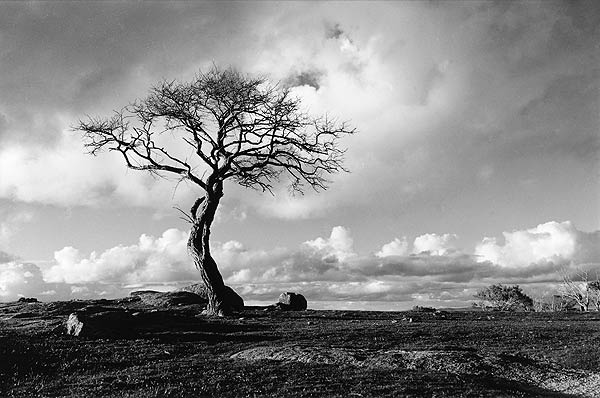 Geoff Schirmer, Dog Rocks, Victoria
Dog Rocks at Batesford is well known amongst the Victorian photographic community as a venue to make some magnificent landscape photographs. Located 10 kilometres west of Geelong, Dog Rocks is a changeable landscape with the windswept trees being deciduous, and during summer the surrounding grasses turn brown. The rocks were formed 365 million years ago and are the oldest rocks known of in Victoria.
Schirmer photography is concerned to juxtapose what is actually seen and what lies beyond the image as a symbol. The symbol, which “fully represents within itself the whole of which it is a part”, provided the Romantics a means of escaping the dualistic, mechanistic universe of the Enlightenment, through a new mythology
In the Romantic view, symbols were the human aesthetic correlatives of nature's emblematic language. They were valued too because they could simultaneously suggest many things, and were thus thought superior to the one-to-one communications of allegory. Partly, it may have been the desire to express the "inexpressible"--the infinite--through the available resources of language that led to symbol at one level and myth (as symbolic narrative) at another.
The Romantic concept of the symbol sees nature as possessing significance for humans far beyond functionality and appearance. It is a response to the central problem of modernity: humanity's feeling of estrangement in the world subsequent to the rise of science and the collapse of the medieval world-view, with its confidence in the inherent meaningfulness of nature and the purposiveness of life. The Romantic concept of the symbol exercised a compensatory function: the greater the feeling of estrangement, the more insistent become the calls for seeing nature as "a symbolical language for something within me.
The symbol ascribes noumenal content to the signs of nature.
November 25, 2013
a change in the culture of health care
This article--The Hospital Is No Place for the Elderly --in The Atlantic speaks a lot of sense in the light of this kind of foreboding about Australian governments needing to make tough choices now to balance the budget, rather than waiting for a crisis to act.
Australia’s future budget problems arise because governments are simply not raising enough in taxes to fund the medical costs of helping us live longer, or to pay the extra living costs via the age pension. The biggest problem is health spending. While education, research and infrastructure will benefit future generations, spending on increased health and age pensions increased the most. While health spending increases workforce participation a little, its major effect is to help today’s generation live longer and enjoy happier retirements. Today’s long happy retirements are being funded by structural deficits that send the bill to the next generation of workers.
The Atlantic article says that thanks to modern treatment, people commonly live into their 70s and 80s and even 90s, many of them with multiple chronic ailments:
A single person might be diagnosed with, say, heart failure, arthritis, edema, obesity, diabetes, hearing or vision loss, dementia, and more. These people aren’t on death’s doorstep, but neither will they recover. Physically (and sometimes cognitively), they are frail...What to do with this burgeoning population of the frail elderly? Right now, when something goes wrong, the standard response is to call 911 or go to the emergency room. That leads to a revolving door of hospitalizations, each of them alarmingly expensive.
The problem is that though hospitals are fine for people who need acute treatments like heart surgery, they are very often a terrible place for the frail elderly. The focus is on providing curative care in the acute hospital regardless of the likelihood of benefit or preferences of patients.
A more appropriate model is providing care and support at home; a kind of care that is more about meeting patients’ goals rather than performing procedures. Home-based model of primary care represents a change in the culture of health care in that hospitalization is a last rather than a first resort.
November 19, 2013
Australia's seaside towns
In her Coast goes from green to greedy article on Australia's coastal or seaside towns and a sense of place Elizabeth Farrelly says that they suffer from a single organising principle: water.
Nothing else figures - church, square, town hall, market, windmill. Only water, which is to say, money. Water makes a town self-arrange like iron-filings along a magnet, its streets pervaded by a palpable straining for view, proximity or access. Architecture is tyrannised by it and those not so blessed are permanently blighted by its absence.It's as though water is the one common value remaining. And it has remade our coast, one of the longest and loveliest littorals in the world, into an encircling crust of suburban gentility.
The coastline becomes very low-density sprawl and there is little attempt by developers, local councils or state governments to create hamlets, villages and cities that act as counterbalancing goods to nature.
November 10, 2013
a dying land
The big ice is sick." These words, spoken by an old Inuit hunter, express what is happening to the Arctic. It is a dying land.
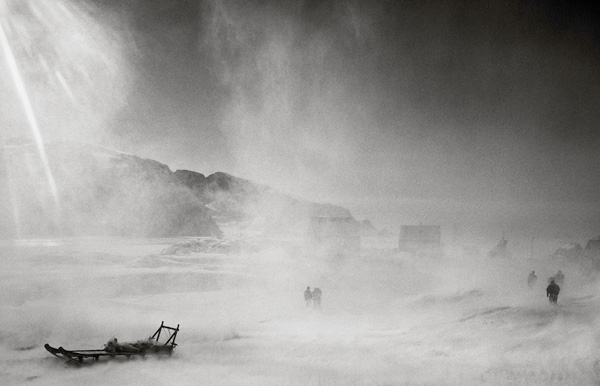 Ragnar Axelsson, storm, Ittoqqortoormit, from Last Days of the Arctic: Journeys with the Greenland Inuit.
Ragnar Axelsson travelled the austere landscape of remote Greenland and Canada by traditional dog sled, often crawling at 5 kilometres per hour at -40 °C. "You're fighting the cold and wind, just watching white ice over and over. It's a long time between some action." The temperature posed gruesome challenges, he recalls: "Your fingernails get loose when you're trying to open the camera."
The ice is now inaccessible for long periods, changing hunting seasons and methods. Its retreat has opened isolated villages to tourism, changing the aspirations of the younger population and saddening those who wish their traditional culture to persist. Combined with a decreased demand for hunting products, the changes are causing Inuit hunters to lose hope.
November 2, 2013
“re-purposed” landscapes
Joshua Dudley Greer's series, Point Pleasant, is structured around an explosives manufacturing facility constructed during World War II just outside Point Pleasant, West Virginia.
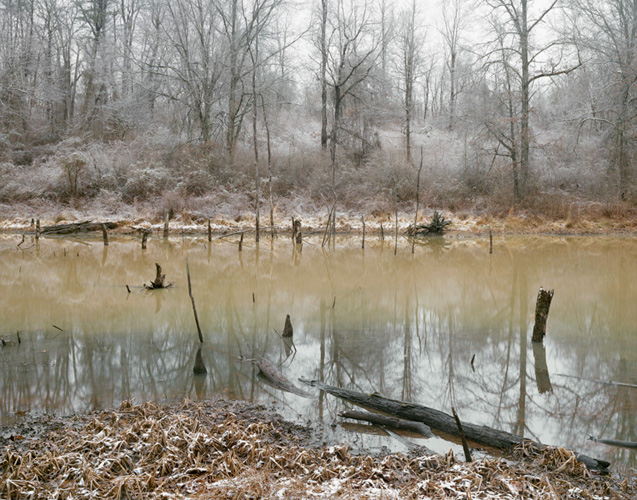 Joshua Dudley Greer, Pond 34, Point Pleasant, West Virginia, 2011
A large system of ponds and wetlands was constructed as a habitat for waterfowl, migratory birds and other wildlife species. This area came to be known simply as T.N.T. and developed into a popular hangout for local youth, hunters and fishermen.
In the early 1980′s, EPA and state investigations revealed that the groundwater, soil and surface water of T.N.T. were heavily contaminated with explosive nitroaromatic compounds including TNT, trinitrobenzene, and dinitrotoluene, as well as arsenic, lead, beryllium and asbestos.