February 28, 2013
Leunig: autumn
I welcome autumn. We can say goodbye to the summer heat. It's been a hot summer across southern Australia.
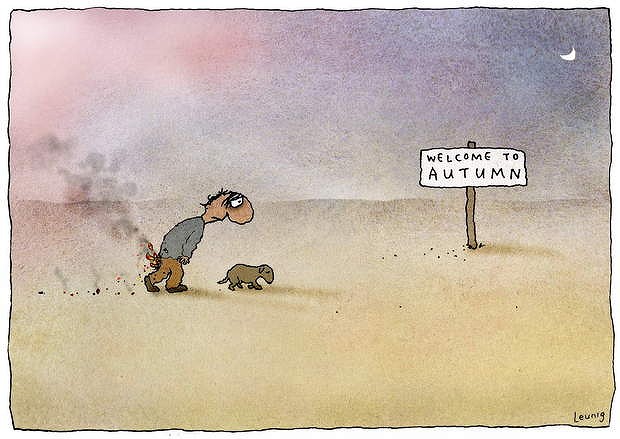 Leunig
Autumn mean cooler temperatures and the start of the rain. However, summer in southern Australia extends well into March. We have just started a fortnight of hot weather.
February 24, 2013
Paul Kenny: Lonbain Wall
Paul Kenny has photographed a stone wall near the ruined village of Lonbain, on the Applecross peninsula in Wester Ross in the Scottish highlands. The ruined village is a remnant of the clearances of the 1780's.
Kenny says:
Above the beach, on a plateau above the shoreline, is a sheepfold made of the most beautiful rounded stones. The wall is beautiful, each stone, shaped to perfect ovoid symmetry by hundreds (thousands?) of years in the sea. Each stone is decorated with intricate colonies of lichen.
Kenny has constructed a project out of photographing the wall:
 Paul Kenny, lonbain stone with caligraphy 1993.
Kenny focuses on the detail of the Lonbain wall--the individual stones in the wall. It is lovely work. I just love the rich black and white tones of the images.
February 23, 2013
Joyce Evans: landscape
Joyce Evan's interpretation of the Australian landscape involves a‘seeking out the beauty, synergy and the spiritual in the everyday‘.
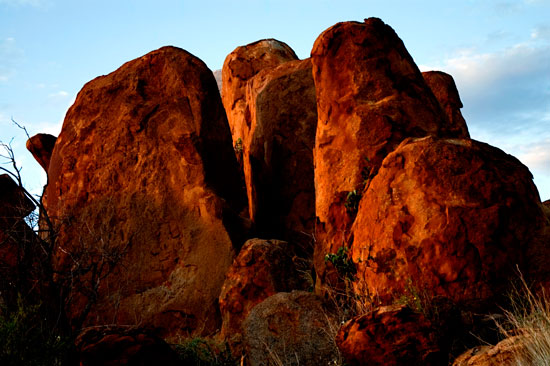 Joyce Evans, Rain Dreaming, from Imaging the Spiritual, 1980-2010,
Evans took up photography professionally after closing her Church Street gallery space in Melbourne in 1982.
February 21, 2013
the creative class
Geoff Mulgan in Is There a Creative Class? assesses the work of Richard Florida on the creative class and the creative economy. The assumption her eis the insight that the creative economy is continuing to grow in importance, and every city should have a serious strategy for growing its creative economy.
Mulgan acknowledges that Florida has promoted what to Mulgan are important truths about how the world works:
the growing importance of creative roles, sectors and jobs; the need to shift urban regeneration away from its fixation on physical improvements to a focus on people; and the links between cultures and milieu and economic effects.
However, Florida's most prominent claim is that there is a meaningful category called a creative class, which in the US accounts for as much as 30-40% of the workforce, and that its size drove economic growth: the bigger the creative class in a city, the faster its growth rate. The implication was that cities shouldn't just build art galleries - they should do all they could to grow and attract this group of people.
Mulgan says that:
the argument that there is a single creative class has crumbled under investigation. Accountants, consultants, professors, engineers are very different from each other, and not obviously much more creative than, for example, builders or engineers. No generalisations about the creative class - for example about their movement, motivations, cultures - has survived analysis.
The size of the creative class is much smaller than Florida claimed, and it would be unwise to conclude that they are a cause rather than an effect of growth.
February 16, 2013
Alessandro Imbriaco: temporary autonomous zones
The Italian photographer Alessandro Imbriaco explored the idea of "temporary autonomous zones" in Italy in a five year project.
Temporary autonomous zones in the 1980s referred to the often illegal makeshift communities that were being created in cities and remote rural areas by squatters, travellers and the various alternative communities living outside society's norms. The term now also applies to the many illegal urban communities – made up mostly of migrant workers and their families – that have sprung up in European cities over the past decade or so. Many have become semi-permanent settlements, existing almost invisibly on the edges of mainstream society.
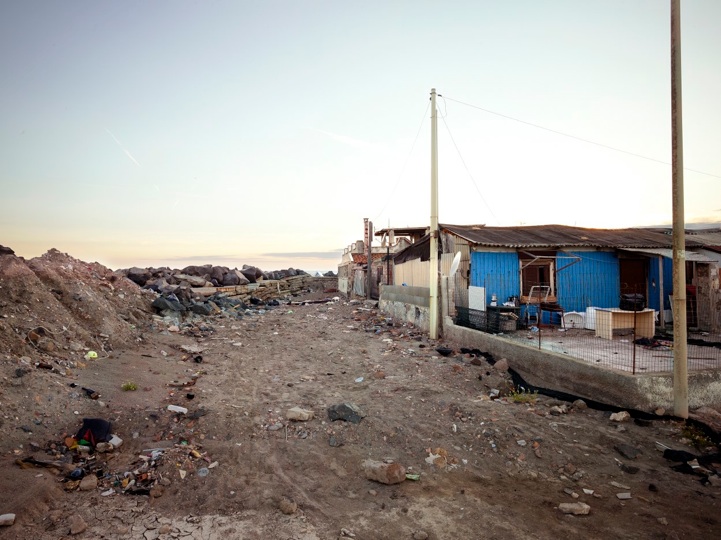 Alessandro Imbriaco, untitled, AIdroscalo
AIdroscalois is the area by the mouth of the Tiber, just 10 kilometres from Rome. The community living there is a mixture of migrants from Eastern Europe and poor Italians.
The equivalent squatting camps in Australia would be those of the Aboriginal people in towns like Alice Springs in the Northern territory.
February 14, 2013
The Denison Debates
Inglis Clark Centre for Civil Society has been holding the Denison Debates and public lectures about Tasmania. Where does Tasmania’s future lie? Has Tasmania reached a ‘tipping point’, politically, economically and culturally? Is is an island of broken dreams for those on welfare, with poor health and low educational qualifications. One view is that Tasmania is a basket case subsidized by the rest of the country--it's a “mendicant state”.
Tasmania ranks at the bottom among Australian states on virtually every dimension of economic, social, and cultural performance: highest unemployment, lowest incomes, languishing investment, lowest home prices, least educated, lowest literacy, most chronic disease, poorest longevity, most likely to smoke, greatest obesity, highest petty crime, worst domestic violence.
This is an underclass that helps to reproduce underachievement, generation after generation. Jonathon West, Director of the Australian Innovation Research Centre at the University of Tasmania argues that:
Demographics and income sources have coalesced to create a specific culture in Tasmania. More accurately, it is two cultures – one of a substantial “underclass”, the other of a smaller, comfortable, government-dependent middle class. The dark side of Tasmania’s enviable emphasis on a laid-back lifestyle is a culture of low aspiration, especially among the under-class.
His argument is that the problem is culture not economic disadvantage. That implies that even if they realise the awful truth about themselves, they are powerless to do anything about it. This is Tasmania as the failed state thesis.
West’s thesis is that Tasmania’s economic and social indicators are the worst in Australia because our high dependence on government welfare and employment means there is no incentive to overcome political and cultural barriers to personal improvement and private enterprise. Since Tasmania is a flawed and failed place so change can only come from outside.
Rodney Croome states that prejudice, ignorance and shallowness characterise the current national debate on Tasmania and its future:
On the political right the island is portrayed as the kind of poor, tree-hugging, gay-loving, welfare-dependent, enterprise-free society Green-dominated Labor governments inevitably create...The anti-Tasmanian myths perpetuated by progressive intellectuals are less obvious but just as self-serving. Debate on Tasmania is framed in terms of a unique ‘moment’, ‘watershed’ or ‘tipping point’ where the island faces the choice between embracing the creativity and innovation of the elite few or being held back by ‘local resistance to change’ and ‘stuck in the mud of the past’.
He adds that as with the Right’s story about Tasmania’s poverty and weakness, the cultural left’s wipe-the-slate-clean-and-start-again story about Tasmania’s future is based on the assumption that mainstream Tasmanian politics and society is fundamentally flawed, destined to failure and in need of rescue.
February 12, 2013
Chris Cherry's photos of China's migrant workers
Chris Cherry, a photographer loosely based in Beijing, has undertaken a photographic project on China's migrant workers.
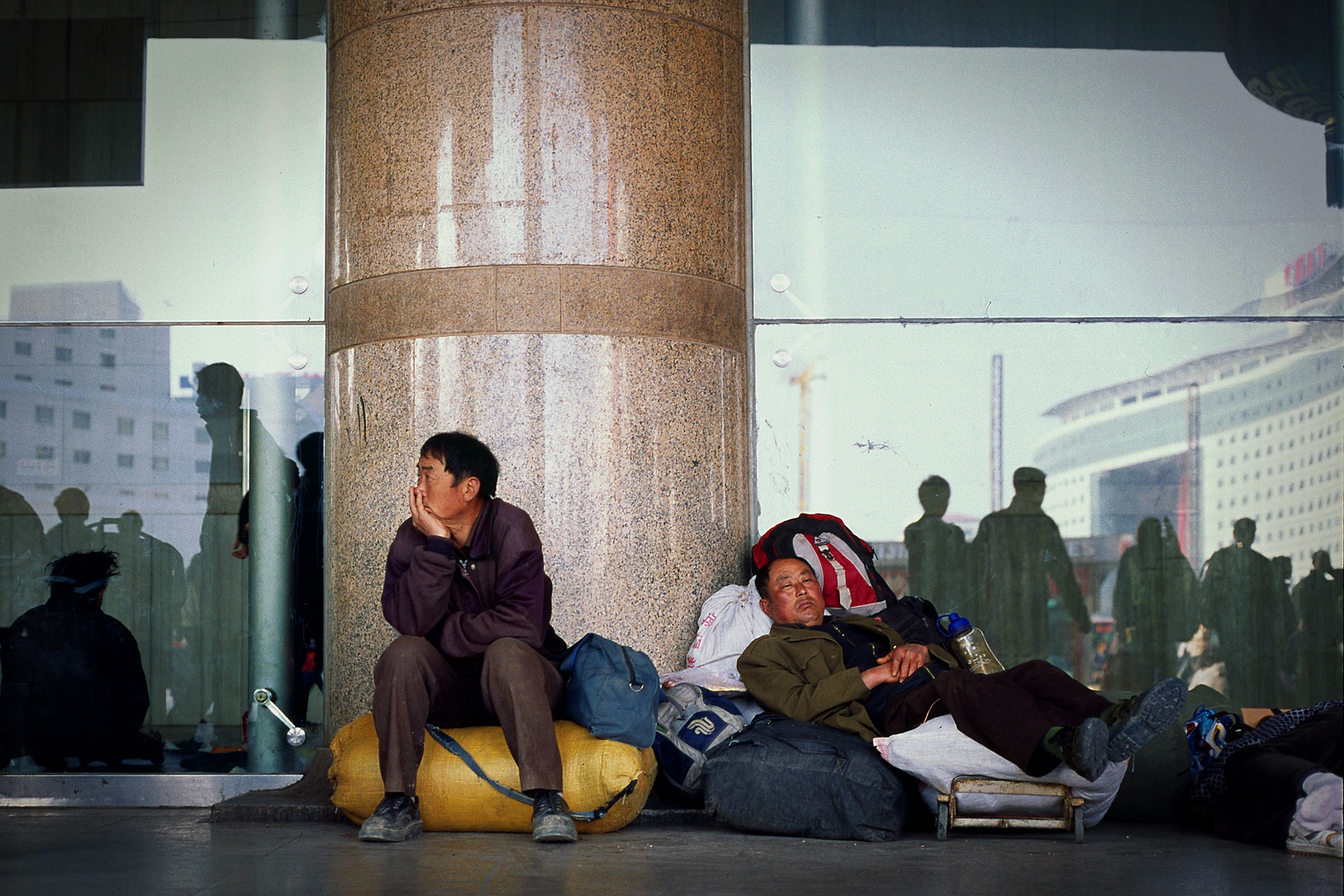 Chris Cherry, Wang Jia Yi and Gao Tian Ci, Dalian to San Li Village, Anhui Province, 2011
Cherry's says that:
Each year, millions upon millions [of migrant workers] untie themselves from the rhythms of rural life to chase down a future in the prestige cities and sudden boomtowns of the eastern and southern coasts. In doing so, they begin a dramatic journey from farmer to worker; one marked by a profound shift from cultivating land they own, to producing goods they don’t...On the factories and construction sites where they will find work they are considered lower still. Here migrants are merely human capital, valued for their sweat and energy — the raw materials of capitalist growth.
The project is a set of portraits taken at various train stations across the country — the most obvious place to locate a transient population, and what seemed a fitting backdrop for a people in flux. Subjects are either on their way to cities, or are returning home to their villages.
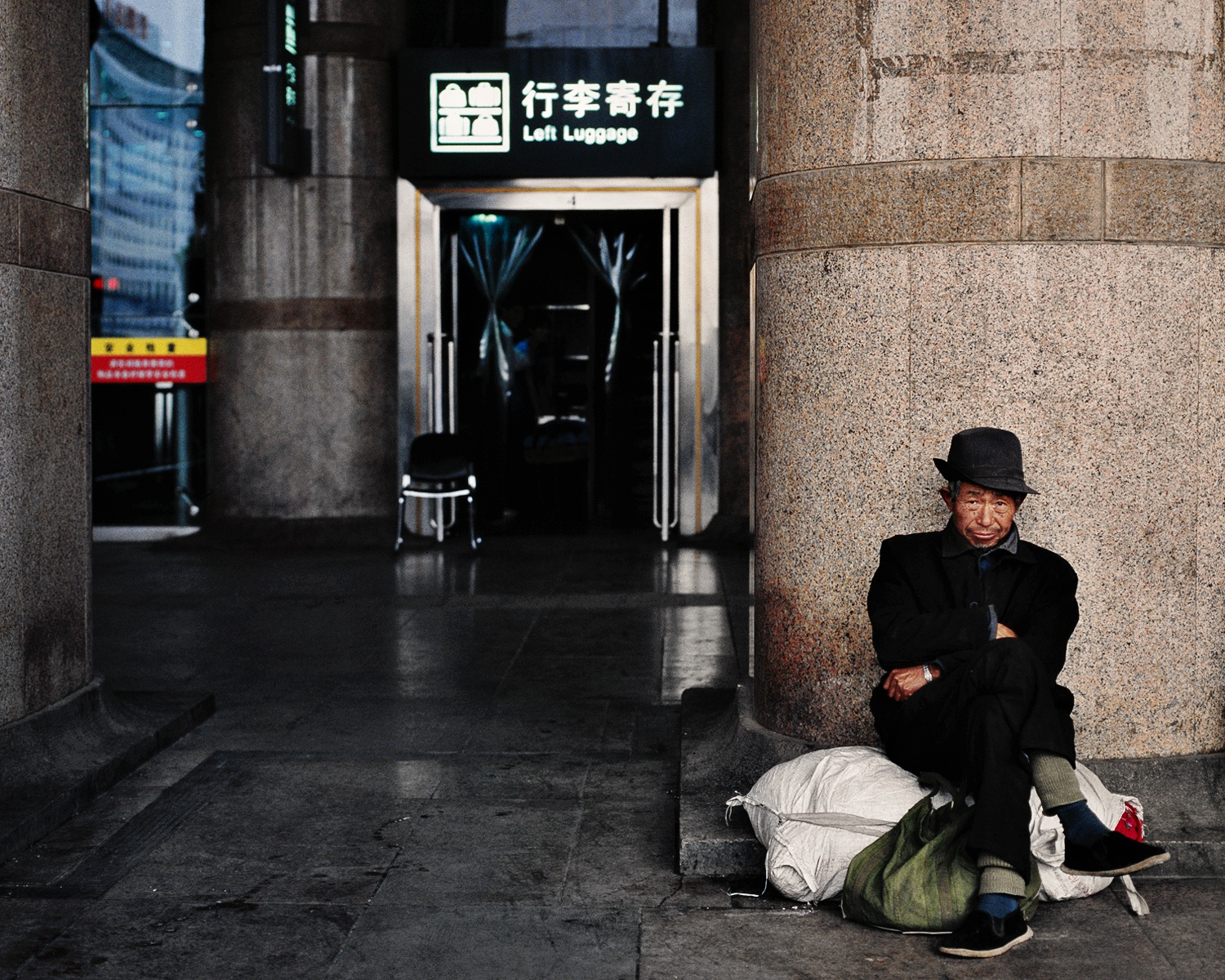 Chris Cherry, Chen Jun, Tianjin to Shahe Village, Henan, 2011
It's an interesting project.
February 10, 2013
Fiona Pardington: still life
It's a lovely still life:
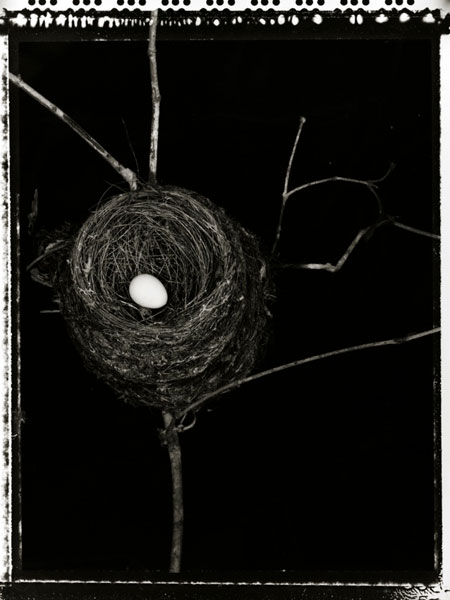
Fiona Pardington, Piwakawaka Pied Fantail's nest with an egg. Rhipidura fulginosa AV10478 Stewart Island, November 1948 Otago Museum, 2006, Toned silver bromide fibre based paper
It is such wonderful light.
February 5, 2013
the erosion of the culture of critical thinking
In Beyond the Limits of Neoliberal Higher Education: Global Youth Resistance and the American/British Divide Henry A. Giroux says that under neo-liberalism the culture of critical thinking has been slowly disappearing on U.S. campuses. The corporate university means that:
The corporatization of schooling and the commodification of knowledge over the last few decades has done more than make universities into adjuncts of corporate power. It has produced a culture of critical illiteracy and further undermined the conditions necessary to enable students to become truly engaged, political agents. The value of knowledge is now linked to a crude instrumentalism, and the only mode of education that seems to matter is that which enthusiastically endorses learning marketable skills, embracing a survival-of-the-fittest ethic, and defining the good life solely through accumulation and disposal of the latest consumer goods. Academic knowledge has been stripped of its value as a social good. To be relevant, and therefore adequately funded, knowledge has to justify itself in market terms, or simply perish.
He adds that the enforced privatization, the closing down of critical public spheres, and the endless commodification of all aspects of social life have created a generation of students who are increasingly being reared in a society in which politics is viewed as irrelevant, while the struggle for democracy is being erased from social memory.
In a social order dominated by the relentless privatizing and commodification of everyday life and the elimination of critical public spheres, young people find themselves in a society in which the formative cultures necessary for a democracy to exist have been more or less eliminated, or reduced to spectacles of consumerism made palatable through a daily diet of game shows, reality TV, and celebrity culture.
Under the reign of market fundamentalism has been transformed into a society that is more about forgetting than learning, more about consuming than producing, more about asserting private interests than democratic rights.
February 2, 2013
D. Darian Smith: architecture
A photo by D. Darian Smith of a corner in my local neighbourhood when newspapers were a central part of everyday life. It's a good example of how photography is a part of history.
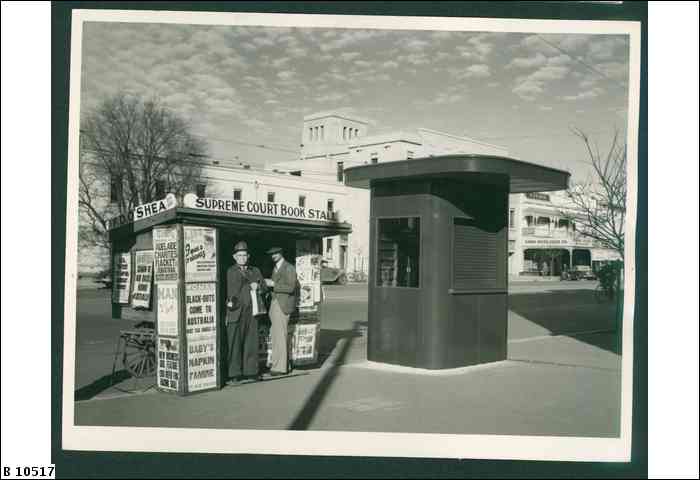 D. Darian Smith, south -west cnr King William and Gouger Streets, Adelaide, 1941
D. Darian Smith was an Adelaide photographer who worked from the 1930's to the 1970s. I really love his architectural work:
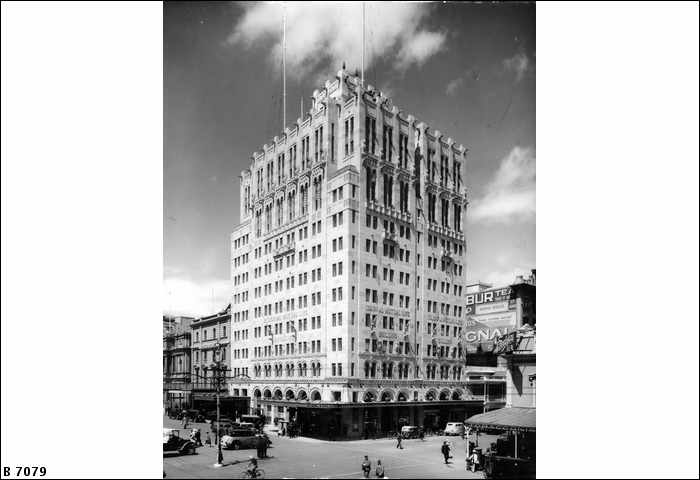 D. Darian Smith, C. M. L. building, south corner King William Street and Hindley Street, 1936
This is an excellently composed picture of a now heritage building.