April 30, 2012
Edward Burtynsky
Edward Burtynsky is well known for his large-format photographs of industrial landscapes amongst other subjects that refer to, and represent,"the industrial sublime" or "the toxic sublime" in western capitalism.
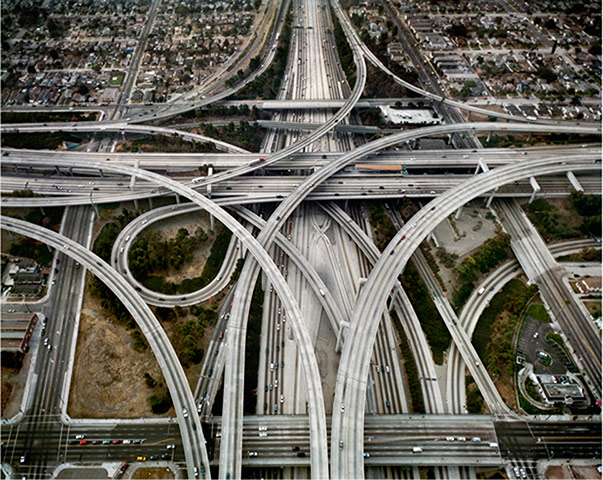 Edward Burtynsky, Highway 1, Intersection 105 & 110, Los Angeles California, USA, 2003
Burtynsky has also photographed Australian mining landscapes in Western Australia. This series of photographs was taken in 2007 and continues Burtynsky's interest in the global human effect on the natural environment.
The series continues Burtynsky's interest in the global human effect on the natural environment.
In his analysis of Burkynsky's work Jonathan W. Marshall says:
Burtynsky began taking photographs of the North American hinterland in the early 1980s. Strongly influenced by the cool revelation of banal beauty and ordinary ugliness executed by the Bechers and the American New Topographers of the 1970s, Burtynsky initially focussed on marginal settlements which mixed urbanity with the rural in what might be read as a commentary on Canada's stockade mentality, whereby Northern American settlement has often been figured as a defensive extension of technology linking fortified blocks through railroads, telegraph lines and other melancholy signs of an endless battle with Nature in the far north.
These themes are a key feature of Canadian Modernist art, as in the work of the Group of Seven painters (Tom Thomson, A.Y. Jackson, J.E.H. MacDonald, and others, 1920-33).
Burtynsky's first major series was devoted to railcuts: the passage of train tracks through an inhospitable environment across which human designers have engineered an aggressive scarification of the land. Whilst still to some degree reflecting a specifically national aesthetic, charting the ambivalent violence of the Canadian frontier wherein technology has served as a tool of both civilisation and alienation, many of the major characteristics which were to define Burtynsky's oeuvre were already visible.
Marshall says that these characteristics include:
human technology and capitalism as violent forces which radically transform the landscape to produce spectacles even more awesome and sublime than those they replace ("industrial incursions into the landscape", as Burtynsky has described them; nd); technology as an interlinked nexus whose function is to create associations between places, landscapes, societies and capital; large scale imagery filled with detail, especially that of the stressed, fractured surface (rock faces, and so on); a tendency towards an abstracted vision of place in line with what Philip Goldswain has called the New Topographics' perspective of the "empty terrain vague of the American city" (... or the similarly depopulated vistas of Canada's own Group of Seven painters ....; and a photographic practice increasingly based on tracing thematic concepts and categorical definitions across a visually diverse but aesthetically formalised and unified visual field (railcuts, mines, quarries, tailings, the extraction and consumption of oil, etcetera).
Burtynsky's wide but precise cropping, his organised viewing of potentially chaotic visual material, and the clear delineations of blocks of tonality and line which his imagery offers, was to define his mature style from this period onwards.
April 27, 2012
South Australian photography: Paul Foelsche
Paul Foelsche was a policeman based in Darwin in the 19880s when it was known as Palmerston prior to 1911 when it passed to the Commonwealth. Foelsche built a small photographic studio next to his house in Palmerston, and it was here that he made many of his portraits. He also took landscape views:
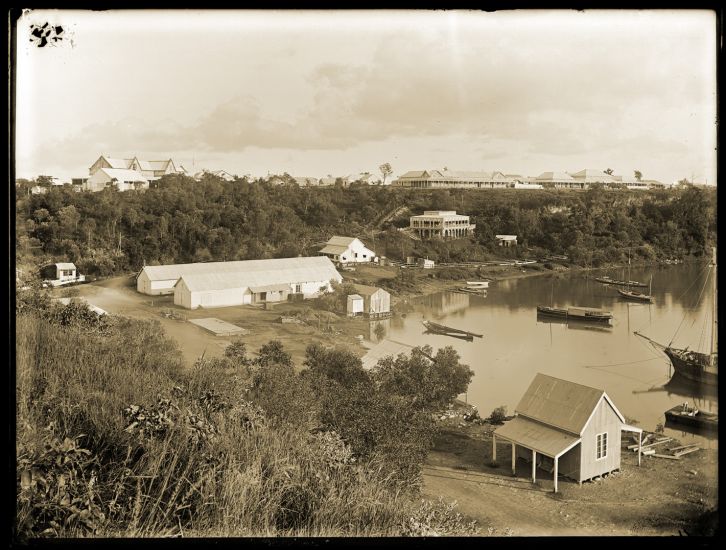 Paul Foelsche, Palmerston from Fort Hill, March 1887
He had a wagon with his camera, tripod, portable darkroom and chemicals. He often cleared the foregrounds of vegetation and positioning people like actors on a stage.
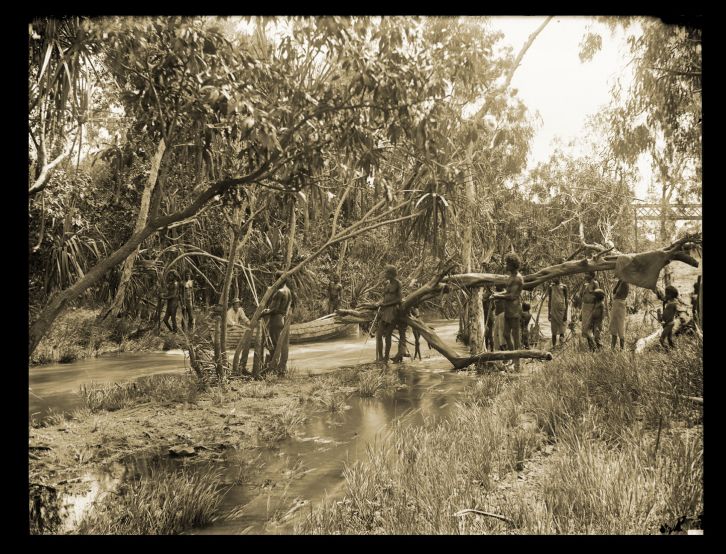
His preference was for wider, more complex landscape views, rather than close-ups of single subjects.
April 26, 2012
re-reading Martha Rosler on docmentary photography
I'm at a bit of a loss to know how to continue with my Rethinking documentary photography after returning from Tasmania. So I thought that I'd do a bit of reading of old texts on documentary photography that I remembered reading, such as Richard Bolton, ed., The Contest of Meaning: Critical Histories of Photography (Cambridge, Mass.: MIT Press, 1990).
Included in it was Martha Rosler's her late 1970's essay 'In, Around, and Afterthoughts on Documentary Photography)' in Decoys, Disruptions: Selected Writings 1974-2001. She begins by asking 'How can we deal with documentary photography itself as a photographic practice? What remains of it?' It's a good question.
She answers thus:
We must begin with it as a historical phenomenon, a practice with a past. Documentary photography has come to represent the social conscience of liberal sensibility presented in visual imagery (though its roots are somewhat more diverse and include the “artless” control motives of police record keeping and surveillance). Photo documentary as a public genre had its moment in the ideological climate of developing State liberalism and the attendant reform movements of the early-twentieth- century Progressive Era in the United States and withered along with the New Deal consensus some time after the Second World War. Documentary, with its original muckraking associations, preceded the myth of journalistic objectivity and was partly strangled by it.
It's a very American perspective, understandable given her concern with the Bowery in New York as a historical site of victim photography in which the victims, insofar as they are now victims of the camera—that is, of the photographer—are often docile, whether through mental confusion or because they are just lying there, unconscious.
Yet documentary, still exists and it, carries (old) information about a group of powerless people to another group addressed as socially powerful. She adds:
the documentary that has so far been granted cultural legitimacy has no such argument to make. Its arguments have been twisted into generalizations about the condition of “man,” which is by definition not susceptible to change through struggle. And the higher the price that photography can command as a commodity in dealerships, the higher the status accorded to it in museums and galleries, the greater will be the gap between that kind of documentary and another kind, a documentary incorporated into an explicit analysis of society and at least the beginning of a program for changing it.
The liberal documentary, in which members of the ascendant classes are implored to have pity on and to rescue members of the oppressed, now belongs to the past. This is a contrasted to a radical documentary of the present; a financially unloved but growing body of documentary works committed to the exposure of specific abuses caused by people’s jobs, by the financier’s growing hegemony over the cities, by racism, sexism, and class oppression; works about militancy or about self-organization, or works meant to support them.
Rosler's work was an act of criticism which demonstrated how both language and images are insufficient to for a full description and analysis of this poor area of New York where homeless people gather to drink alcohol. Whilst doing so punctured the assumptions of liberal or humanist documentary photography.
April 23, 2012
Captain Sweet: architectural photography
Captain (Samuel White) Sweet makes occasional appearances in Gael Newton's standard reference work on the history of Australian photography, Shades of Light: Photography and Australia1838-1988.
She says that the collodiotype had facilitated the rise of the views trade to such an extent that by the mid 1860s some photographers like Captain Sweet in Adelaide could advertise as specialist landscape photographers. In Expeditions, Excursions and Expositions chapter she says that in:
1870 Sweet was commissioned to supply the northern construction teams racing to complete, on schedule, the British-Australian overland telegraph link from Darwin to Port Adelaide. His views of the men and camps, and the ceremony of laying the first telegraph pole in Port Darwin, are the only records of a momentous leap in Australia's communication with the world.His finely composed, large, well-printed images of the new settlement in the north were encouraging to those who still hoped that settlement would one day cover the continent, and the pictures of the electrical umbilical cord connecting Australia with Europe were a promise of the future
Sweet had a studio in Adelaide from 1866 to 1886 and he photographed the growth of the city of Adelaide:
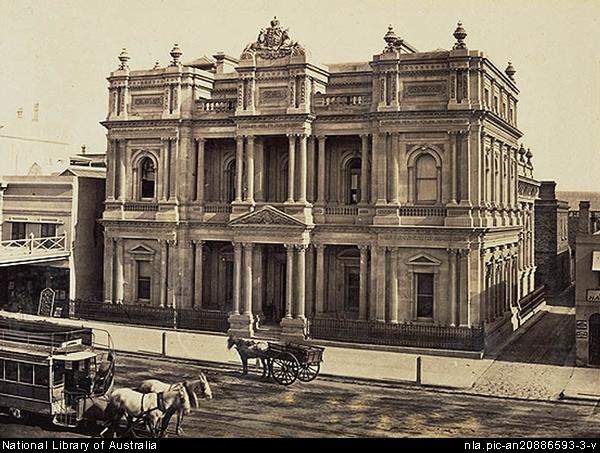 Samuel White Sweet, Bank of S.A., Adelaide, NLA
Newton says that the late work of Captain Sweet the photographs of the early 1880s-- have both complex arrangements of figures and machinery and also a formal signature of novel angles, diagonals and interests in linear patterns.
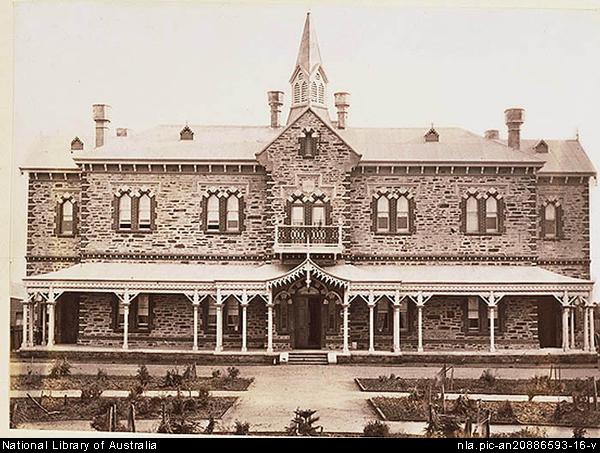 Samuel White Sweet, Deaf Dumb & Blind Asylum, Adelaide, gelatin silver NLA
Newton adds that a heightened awareness of the photograph as a pictorial entity is evident in the work of the best view photographers of the period. As a consequence of this instinctive or conscious recognition of the difference between reality and its photographic representation, the personal styles, and even personalities, of many photographers in the 1880s are more evident than during the pioneer generations.
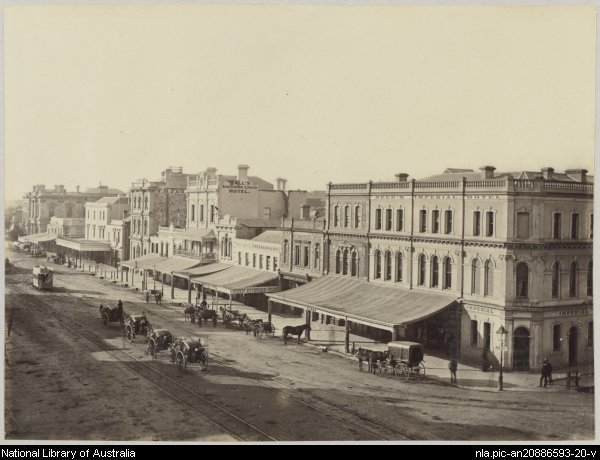 Samuel White Sweet,King William St, Adelaide [showing Hall's Southern Cross Hotel, the Imperial and various shops, horse and buggy and tram] , gelatin silver, NLA
So we have a sensitivity to the photograph as a picture in its own right in addition to the traditional topographical role of the view photograph. What that role is is unclear. What topographics is in the Australian context is not made explicit. Does it mean objective, scrupulous and documental descriptions or urban life with large format cameras? Does it imply a particular interpretation of this urban views?
And that's pretty much it. Pictorialism emerges in Adelaide in 1897 with John Kauffmann. A new chapter.
If we tarry a while on topographics can we say that Eugène Atget and Walker Evans, who examined and documented the built, vernacular landscape, the former in Paris at the turn of the 20th century and the latter in Depression-era America, are a continuation of the topographic photographic tradition? What is a topographic photograph? How is it different from trade views?
What is 19th and 20th century topographic photography? What would contemporary topographic interpretations of 21st century Adelaide look like?
April 20, 2012
Levon Helm: In memoriam
Levon Helm died of throat cancer aged 71 today.
The reformed Band without Robbie Robertson opened for the Grateful Dead on New Years Eve 1983 with Jim Weider on guitar. Here is their set.
The reunited Band was generally well-received, but they found themselves playing in smaller venues than during the peak of their popularity. On March 4, 1986, Manuel committed suicide, aged 42, in his Florida motel room. He had suffered for many years from chronic alcoholism.
Helm, Danko and Hudson continued in "The Band", releasing the album Jericho in 1993 and High on the Hog in 1996. The final album from The Band was the 30th anniversary album, Jubilation, released in 1998. Helm went on to carve out an individual career.
Helm used his house to stage “rent parties” in an effort to pay his mortgage and medical bills. The Midnight Ramble kicked off in the barn at 8:00 on Saturday night and shimmied ‘til midnight, becoming a continued event and one of the most cherished musical venues in the country.
Levon’s Midnight Ramble Sessions rejuvenated a creative spark, inspiring an ode to his family with Dirt Farmer, for which he received a Grammy for Best Traditional Folk Album in 2008, and Electric Dirt, which won the Best Americana Album in 2010.
April 17, 2012
Watkins Glen, NY, 1973: Summer Jam
Allman Brothers with the Grateful Dead and members of The Band, at the legendary Watkins Glen concert in Upstate New York in 7/28/73. The largest crowd that ever gathered for a rock festival did so at Watkins Glen, New York, in July of 1973. More than 600,000 young people sardined themselves into the Watkins Glen Grand Prix Raceway for a single-day festival known as the Summer Jam featuring the Grateful Dead, the Allman Brothers, and the Band.
Each of the three groups at Watkins Glen played unusually long sets. The Grateful Dead performed for five hours, the Allman Brothers for four, and the Band for three, including a thirty-minute break due to a thunderstorm.
Prior to the concert--the day before-- we have the Grateful Dead's sound check that includes the jam into Wharf Rat or alternatively, the 1973 Watkins Glen sound check jam.
April 15, 2012
Eugène Atget: Le Pont Marie
In documenting old Paris Eugène Atget returned to the same location again and again. A case in point is the two photographs of Pont Marie that Atget took over a period of more than 20 years:
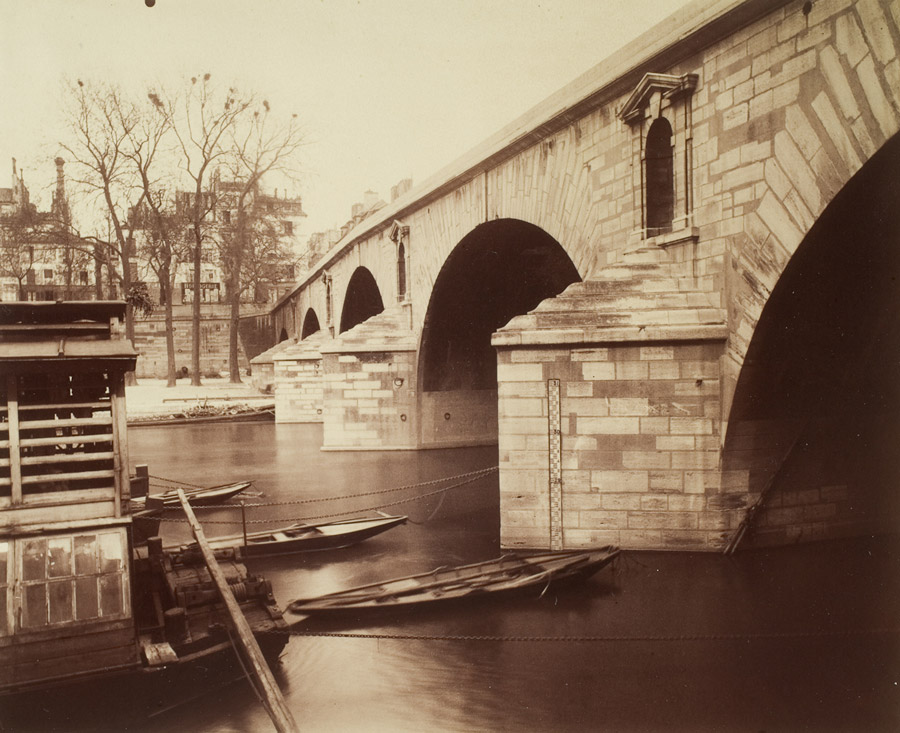 Eugène Atget, Le Pont Marie, 1903
Le Pont Marie is an architectonic 17th-century bridge set in the heart of Old Paris, where it connects the residential Île Saint-Louis to the right bank of the Seine.
Over 290 years latter Atget has composed the photograph of Le Pont Marie with the sycamore trees dominating the foreground and he is shooting into the light:
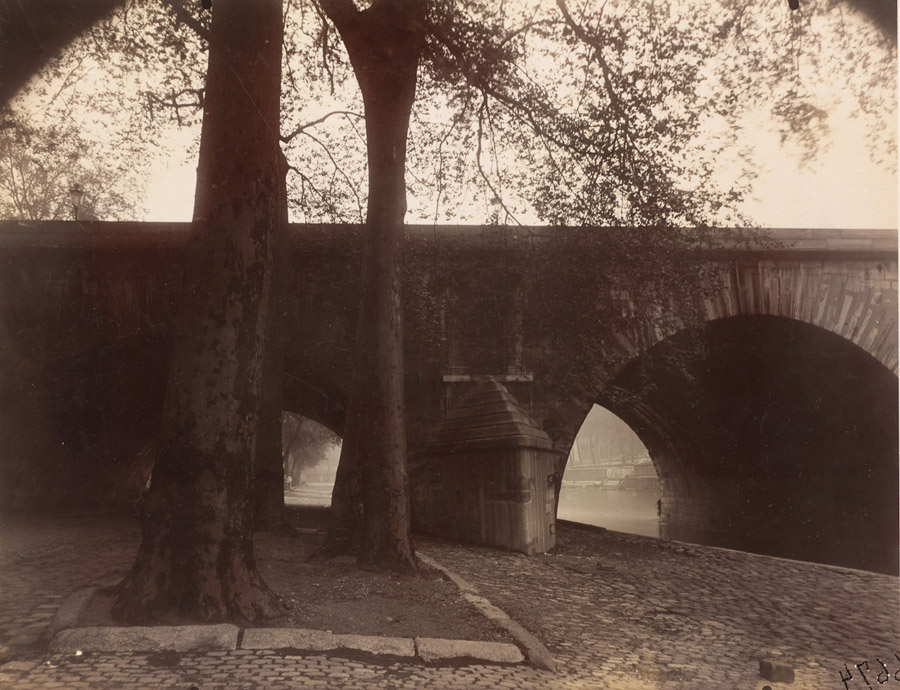 Eugène Atget, Le Pont Marie, 1926
Whereas the 1903 study is picturesque whilst showing the bridge in relation to the Seine's role in the life of the city the latter study is more sombre.
April 12, 2012
Adelaide Festival: Pat Brassington
The Adelaide Festival of Arts was on whilst I was a phototrip in Tasmania. The visual art highlight was Parallel Collisions at the Art Gallery of South Australia.
This presentation of contemporary Australian art included the work of Pat Brassington who also featured in the Hits and Memories: ten years at the Academy Gallery exhibition at the School of Visual and Performing Arts at the University of Tasmania.
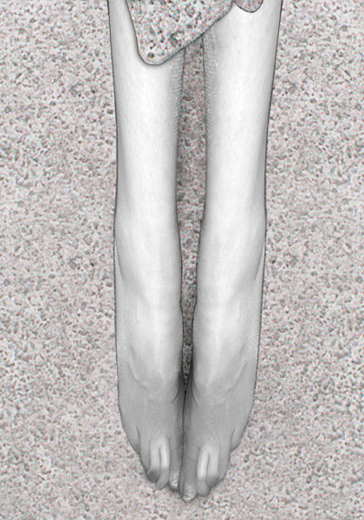 Pat Brassington, Like a Bird Now, 2010, Pigment print
The images are offsetting or off centre in such a way that they disturb and create unease--they are part of a postmodern culture in that they deconstructed notions of the original and authenticity, interrogated the epistemology of the gaze and the stereotypes of feminine sexuality.
It is the psychoanalytic world of the uncanny that we have entered into but one viewed through surrealism. Ane Marsh in A Surrealist Impulse in Contemporary Australian Photography in Papers of Surrealism Issue 6 Autumn 2007 puts it thus:
Freud’s notion of the uncanny is exploited in much of Brassington’s imagery,as here what is homely and familiar becomes unhomely, unfamiliar, strange. The uncanny haunts the everyday and is sometimes experienced as a sense of unease, a kind of déjà-vu when we sense that we have seen this or been here before. This feeling of history repeating itself is intimately tied up with imaginary/psychic memory which is incomplete and fragmented, full of lost images and repressed fears. This kind of imagery circulates in the cultural imaginary and comes alive in art, literature and film. Brassington operates as a kind of archaeologist of the uncanny, picking over the ruins of conscious life and lived experience to find something beneath the surface which excites fear.
April 10, 2012
Facebook, Instagram, Pinterest
Faced with its first serious competitor, Facebook has spent a billion dollars to purchase Instagram, a photo-sharing service. Why would Facebook spend a billion dollars on a photo-sharing anything? Why would Facebook promise to keep Instagram a separate service and invest in it?
Now Instagram does mobile photos better than Facebook .Instagram has become the Flickr of mobile photos. Instagram is popular in the mobile world which is where Facebook has struggled. If mobile is the future, then Facebook’s achilles heel is mobile photo sharing. Computing is increasingly going mobile and consumers are snapping up mobile devices with increasingly better cameras built in. This leads to Instagram.
In Facebook's instant Instagram gratification Charis Palmer says that:
Facebook's $1 billion purchase of Instagram is an acknowledgement that Facebook is basically a photo sharing business. If only Kodak had realised photo sharing was the future of photography, it might have bought, or at the very least partnered with Facebook, and wouldn't now be faced with a future that consists of little more than flogging off its patent portfolio
She asks will Facebook continue to identify and buy businesses that are strategic threats, or will it be leapfrogged by a faster, nimbler player that no one sees coming? Maybe Facebook is placing a roadblock in front of Pinterest?
Secondly, it's easier to buy a company than transform one. Facebook, like Apple, is big enough that it can buy impressive upstarts - even overpaying in the process - in part so that no one else can buy them instead. Facebook, for now, are many people’s “home base” to provide login, authentication and open APIs to cross-post content and opinions.
Maybe buying Instagram gives Facebook direct access to the photos shared as opposed to the indirect (only photos shared FROM Instagram to Facebook) and to ensure its continued dominance in photo-sharing. Though Zuckerberg promises a standalone Instagram, he will, of course, import all the pictures in their context and metadata, to be monetized like everything else is in the Facebook network.
Consumers appear to work with one major social media “hub” like Facebook then one, maybe two specialized social media sites that are somewhat connected back to the home base. There’s only so many sites we can handle. So Facebook becomes the best “home base” it can be, integrating and facilitating traffic between smaller, specialized social media services.