March 23, 2012
on the edge of The Tarkine
It was raining yesterday so Suzanne and I went for a days drive though south western Tasmania---Waratah, Savage River, Corinna, Zeehan---along the edge of The Tarkine. The working mines--eg.,the open cut tin mine at Mount Bischoff and the open-cut magnetite mine at Savage River---were off limits. We didn't have the time to walk to the ruins near Waratah.
The painting below by Raymond Arnold is part of a collective set of 30 panels, plein-air paintings depicting geographical and mining aspects from the Savage River and Roseberry mining communities when Arnold was a community artist-in-residence in the early 1980s.
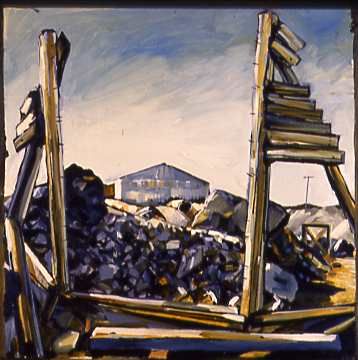
Raymond Arnold, Timber frame and rocks, construction site, from Traces, West Coast Tasmania, 29 from Set of 30 Paintings, Oil on canvas
Being an artist in resident is probably the only way to explore the mining ruins in any systematic way.
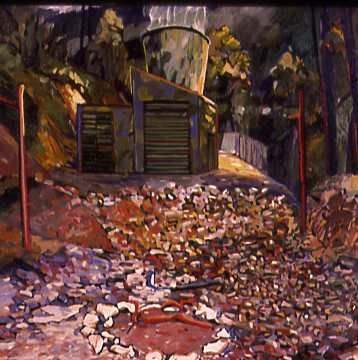 Raymond Arnold, Green shed, furnace disposal dump in foreground 30 from Set of 30 Paintings, Oil on canvas from Traces, West Coast Tasmania.
March 21, 2012
Tasmanian Photography: Stephen Spurling 111
I know very little about early twentieth century wilderness photography in Tasmania or about Stephen Spurling 111, the Tasmanian photographer of the early twentieth century. Like John Watt Beattie Spurling 111 produced work-- scenic attractions--- for the burgeoning tourism trade.
I have come across these industrial views of the Mt Lyell mine in Queenstown on the Collections Australian Network:
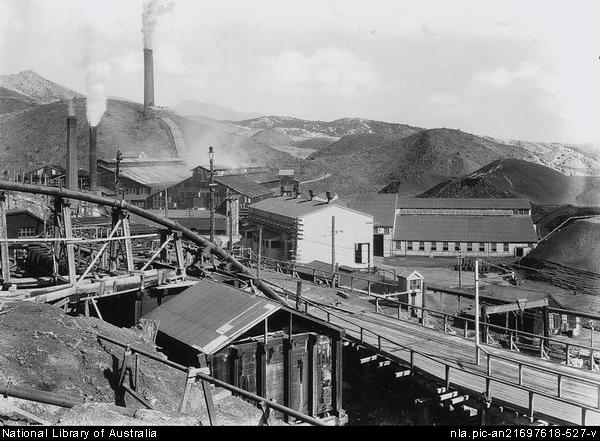 Stephen Spurling 111, Mt Lyell Reduction Plant, NLA
Spurling III was a prolific landscape and commercial photographer, with the largest studio in northern Tasmania from the turn of the century until 1937 and he is noted for his landscapes of Tasmanian wilderness areas.
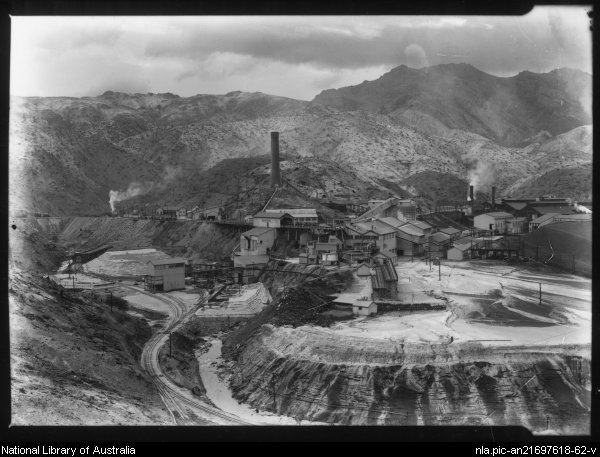 Stephen Spurling 111, Mt Lyell Reduction Plant, NLA
I understand that Spurling worked in the mines on the West Coast.
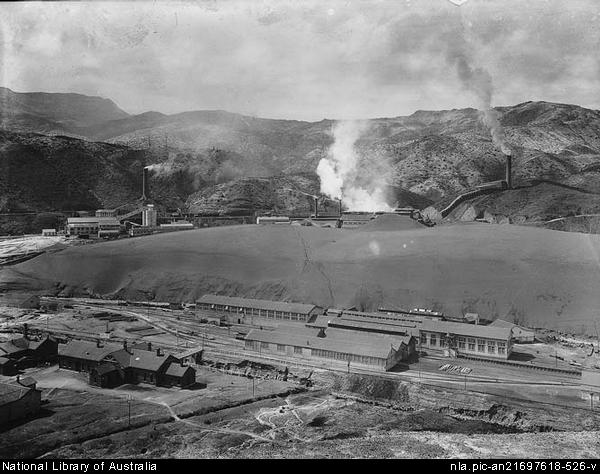 Stephen Spurling, Mt. Lyell Smelters and Railway Workshops, NLA
March 19, 2012
Raymond Arnold: the dead still live with us
Queenstown is haunted by its past. It casts a big shadow over the town. How is this haunting represented?
Raymond Arnold runs Landscape Art Research Queenstown (LARQ) in Queentown Tasmania. 'The Dead March Here Today' is Arnold's winning entry in the $20,000 Gallipoli art prize in 2010. It is the cenotaph in the night at Devonport in Tasmania:
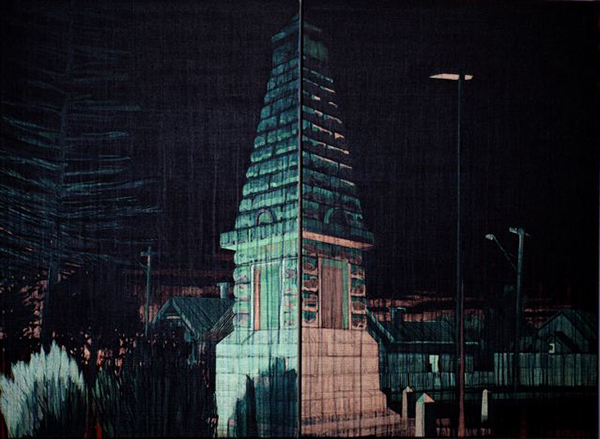 Raymond Arnold, 'The Dead March Here Today', 2010, oil on canvas.
Arnold, who regularly visited the Somme while living on and off in Paris during the 1990s had a grandfather who lost both legs to the medical condition of trench foot while serving in France. He said:
I grew up in the 1950s and 60s surrounded by men like that, including Japanese POWs, who had been damaged by conflict. I am carrying all that baggage, as so many people do.Everybody seems to have a story.There are hundreds of cenotaphs in Australia and New Zealand.The Devonport cenotaph could be any of them. It could be any cenotaph, any group of names that speak of great sacrifice, great honour to the people on these. They are sacred places.
It suggests a spectral figures of the past that still live with, and haunt, us.
Arnold has been walking, cycling and making his own artwork in those old World War I battlefields of Europe for decades:
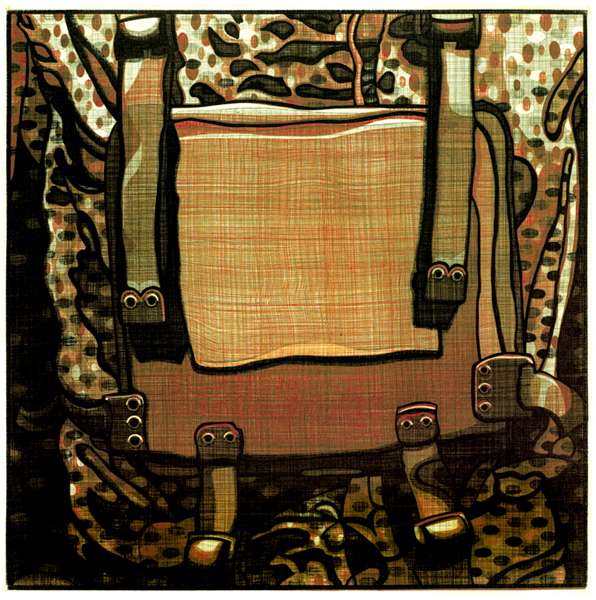 Raymond Arnold, Bayeux soldat I - Polish lancer 2004, two-plate etching.
March 9, 2012
Jon Cattapan
The Academy Gallery at the School of Visual and Performing Arts of the University of Tasmania. They were showing Hits and Memories: ten years at the Academy Gallery exhibition. The exhibition will include a showcase of Academy Gallery's archive media, exhibition catalogues and memorabilia associated with the Academy Gallery's history.
The work of Jon Gattapan is included:
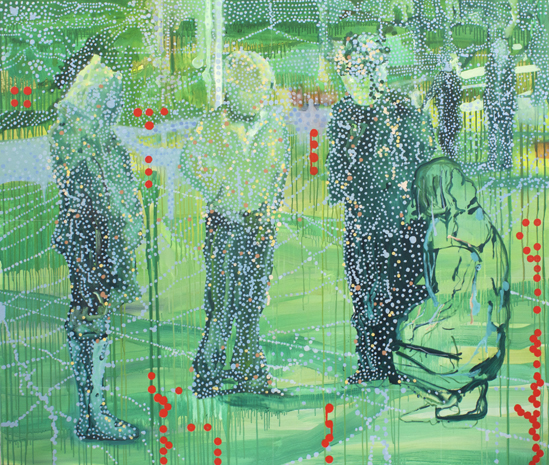 Jon Gattapan