November 26, 2012
Australia's refugee policy
It's a race to the bottom where the politics of the dog whistle, the veiled racism, is the norm.
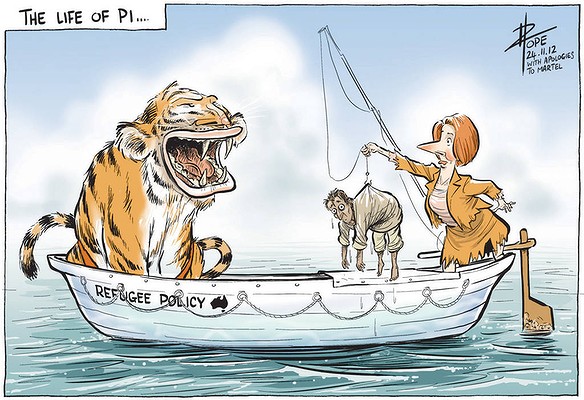 David Pope
The rhetoric around the refugee issue is one of defending the borders, queue jumpers, illegals, peaceful invasions' us and them, work for the dole. The Coalition keeps ramps up the conservative populism. It is being used to attack the minority Gillard Government.
November 23, 2012
Mars: Valles Marineris canyon
The Valles Marineris canyon on Mars is the largest known canyon in the solar system, is up to 11km deep. By comparison, the Grand Canyon is only 2km deep.
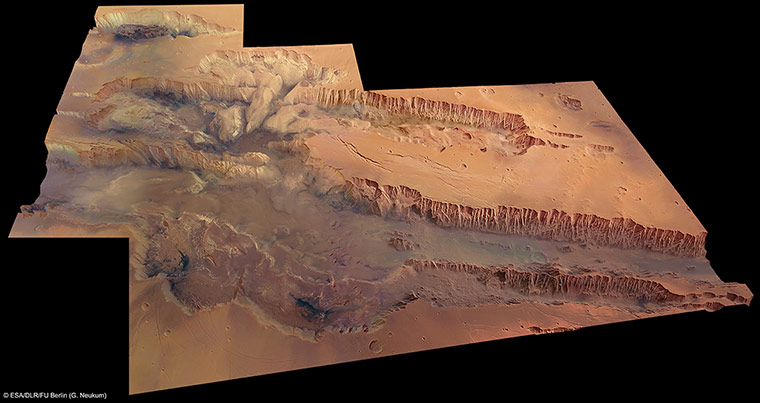 Mars Express, Valles Marineris, Mars, 2012
The image presented shows a bird's-eye view of the central and eastern part of Valles Marineris, or to put it more precisely, from the perspective of ESA's Mars Express spacecraft, which repeatedly crosses the Martian equator from north to south or south to north.The High Resolution Stereo Camera (HRSC) on board Mars Express, which is operated by the German Aerospace Center (Deutsches Zentrum für Luft- und Raumfahrt; DLR), has been taking image strips of the valley system since 2004 as it passes overhead.
The individual HRSC image strips are each between 50 and 200 kilometres wide, depending on Mars Express' orbit, so this view of Valles Marineris has only been made possible by creating a mosaic using 20 separate images.
Did water flow through the valleys with great energy, changing the landscape of Valles Marineris and making the valley floor even deeper?
November 22, 2012
Jeffrey Smart: The Holiday Resort
Carrick Hill is show working works from Jeffrey Smart’s early years between1940 to 1951. Twenty four paintings and as many drawings and watercolours will show the places he visited and depicted in South Australia tracing his emerging style and interests.
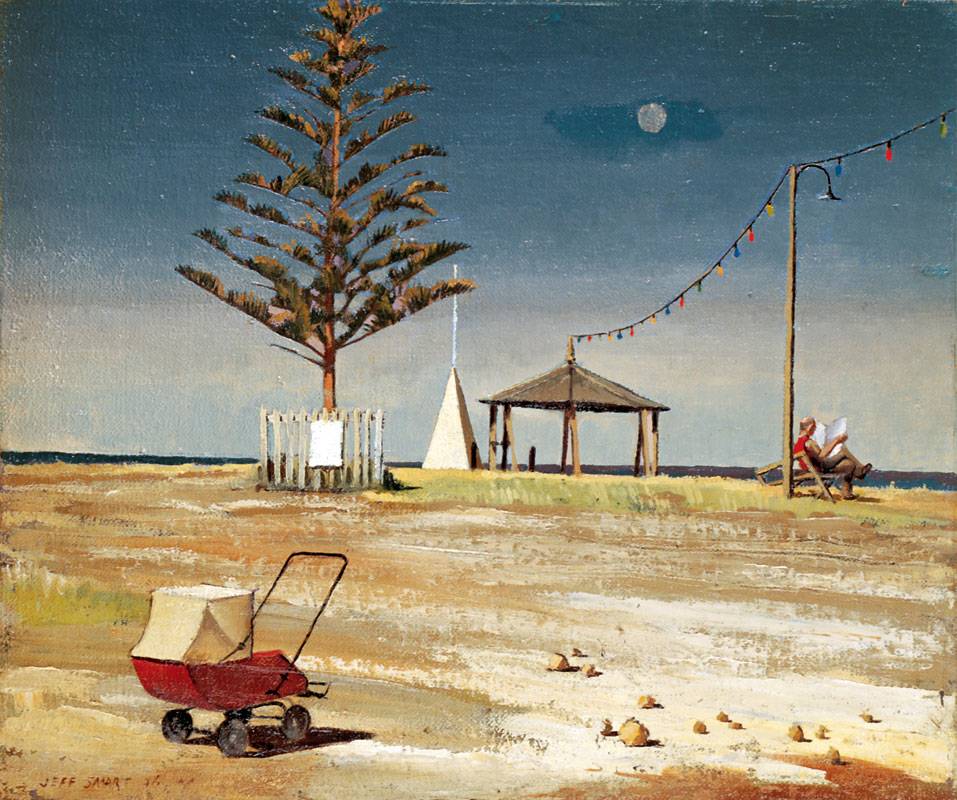 Jeffrey Smart, The Holiday Resort, 1946 oil on canvas
Smart left Adelaide at the beginning of 1950s to live in Sydney and later moved to Italy where he continues to live and work at his home in Tuscany.
November 19, 2012
Jeffrey Smart: Wallaroo
Wallaroo is located on the Spencer Gulf coast off South Australia. Jeffrey Smart visited Wallaroo in 1951 and made a number of watercolour studies of the town’s buildings, beach, mining sites and breakwater. Returning to his studio, Smart began mixing all the sketches together, trying them this way and that, seeing how they could agree in a large composition–a painting in oils.
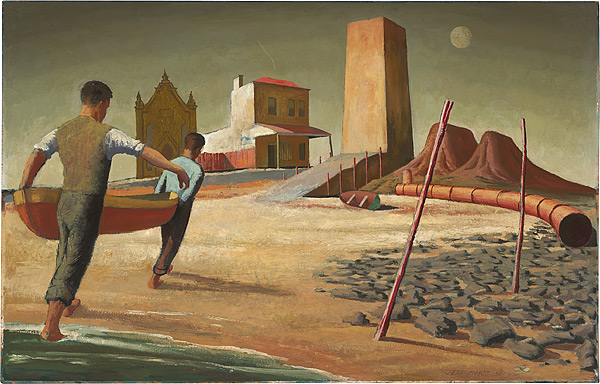 Jeffrey Smart, Wallaroo, 1951, oil on canvas
It is very surrealist. The first modernist style to arrive in Australia while it was still alive in Europe was Surrealism. In the decade from 1938 Surrealism was strongly associated with the formation of contemporary art societies in a number of Australian states. While there was no organised Surrealist movement in Australia, its importance lies in the fact that some of Australia’s leading artists were influenced by Surrealism at a formative period of their careers.
In Adelaide, in July 1942, a band of ‘rebel’ artists including, Douglas Roberts, David Dallwitz, Jacqueline Hick, Ivor Francis, Jeffrey Smart and Ruth Tuck formed a South Australian associate chapter of the Contemporary Art Society. Their inaugural exhibition of painting supplemented by works by James Gleeson, Carl Plate, Nolan and Tucker shocked elements of conservative Adelaide society. The work of these artists favoured distinctively Surrealist conventions. This group was joined by Dusan Marek in 1948 and James Cant the following year.
By 1949 the climate had altered considerably. A combination of the Ern Malley Affair and the William Dobell trial in 1944 had resulted in a swing towards extreme conservatism in the Adelaide art world, and Australia in general. Proclaiming oneself a surrealist in the post-war climate of Australia was tantamount to openly professing a belief in communism.
November 7, 2012
Thomas Birke: Tokyo
Thomas Birke went to Tokyo in 2008 to photograph the urbanscape. He always knew in advance where to shot in the evening or at night,from his intensive scouting.
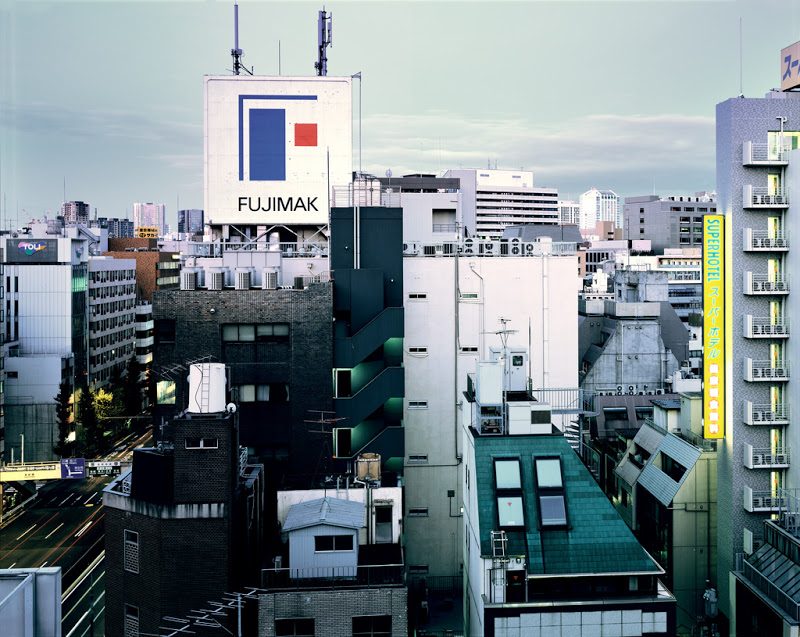 Thomas Birke, Tokyo, 2008
The pictures were shot mainly in twilight. The magic hour, where the houses are shining as bright as the residual daylight in the sky and the colourful neon signs melt with the green-blue of the beginning night. Presumably he worked from observation decks with open air, so that he didn't need to shoot through glass.