September 20, 2005
bodies, sex, ecstasy
Another reason for turning to the work of Bill Henson is that it is about bodies and sexuality as well as inner experience and the unconscious:
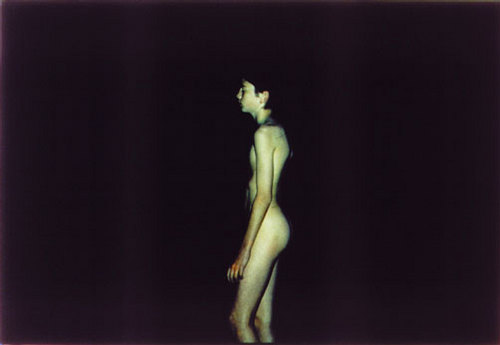
Bill Henson, Untitled #47, 1998, Untitled, 1997 - 1998
We have hints of ecstasy:
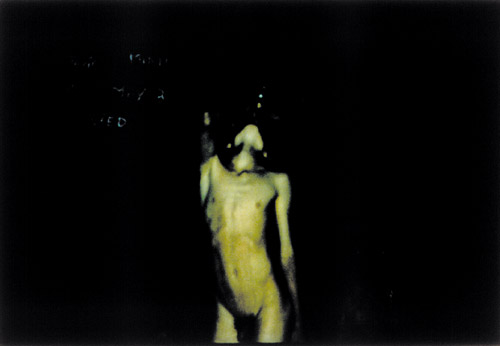
Bill Henson, Untitled #86, 1998, Untitled, 1997 - 1998
This takes us beyond the utilitarian conception of pain and pleasure the possibility that something could be pleasureable because it is painful. This throws the theory of utilitarianism into disarray. In this world, pleasure is good, and pain is bad. The notion that pain and pleasure can fold back onto each other in complex ways is absent. The ways in which pain and pleasure can annihilate the self and liberate one from the bounds of the ego are not included.

Bill Henson, Untitled 1994 / 95
This is a world of conflicting forces. in which the boundaries of the self are overcome and the edicts of the rational ego often ignored in the pursuit in sexual experience. Though the pursuit of sexual ecstasy through pain is seen as masochism, as a perversion, Bataille argues that this is one example of liberation through surrender.
September 19, 2005
September 18, 2005
I'm back on deck
I'm back on deck. I was busy working in Melbourne over the weekend and I had little time to post, read or even to think about becoming.
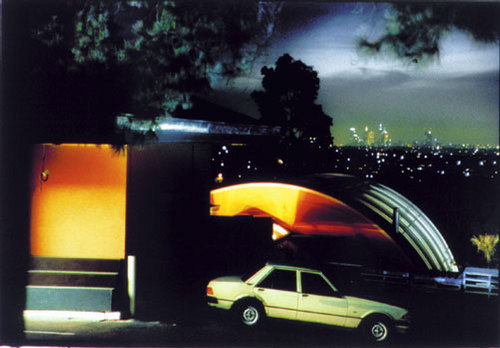
Bill Henson, Untitled #37, Untitled, 1997 - 1998
I 'll have to ease my way back into posting, as I've become disconnected from my previous posts.
So I will rely on the work of Bill Henson He seems to have an affinity with the French philosophers:

Bill Henson, Untitled #5, Untitled, 1997 - 1998
I was thinking of Bataille and Kossowski

Bill Henson, Untitled #12, Untitled, 1997 - 1998
It's all about inner experience, the unconscious and sexuality:
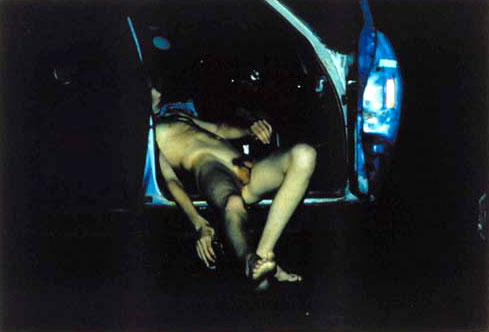
Bill Henson, Untitled #19, Untitled, 1997 - 1998
Art for Deleuze is interpreted as having a capacity to rupture life. Does Henson do this? I Dunno. The images are more affective than cognitive. I guess it does disrupt the everyday and common sense.
September 14, 2005
A review of a book on Deleuze by Eric Alliez, entitled 'The Signature of the World: What is Deleuze and Guattari's Philosophy?', This text focuses on What is Deleuze and Guattari's text 'What is Philosophy? The reviewer says that his second chapter, "The Aetiology of Science," Alliez stages :
'...Deleuze and Guattari's polemic against analytic philosophy, as scientization of philosophy. Now we have to read the analytics not as Hegelians, that is, as philosophers judging science from above, but as faithful to Deleuze and Guattari's notion that philosophy, science, and art are three different modes of thought. For Alliez, Deleuze and Guattari are engaged in the attempt "to sketch a programme of physical ontology up to the task of superseding the opposition between 'physicalism' and 'phenomenology' by integrating the physico-mathematical phenomenology of scientific thought into a superior materialism founded on a general dynamics" '
I too understand analytic philosophy in Australia to be a scientization of philosophy.
September 13, 2005
Deleuze/Nietzsche #2
Another post from John C. Halasz that has been taken from the comments section of this post..
Well, I read the Deleuze/Nietzsche article a few days back, though, needless to say, I wasn't exactly convinced by it, nor did it seem of compelling interest. (Such a lot of homework, but I treat it as an "open book" exam anyway.) But the bone I want to pick is the notion that there is a distinctively "post-modern" critique of metaphysics, with an unprecedented scope and force of its own.
To the contrary, my understanding of the main line of Western philosophy since Kant is precisely as a progressive critique of metaphysics. By "progressive", I don't mean a linear development, nor that the various proponents habored a progressive intent or view of history. I'm borrowing from the philosophy/historiography of science, and I mean a step-by-step and cummulative process, whereby the various positions mutually modify one another, leading through such acccumulation to the transformation of frameworks and shared, but contested problematics. You can name the parade of usual suspects, as you please, and the outliers, some of whom subsequently were promoted to the head of the class,- (though my own favorite outlier, Vico, actually preceded this whole development),- but what they all shared was a sense of growing crisis in the inherited, received metaphysical conception of reason, and the response of attempting to remedy that growing deficiency, however variously.
The case can be summarized thusly: Greek metaphysics first emerged, in opposition to the enmeshment and sacrificial submission to the mythic powers of the world, through the recognition of the transcendence of being, which yielded the sense that the world could be understood in terms of a quasi-systematic rational implicature, and a trauma of separation from the mythic world, which the "rational soul" had to master in order to be equal to its insight into that rational implicature. Henceforth, the notion of reason as a self-sufficient mode of the human understanding of the world and of human self-understanding is born. But Greek metaphysics, through its "binary" opposition to myth, carried its mythic antagonist with it as its doppelgaenger.
Further, Greek philosophy was born precisely at the point that the world of the Greek polis, which it presupposed, was at the point of collapse,- ("the owl of Minevrva flies at dusk")-, and would be transmitted into tradition by societies/cultures that were at once more politically diffuse and more mythically enmeshed than what had emerged and come to fruition in classical Greece. But eventually, the ideal of Greek metaphysics would make its way into the (re-)emergence of Western (philosophical/elite) culture, whereby the distinctive mark was that all knowledges, practices, social or natural orders, received their legitimation ostensibly through their "justification" by "Reason".
Given the forgoing synopsis, the point of the progressive critique of metaphysics is that it amounts to a reflexive continuation of the critique of myth: a critique of metaphysics is a critique of the myth of (metaphysical) reason. (Marx, a major suspect, is a crucial case here. It's important to recognize that Marx did not have a critique of religion, but rather a critique of the critique of religion. In consequence, he transferred the critique of religion on to a critique of secular ideology, while fitting it out with a "material" basis, all the while giving rise to a novel secular ideology.)
To further sharpen the point, though the metaphysical form of reason, indeed, criticizes and evades the mythified powers of natural and social domination, it is wont thereby to form conceptual mythologies of its own, de facto in submission to those self-same powers, and it is the reflexive critique of those conceptual mythologies that has been the contested burden of modern philosophy. (My own personal position is that this work is "completed" in the critical dissolution of epistemology in the work of Wittgenstein and Levinas. Henceforth, philosophy of itself has no claim to knowledge as such: there is no distinctively philosophical knowledge.
In fact, the criticism of the notion that knowledge is the supreme justification of existence is one of the main concept-fetishes to be purged of myth. Henceforth, other than the interminable debates over rationality and reason, the only competences left to philosophy as a distinct perspective or discipline are the interpretation and analysis of meaning- rather than truth-, the criticism of abstraction and its derivation, and the elucidation of norms, all without any claim to self-grounding or self-constituting "autonomy" and without any accompanying claim to the human sufficiency of reason, which is always contested and always at stake.)
The paradox of the "end" of philosophy is that it is precisely one of the finest products of the ideal of critical and self-critical reason that first emerged into the light of day under the aegis of Greek metaphysics. It's at that point that any specifically post-modern approach or mode enters onto the stage.
As to Nietzsche, I've never exactly taken him as a "positive" doctrinal philosopher, rather than as an extremely acute philosphical critic/critic of philosophy. I'd thought Heidegger's point about Nietzsche being, willy-nilly, enmeshed in the metaphysical tradition, aside from that deriving from taking the "doctrinal" Nietzsche a bit too seriously, even ponderously, was that Nietzsche was relying on a metaphysical notion of subjectivity, both in his appeal to "will" and to "values", which subjectivity, according to Heidegger, is a reflex of the metaphysical notion of substance. The critique of the metaphysics of the will, in my humble opinion, is one of the more valuable and recuperable parts of Heidegger, however mightily he sinned against it.
But I've alway thought that, whatever his broader prospects as a classical philologist, Nietzsche really needs to be understood against the background of Kant. It's not just that his ad hominem polemics bring out all those half-truths that are suppressed by the four-square Kantian conception of "Reason". It's that the basic move he makes is to reduce and identify all judgments to aesthetic judgments of taste, the rationality of which Kant first foregrounded and vindicated.
But the Kantian "justification" of aesthetic judgments of taste relied precisely upon the infrastructure of Kantian differentiations between domains of judgment, which are at once relied upon and collapsed by Nietzsche's generalization of aesthetic judgments onto a "cosmic" scale. (Briefly, the correlation would run: the "will-to-power" = transcendental synthesis, the uebermensch = transcendental subject, and "eternal recurrance" = the categorical imperative gone beserk. It's not so much that Nietzshe is "wrong", as that he's already operating in a parodic mode of criticism.)
But Nietzsche's criticisms actually gain greater force if one understands the "will-to-power", not as some generalization of 'cosmic" force, as he seems to present it, but as an existential locus of a perspectival criticism of presuppositions: where Nietzsche differs from his aestheticizing contemporaries is not just in his refusal to restrict such awareness to the domain of art, but rather in his lending it a specifically ethical import- hence "immoralism". Perhaps the whole paradox of Nietzsche's subsequent reception- how could he have known?- is that, while the thrust of his endeavor is against the notion of a return to any mythic "home", as represented to him by romanticism, as well as, Hegelian historical dialectics, he was taken by his epigones as authorizing a "new" mythology, in whatever direction, as a requirement for new "meaning".
As for Deleuze and his ilk, there are several worries. For one, does the obsession with difference actually have a flattening and de-differentiating effect, authorizing a regressive atavism by failing to sustain a sufficient conception of reason to acknowledge real differences and their effects? Does the collapsing of the notion of reason and its infrastructure proceed so far as to lose the demythifying intent and "authorize" or perversely legitimize new forms of mythic delusionality? Does the obsession with "becoming" not only conflate the the differences between change in "being", change in the world, and change in individual or collective human existences, but convert human freedom into a blind compulsion, rather than a real phenomenon, which can be delineated under different contents and conditions?
And doesn't such a self-insistent approach to sheer differentiation for difference's sake mirror the disintegrative tendencies of late capitalist societies without allowing for the establishment of any framework of social analysis by which such differentiation can be appreciated, beyond the sheerly categorical level? (It matters little that the claim is issued in the name of the acategorial: what is really at issue is what is "properly" and meaningfully acategorial.) Finally, isn't the insistence on differentiating "force" a (sollipsistic) continuation of the classical metaphysical insistence on the superiority of activity over passivity: patience, waiting, attentiveness, vulnerability, suffering, woundedness?
So, to return to the initial question about being and becoming, I'm not sure that is a good one in which to raise the issue of "binary oppositions" and the excluded middle and the ways such oppositions determine the alternatives of thinking, since, while the Parmenidean identification of thought and being is irremediably broken, the association of being and becoming is not, nor is it a crux through which to view different perspectives on reality.
"Reality" is precisely not that which remains the same through all change, but rather that which changes of itself, willy-nilly, whereby we understand change through what endures and enduring reality through what changes. Reality is the sense of cohesion in change. That such a reality does not satisfy us, indeed, might on occasion appall us, does not mean we can change it by simply appealing to its opposite.
September 11, 2005
The big easy
What millions of ordinary Americans saw on television's images of New Orleans was the brutality, destitution, desperation and chaos of the Third World. Instead of instinctive solidarity, mutality and compassion, they were witnesses to a descent into a Hobbesian state of nature; with Leviathan offering fly-by compassion, 30,000ft up.
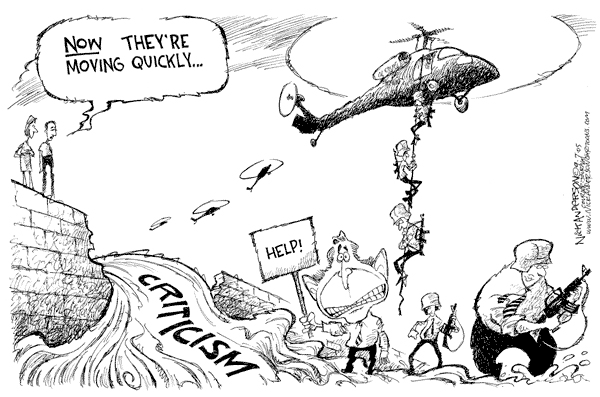
Katrina was the most anticipated natural catastrophe in modern American history. Instead of acts of mutual support there was the police force of Gretna, south of New Orleans, sealing off a bridge across the Missisippi river against incoming evacuees, and turning them back under threats of gunfire.
September 09, 2005
Kandinsky
Wassily Kandinsky's expression of his emotions perceptions led to the development of an abstract style of painting based on the non-representational properties of color and form.
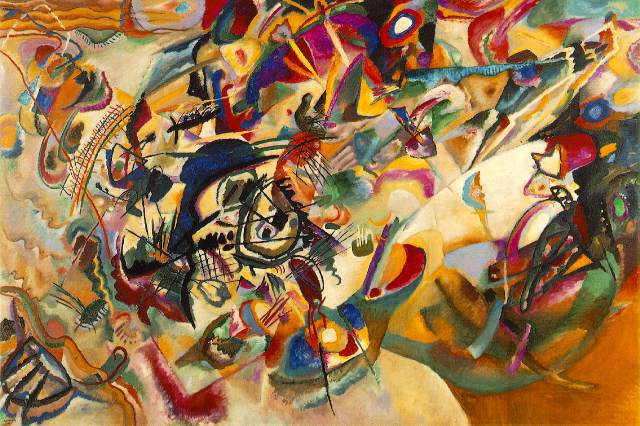
Kandinsksy, Composition V11, 1913
Colour gives way to form
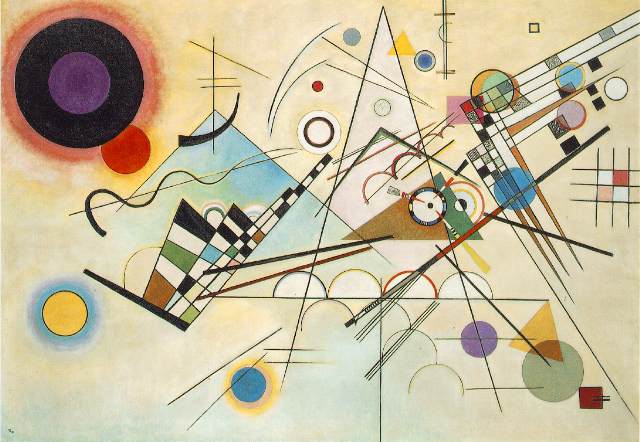
Kandinsky, Composition VIII, 1923
I wonder wha this kind of abstraction has to do with the abstraction explored in Adorno and Horkheimer's Dialectic of Enlightenment?
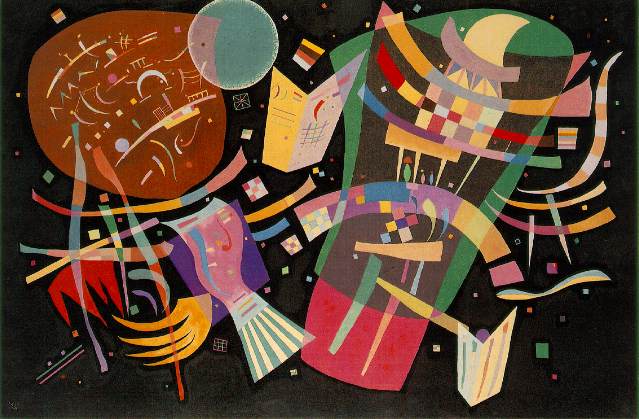
Kandinsky, Composition X,1939
September 08, 2005
criticizing Hegel
This is one way to interpret the representation of system in Hegel's texts:

A link for other interpretations.
Theodor W. Adorno, describes the challenge to critique Hegel in the following way:
Like other closed systems of thought, Hegel's philosophy avails itself of the dubious advantage of not having to allow any criticism whatsoever. All criticism of the details, according to Hegel, remains partial and misses the whole, which in any case takes this criticism into account. Conversely, criticizing the whole as a whole is abstract, "unmediated," and ignores the fundamental motif of Hegelian philosophy: that it cannot be distilled into any "maxim" or general principle and proves its worth only as a totality, in the concrete interconnections of all its moments. (Three Studies 2)
The bind in which Adorno situates the would-be explicator of Hegel needs to must be taken seriously.
Self-described "deconstructive" commentators have sought to reveal "cracks" or "flaws" in the Hegelian system, locating passages with which to argue that he is not a thinker of mastery because he understands subjectivity as a constant process of abandoning oneself and that he is not a thinker of totality and of pure self-presence because he treats discord and privation as constitutive of any position. To some degree, these demonstrations must be welcomed given the all-too-common impression that Hegel is a purveyor of reconciliation who strives to "mediate" between extremes, employs negativity to "erase" negativity, and offers us unlimited optimism in the form of a system that can only make progress in its quest for the truth of absolute knowledge.
Unfortunately, such efforts to locate instabilities internal to the Hegelian system may lack a broader interpretive significance. As Derrida never tires of reminding us, merely reversing the terms of an oppositional hierarchy does not necessarily even alter the dynamic at work, much less explain why it takes the form it does or what its pretensions to a totalizing authority may be.
September 07, 2005
Adorno's microanalysis of a deformed ethical life of private existence points to a disenchanted rationalized morality in a disenchanted natural world that is represented as a casual order knowable in mathematical terms.
It is this rationalized instrumental reason that is deployed to rationalize the major institutions of society into the modern bureaucratic legal-rational form---Weber's iron cage of modernity dominating persons.
September 06, 2005
Adorno: the end of ethical life
I've been watching television images of a flooded New Orleans. Large parts of it look like as if it is a banana republic in the Third World. Here a public ethical life whose elements make us ethical subjects has broken down, and everyday life has become a Hobbesian state of nature.
Swat teams are invading their own city and they having to fight to regain control of the hospitals. The state could not proceeed with the rescue until the city had been secured.
Not even the Adorno retreat to the deformed personal or intimate sphere is possible in many parts of the city. That too has disintegrated.
New Orleans highlights the truth of Adorno's argument about the rationality deficit in our ethical life.
Where to from there?
September 04, 2005
Nietzche's reversal of Platonism
In the light of the double bind in which interpretive critique finds itself, how then does Deleuze read Nietzsche's reversal of the Platonic tradition in Nietzsche and Philosophy?
Nietzsche argues that chaos needs to be ordered by us. We do so by schematizing in order to impose upon chaos as much regularity and form as our practical needs require. Our practical needs require that the strange and unfamiliar be reduced to what is familiar and the same. In this way they become calculable and usable to us [i.e., conform to our "practical needs". The predictable, regular, and ordered is therefore necessary for life.
How does this overcome Platonism? This article can help us. Nietzsche's pragmatism displaces Plato's conception of the Forms in which the 'Idea' of X -pre-exist it being applied to the realm of practical, day-to-day necessity; they are a consequence of this necessity, of our "practical needs." The Idea is contrasted with the sensuous world of appearances and thus it is part of a supersensuous world. It is therefore the relationship between the sensuous and the supersensuous which Nietzsche reverses: the sensuous world is genuine being. Hence Nietzsche's overcoming of Platonism is an inversion of Plato, as the Plato's true world of the (ideal) Forms is expunged.
This leaves the dual/oppositional, metaphysical structure intact. Is this a plausible interpretation of Nietzsche?
September 02, 2005
double bind
The usual response to the postmodern critique of metaphysics thast does away with metaphysics is to argue that this critique presupposes concepts and argumentative strategies that are at the core of the tradition of metaphysics itself, and thus the critique fails to overcome this tradition. This criticism was Heidegger's criticism of Nietzsche's inversion and reversal of Platonism. It was reinforced by Derrida, who cited Heidegger's claim that the Nietzschean reversalof Platonism (and its demolition) remains dogmatic and, like all reversals, a captive of that metaphysical edifice which it professes to overthrow".
Habermas claimed that such a claim is equally valid of Heidegger and Derrida themselves, in that each remain within "the constraints of the paradigm of the philosophy of the subject," a paradigm they claim to be criticizing.
This kind of criticism works in terms of the logic of either/or, whereby either one opposes and reverses the tradition completely, or one remains stuck in this tradition.
This would be a criticism I would make of being and becoming: we have the logic of either/or; consequently, critique is a reversal, inversion, or opposition (becoming)to that which is critiqued (substance), or attempts to reveal and restore a pre-existing order and realm of concepts.