July 31, 2004
Romanticism
Trevor
I understand your appeal to Medlin in terms of the dualism of modernity. This dualism is interrelatedas we have an unrestrained, irrational subjectivity interrelated with a hyper objectivity of abstract reason.
The modern form the concrete and the qualititative---the modern form of subjectivity-- is romanticism, by which is meant subjective expression that aesthetizices objects. Romantics seek out objects and situations as occassions for the expression of their subjective feelings. This romanticism has latent irrationality. Romanticism both celebrates the concrete and particualrity and infuses the technologically disenchanted world of modernity with meaning and value.
This is not a historical argument. It has relevance in terms of the
expressly individual romantic sensibilities of aestheticism, which has come to be the spiritual link between the individuals of the industrialized world, the shape of our ethical life. We now equate a meaningful life to the pursuit of unique experiences. These individual experiences are all given an aesthetic twist by which is meant beautiful.
The romantic movement performs a dangerous form of poetization and aesthetization. Though there is nothing wrong with aesthetics qua aesthetics, provided it remains within its own sphere, what romanticism does is to aestheticize everything.
Medlin stands for a political romanticism. This is left wing revolutionary action that views history as the univeralsing of Enlightenment values. It is intervention into, and control over history, through revolution, It is also the counter-revolutionary notion of history as the organic development of a people to block a leftist revolution.
July 30, 2004
Adorno: interpretations
Trevor,
That post was very insightful in terms of interpreting Adorno's understanding of the dialectic of enlightenment and distinquishing it from that of Habermas. It is very necessary to do that as the Habermas interpretation has been accepted. We do need to get back to Adorno.
What does that mean? You say:
"The dialectic of enlightenment cannot be overcome by perfecting enlightenment because, in essence, it has already been perfected. Auschwitz is the perfection of enlightenment – that’s the point. Negative dialectics is not superior reason. It is the negative moment of enlightenment turned against itself. But this is not an end in itself for Adorno. Negative dialectics needs to be overcome or it turns into a metaphysics, into another binding universal, another immanence, another myth. Negative dialectics is an historical curse, a kind of false teeth, as Canetti describes it."
Okay. Let us dump the perfection struff. I have no truck with the enlightenment perfecting itself.
Some questions.
But how is negative dialectics --as the negative moment of the enlightenment turned against itself---to be overcome?
Does not Adorno suggest an aesthetic reason working off high modernist art?
Why not an ethical reason that reaches back to the Greeks --a medical conception of ethics that starts from living damaged lives?
Are these not different pathways? Why should we accept tha the only pathway is through laughter, whereby the enlightenment finally recognises itself for what it is and gives up its destructive urge.
Why should we accept that reason is equivalent to the instrumental reason of the Enlightenment tradition. Why is negative dialectics the only way of thinking otherwise to that tradition gone sour?
What I find strange is that your interpretation of Adorno sees the textual overlaps between Adorno and Deleuze (fine) but none between Adorno and Heidegger. The same old repetition of insight and blindness.
Heidegger is displaced---yet again---whilst the overlap between the domination of nature in The Dialectic of Enlightenment and Heidegger's substantive account of the technological mode of being is ignored. And we have silence about the ecological interpretation of the domination of nature and technological mode of being--once again. Why this continuing silence.
Now for some polemics.
Given that this kind of silent response to ecological destruction is a systematic one I am now reading your appeal to marxism as some sort of social science touchstone that is premised on the domination and exploitation of nature. That would account for the constant sidelining of an alternative reason (mimesis, the ethics of a good life or a dwelling ethics) to a (Baconian?) concept of the Enlightenment reason perfecting itself.
What you offer is the "the negative moment of enlightenment turned against itself" until it recogizes itself in laughter. Any other pathway of overcoming, opened up by an immanent critique of an Enlightenment reason and its technological mode of being, is shoved aside as turning into "a metaphysics, into another binding universal, another immanence, another myth."
So you speak in the name of reason whilst we ecologists talk in the name of myth. How very convenient. That is a really nice modernist duality you have got going there.
Reason says that it is only in laughter that enlightenment finally recognises itself for what it is and gives up its destructive urge. Really?
Why should I accept that pathway? Why should I be concerned with figuring how do we come to see the joke through negative dialectics? What I see in your turn to aesthetic reason (literature) is a blindness to ecology. A very European blindness. Ecology is the radical difference between us.
There is not even a hint in your account that we live within ecosystems in that account. How very modernist and European. The memory of Australians once living within a healthy ecosystem has been obliterated. You could be living anywhere or nowhere and not at the end of a very sick River Murray.
What I see in South Australia is a lot of people responding to the destruction wrought by an Enlightenment reason on our ecology.They are deeply concerned by this. They desire to develop a new ethical way of living. It is a mode of living that cares for and is concerned about the river country they live, and which is a part of, in their everyday life.
July 29, 2004
Negative Dialectics
Gary,
Thanks for the comments so far. I really appreciate them.
Where to begin?
The Quotation about the Dialectic Of Enlightenment: I don’t know what the source is but it is wrong. The idea of a more substantive reason comes from Habermas – and perhaps Horkheimer but I don’t know his thought well enough – but definitely not from Adorno. The dialectic of enlightenment cannot be overcome by perfecting enlightenment because, in essence, it has already been perfected. Auschwitz is the perfection of enlightenment – that’s the point. Negative dialectics is not superior reason. It is the negative moment of enlightenment turned against itself.
But this is not an end in itself for Adorno. Negative dialectics needs to be overcome or it turns into a metaphysics, into another binding universal, another immanence, another myth. Negative dialectics is an historical curse, a kind of false teeth, as Canetti describes it.
One way of seeing this is as an attempt to get around the problem of identity, the negation of the negation. Negative dialectics is negation without identity. From this perspective Adorno is close to Deleuze. In fact, I’ve recently come to think that Deleuze and Adorno are much closer than is commonly recognised. They are both trying to get around the negation of the negation.
Dialectics cannot lead to its own dissolution but if that is all that we can do then it must contribute in some way to its overcoming. Adorno certainly thinks in this way. We know how it is overcome – through laughter. Through laughter enlightenment finally recognises itself for what it is and gives up its destructive urge. The question is, how do we come to see the joke through negative dialectics? Once again, Adorno thinks that dialectics, squarely faced, reflects the mirror image of its opposite, which is not identity but affinity.
For Adorno, this process is redemptive. We can’t have a positive image of a better world that we pursue, but in persistent critique we get a kind of negative reflection of that nebulous world that is always there in our longing.
In my view, it’s not a question of Adorno being more constrained and narrow than Heidegger. This treats philosophy like a bag of tricks – Heidegger is better because he has more applications, that sort of thing. It’s about the truth, and the truth is a negative truth. It lies in the unrest that negative dialectics promotes, to paraphrase Bataille, in a continual state of dissatisfaction with all that is, with everything that comes to pass.
As contingent beings, we must interact with all of the institutions that are subject to radical critique by Adorno. That’s just the way it is. ‘In order to exist human beings enter into definite relations with other human beings…’ I can’t keep away from the universities just because after Auschwitz all institutions that reconstituted themselves untransformed are garbage. If that’s the way it is I just have to play on the garbage heap. But I don’t think anyone should imagine that they will find an institution that isn’t garbage. Let’s be realistic!
I guess what I’m trying to say is that we do enter into our social institutions and we conduct ourselves ethically in relation to these institutions. We even engage in activities aimed at their betterment. I carry on as if the idea of the university really was true, although my view of the institution is essentially the same as Adorno’s. With the very limited access I have to students, I try to conduct myself as a teacher and do a good deal of unpaid work in upholding my self-imposed professional obligations. You are doing something similar in another realm. You are conducting yourself as if the institution really did what it pretended to do. The point is, as well as doing this, we must remain negative, for ever negative until – if we’re lucky – laughter intervenes.
Here’s hoping. Perhaps this is what Karen Blixen means when she says that God loves a joke.
Auschwitz, culture, technology#2
Trevor,
It seems as if we have a bit of a thread going here. I'm too busy to do any reading so some questions.
First, if culture is inextricably bound up with guilt (Auschwitz as Holocaust?) and with Auschwitz as administratively-organised mass murder, torture, humiliation, degradation, then what do we do, living the lives that we lead?
From what I can see it involves leading a lonely life as a radical academic, or being an ex-academic on the fringes of academic culture, engaged in the politics of culture in which reason is critically turned in on itself. It involves a retreat in scholarship in European philosophy shared with a few students and staff.
If that is so, then do we cultivate a culture of remembrance of the loss from the historical shudder?
Second question.
How does that compare to Heidegger's dwelling ethics? It strikes me that Heidegger's dwelling ethics is a good response to the dialectic of Enlightenment.
I understand that text--the Dialectic of Enlightenment--- in the following way. On this interpretation this text:
"...proposes an overarching philosophy of history based on the notion of the domination of nature, arguing that the Western world, impelled by the instinct of self-preservation, once overcame the terrors of nature through magic, myth, and finally the Enlightenment but that this cognitive and technological Enlightenment then reverted to myth and barbarism (the historical reference point is German fascism). Reason became instrumental and technocratic, and humans forgot their imbrication with the natural environment. The theme of the domination of nature, with nature conceived (as in Karl Marx) as both outer and "inner" nature, is thus combined with the Weberian motif of rationalization and "disenchantment" of the world to produce a "concept of Enlightenment" (the title of the first, programmatic chapter) that betrays its own original liberating impulse. The equivocation in this account, never explicit in the book, is its reliance on an emphatic or even utopian concept of "good" reason as the basis for its criticism of the insufficient, truncated reason of the Enlightenment."
As I understand it that is the conventional account of the dialectic of enlightenment in academia.
I have two further questions: does not your account of Auschwitz in Australia leave out the domination of nature? Is not a dwelling ethics a response to a technological mode of being and to the truncated instrumental (economic) reason that is based on the domination and exploitation of nature?
July 28, 2004
Auschwitz, culture & technology
Trevor,
okay your post gives me some idea of what you understand Adorno's claim about culture after Auschwitz to be. I found it very useful.
I had interpreted the claim narrowly: as "To write poetry after Auschwitz is barbaric"; or that it was how philosophy, theory, and literature could properly respond to the holocaust.
You set me right. I'm happy to stick with the broader culture claim. It makes more sense to me.
That claim holds that:
"...all culture that re-established itself untransformed after Auschwitz was garbage. It was only a short syllogism from there to the conclusion that they were, well, you work it out. According to Adorno it is their culture, that of the academics and the theologians that led to Auschwitz."
That makes Adorno very relevant to contemporary Australia.
My question was: 'what does that paragraph mean for us in Australia today'?
You say that that you interpret Adorno's thesis to mean:
"Auschwitz stands for administratively-organised mass murder, torture, humiliation, degradation. Instead of being hot-blooded it is cold-blooded and disinterestedly calculated. With Auschwitz, mass murder became a job for public servants, even if the guys found it a bit hard to go home to the wife and kiddies after a full-on day of butchering their fellow human beings – the things you have to do for a living."
Fine, no problems.
That account can, and should be, related to the destruction of the aboriginal people in Australia by the white settlers in the 19th century when they dispossessed the indigenous people of their land under the guise of the legal fiction of terra nullius.
What puzzles me is how, and where, your paragraph differs from Heidegger's thesis about the technological mode of being. I sketched this here and particularly here, where Heidegger connects up concentration camps and agribusiness.The death camps agribusiness, and the destruction of our ecology is organized with the efficiency of a factory.
Does this not indicate that Adorno and Heidegger had much in common in their diagnosis of the destructiveness of late modernity than you are willling to grant? It strikes me that you play off the differences and ignore the similarities. I do appreciate that you think that Heidegger is not worth wasting time on but there was a number of German voices on the right and left addressing the destructiveness of modernity.
Most of them trace their way back to Nietzsche, nihilism and the revaluation of values and work within Hegel's historical account of the development of reason sketched in the groundbreaking Phenomenology of Spirit.
July 27, 2004
Auschwitz in Australia
Gary,
We seem to be back on some plain of agreement, which is good. I must however respond to your remark about the possible irrelevance of Adorno’s remark for contemporary Australia that after Auschwitz any element of culture that doesn’t transform itself is garbage. In my view, no remark was made in 20th century philosophy that is more relevant to Australia at the present than this claim. I’ll try to explain why.
For Adorno, Auschwitz isn’t just a particular place and what went on there during the early 1940s. It is just that for some reason that place obtained a particular notoriety. The word ‘Auschwitz’ also stands for all the other death camps, and for the concentration camps and the forced labour camps, and the immigration detention centres - the list is not endless but long. The word ‘Auschwitz’ also stands for the atomic bomb and the bombing of Japanese cities, and by extension the bombing of German cities, particularly but not only Dresden.
For Adorno, Auschwitz stands for administratively-organised mass murder, torture, humiliation, degradation. Instead of being hot-blooded it is cold-blooded and disinterestedly calculated. With Auschwitz, mass murder became a job for public servants, even if the guys found it a bit hard to go home to the wife and kiddies after a full-on day of butchering their fellow human beings – the things you have to do for a living. It breaks my heart even to talk about this. My eyes are welling with tears. I’m not just being nostalgic. I’m weeping for the present and the future.
I lost my job a few years ago as a part of substantially the same practice that expressed itself in Auschwitz. I’d love to say that I was sacked for my political activities or my views but the truth is that my personal qualities were irrelevant. Arguably, I was the only scholar in the department but who gave a shit? From 28 to 7 - that was the sum. The rest of it was ideological baggage. Deleuze is right: it’s a matter of changing the territory. When that becomes an administrative concern then Auschwitz inevitably follows. This, in my view, is what Adorno was arguing.
It’s a moot point whether Adorno’s ideas are irrelevant to the present in Australia or anywhere else. At the conference there were two Waynes. They were an identity of opposites – there was something similar about them anyway. When I gave my little provocation, in the ensuing discussion both the Waynes felt that Adorno’s – and by extension my – ideas were old-fashioned and too simplistic for ‘the way we live now’, to borrow a line from Trollope.
Okay, I can think of two very different writers who think exactly the opposite – Dorothy Green and Frederick Jameson. They both think that Adorno’s claims are truer now than when he uttered them. I’m inclined to agree.
As far as being simplistic goes, as I have been saying, I’m a nominalist and so William of Ockham is one of my saints: thou shalt not multiply entities beyond necessity. We don’t need some fancy story to explain the present – it is imperialism. The idea of a world economy is an imperialist idea – the international guarantee for capital.
At the conference, more than one person tried to dissuade me from an interest in Adorno. Here are some of the things I heard: he was not a very nice person, he was an academic, he had a high squeaky voice, etc – the ad hominem type responses that everybody loves regardless of any logical consequences. In Germany Adorno has apparently attracted a cult rather like the Heidegger cult he discusses in The Jargon Of Authenticity. Related, there was a worry about his language. In short, there was a worry about everything except his main point: that everyone who is still playing the same old political game or academic game or religious game, or any other game, is just a fascist. You don’t have to get hot-blooded and want to murder. Just wait. You’ll do it in your own cold-blooded way, and then you’ll go home to the wife and kiddies.
Giordano Bruno was tried for everything except the one thing that really offended. The guys who tortured Bruno for seven years before burning him alive didn’t really give a rats about relativity theory but they sure as hell didn’t like him writing a book on the activities of the Catholic Church in Europe with a title that is something like ‘The Beast Unchained’. Even then the cardinals didn’t get too hot under the collar. There was a job to be done and Bruno had to fry.
It is the same with Adorno. No one wants to say where they stand on the question of all untransformed post-Auschwitz culture being garbage. They don’t want to face the accusation that the system of reason in which we take such pride produced Auschwitz out of itself, that it is the inevitable outcome of positive reason – I’d prefer to call it utilitarian reason. And here I agree with Bataille: it is all about delayed gratification, and it is the consequences of this that lead to evil.
You should watch that you are not coming down on the side of the two Waynes. They are not dissatisfied with the way we live now, or that is how they seem to me. That is what their words are saying to me anyway. I hope that I am wrong. To all those who think positively about present administrative arrangements I can only say this: as Freire said, the oppressor can never be a participant in ending the oppression. I can play academic games with you, I say to such people, but thereafter we must part company.
I’m a feminist and I found confirmation of my feminist beliefs in Adorno as well. According to his view, the radical feminism of the 1970s is wrong. Women should not become more like men. Men should become more like women. This is my reading of Benjamin’s famous Kafka remark when asked whether there was any hope. He said there was an infinite amount of hope but not for us. There’s no hope for those who think like the men but there is infinite hope for those who don’t. There you are – my feminism in a nutshell.
You are right that in acting in the way I did at the conference I made myself into a kind of Nietzschean figure, but I am a kind of Nietzschean figure. This is not to say I have half a brain or anything like that but simply that’s the kind of life I lead. I don’t even particularly like this kind of life if you must know but while the world is at it is this is what I must do. I’m not even strong. If someone came along and said come and do this with me I think I would be off in a flash. But until that day here I am.
One last point on Medlin: Brian Medlin was for me a kindred spirit of a particular kind. I shared his torture. As the Buddhists are supposed to say, first we make our demons and then we fight them, and I think Medlin and I made the same demons. He was a singular individual who couldn’t remain within the university and that’s all there is to it. I agree with his sentiments if not the analytic philosophy and Australian materialism within which he tried to substantiate these sentiments.
A post-script because I forgot to mention it: I agree that this stuff is too Europhile, particularly Adorno’s views on music. I could go on about this at length but I won’t. The point is, we become particularly Australian in our thinking by not particularly worrying about Australia in our thoughts. We must attend to the philosophical problem as it manifests itself now by making use of the relevant resources of the philosophical tradition. The truth is that the system of enlightened reason that now expresses itself in a worldwide administrative approach is European. The world is Europe in one sense. Fascism and Europeanism are one. We are all Europeans; we are all fascists. But as long as I wait for my personal messiah to take me out of this, to get me out of this bloody little room where I am writing these words, as long as I have this longing I’m never going to be satisfied with this fascist world. I’m not just talking about me. I’m talking about almost everyone.
July 26, 2004
the walking dead
Trevor,
It is good seeing you being provocative and stirring in a complacent academic culture. Polemics never hurt any one, and philosophy can sure do with some fiery polemics to breath some life back into it's corpse.
Good old Nietzsche. His spirit lives on.
I have to admit that I love the idea of philosophy turning against itself (well, more accurately, its own participation in society) and mutilating itself in the name of the liberating power of reason.
Of course what Adorno and his claim that culture after Auschwitz is garbage has to do with Australia today is anybody's guess. You can see the import for Germany. But Australia? I presume it is saying more than reality television is garbage. But what?
The academic scene you hang about in is all too Europhile for my taste. They talk about the great thinkers, great books and the western heritage, but they fail to make their cultural heroes speak in the Australian idiom. This smacks of the politics of cultural cringe to me, coupled to an elite academic culture living on imported fruit that acts to sanction the status quo. That to me is the affirmative character of high culture (including philosophy) in Australia.
Philosophy in Australia --Medlin's Australian materialism included--does not express human suffering in Australia, not did it even articulate this need.
July 24, 2004
The Conference
Gary,
I'm back - at last, you might say if you've been missing my output. The paper is written for now at least. I'll have to come back to it. I just can't get it quite right. Maybe I'll post a version. I'll think about it.
Let me tell you about the conference - or begin to, at least. As you know, I was involved with Wayne and others in organising a conference called "Messianism, Apocalypse, Redemption: 20th Century German Thought". The idea was to involve philosophers and theologians (and anyone else who might have wanted to pitch in. No one did). It wasn't my idea to talk with religious people but I went along with it, just to see what happens, perhaps, or maybe it was for love...
Anway, I could not have possibly imagined that it would turn out the way it did.
Firstly, it required an enormous adrenaline rush from me, which made me high and low, elated and depressed, slow and speeding by turns. Some of it is mixing with academics in such a concentrated way over so long a time. I'm not that kind of person. There was the organisation I had to attend to as well, and the paper.
The crowd was half and half, accies and religious guys. The accies won the day from my perspective. It was an unfair contest. It was priests against university teachers. There was a theologian from America, who was the keynote speaker. He observed but did not really participate. I don't think it would be unfair to say that he was less attracted to a dialogue with the non-religious over questions about transcendence and values in general.
The presentation took one of two forms, by and large: either an history of ideas or an elaboration on a Christian interpretation. One side was proclaiming a philosophy while the other was painting a picture of a certain time - ne'er the two shall meet.
I made my presentation a provocation. I've been practising at being provocative with you over the past so many months. Indeed, my whole presentation was derived from our discussion. You could say that it was an intervention on the part of this web-page into the conference.
I began with the story I advanced to you, about my connection with Medlin, Australian materialism, analytic philosophy, and the need to find an adequate materialist philosophy for the Marxist and other views he pronounced. It was like Medlin in form, as well. He was always provocative.
The reason for this was to explain why Adorno's philosophy was important to me. And finally I intended to give a brief account of Adorno's metaphysics, principally as an example of materialist philosophy. Before I got to this point I was interrupted by the Chair, however. He wasn't the only person concerned by what was happening, although I wasn't noticing this. When you are an actor on a stage you don't see the audience. If you can you are not concentrating.
This was a third, uncredentialled form of presentation. Was it appropriate? Was it of an acceptable standard? Was the old boy losing it? Should they intervene? These were the feelings flowing though at least the people there who knew me - well, some of them at least. The Chair wasn't the only person who though he should act.
It was the precondition for a riot. I'm exaggerating.
I pressed on, thinking 'fuck you! You cunt!'
But I got a little flustered nevertheless. I'm more of a director than an actor. I cut my story short and told a hurried tale of Adorno and transcendence. I pointed out that according to this tale all culture that re-established itself untransformed after Auschwitz was garbage. It was only a short syllogism from there to the conclusion that they were, well, you work it out. According to Adorno it is their culture, that of the academics and the theologians that led to Auschwitz.
There were some questions, of coures, but the shock effect was considerable. They'd been disarmed. We could no longer talk at the conference in quite the same way. It led to enormous intensity of involvement by almost all the participants. Something close to love welled up in many hearts when it was time to say good bye. They didn't want to part.
Anyway, more anon.
July 23, 2004
Heidegger: Technology#6
Heidegger describes the hydroelectric power station on the Rhine as his paradigm technological device because for him electricity is the paradigm technological stuff. He says:
"The revealing that rules throughout modern technology has the character of a setting-upon, in the sense of a challenging-forth. That challenging happens in that the energy concealed in nature is unlocked, what is unlocked is transformed, what is transformed is stored up, what is stored up is, in turn, distributed, and what is distributed is switched about ever anew."
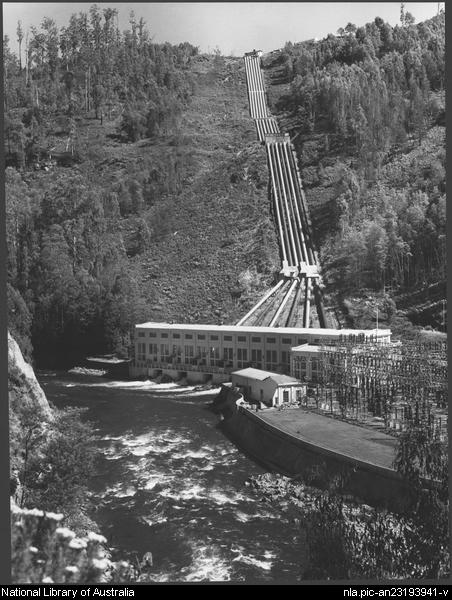
Wolfgang Sievers, Hydroelectric station, Tasmania 1959.
The problem is that electricity is turned on in a household in order to satisfy my desire for coldness in summer or warmth in winter. Yet Heidegger's account of the technological mode of being is presupposed on technology not depending on subject's understanding and using objects. So that would be a modernist understanding of technology:
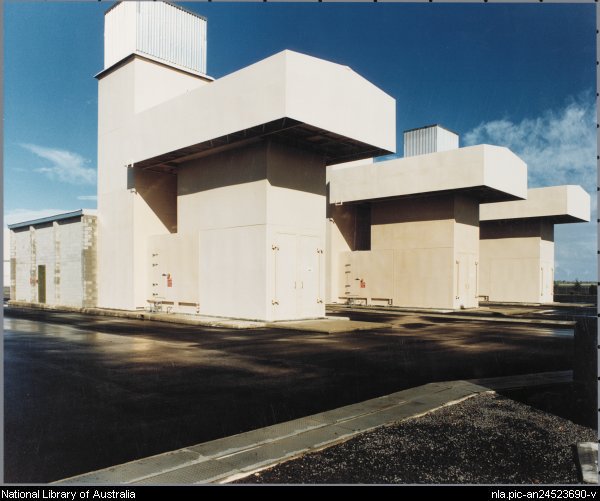
Wolfgang Sievers, E.T.S.A. power station, Mt Gambier, South Australia, 1979
Modern technology, Heidegger says, is "something completely different and therefore new." The goal of technology Heidegger tells us, is the more and more flexible and efficient ordering of resources, not as objects to satisfy our desires, but simply for the sake of ordering. He writes:
"Everywhere everything is ordered to stand by, to be immediately at hand, indeed to stand there just so that it may be on call for a further ordering. Whatever is ordered about in this way ... we call ... standing-reserve.... Whatever stands by in the sense of standing reserve no longer stands over against us as object."
Is that a postmodern understanding of technology? One were objects and subjects are eliminated by this new mode of being.that treats everything as a standing reserve (resources) makes possible endless disaggregation, redistribution, and reaggregation for its own sake.
Is this not the postmodern world where information is truly endlessly transformable due to the computer manipulation of information as his paradigm.This is a rupture with the modern subject's controlling of objects and a disclosure of a new stage in the understanding of being.
July 22, 2004
Technology#5
The image below shows that technology is not about machines, complex techniques or the fabrication of commodities. These are the products of a technological mode of being, but they not are the core of that world.
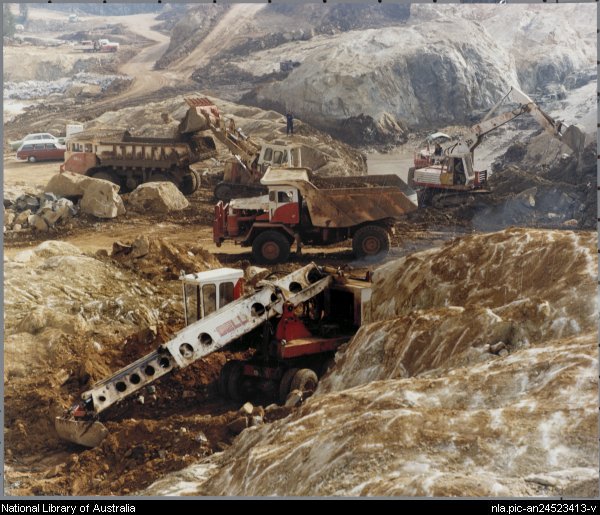
Wolfgang Sievers, John Holland Constructions, Googong Water Treatment Plant, N.S.W., 1977
The core (essence) is a particular mode of being-in-the-world.
July 21, 2004
Heidegger & technology#4
A visual representation of technology:

Wolfgang Sievers, Hamersley Iron's iron ore mining near Mt. Tom Price, Western Australia, 1975
That mining activity embodies the drive for efficiency in which the earth, its creatures, and our fellow human beings are reduced to the status of raw material or a standing reserve.
July 20, 2004
Heidegger & dwelling#2
How can we relate ourselves to technology in a way that not only resists its devastation but also gives it a positive role in our lives?
Heidegger advocates a turn not from a technological disclosure of being but from a metaphysical interpretation of that disclosure, whereby everything is construed as a resource to be used.
Heidegger’s turning is a manner of “caring” or, more precisely, “poetically dwelling” that fosters a turn in the world involving both conservation (recycling waste and protecting endangered species) and enabling intervention such as architectural dwelling. This points to an ethics of dwelling.
July 19, 2004
Heidegger & dwelling
Heidegger's critical response to the enframing of technological mode of being in late modernity can be found in an ethos of dwelling. To dwell is to find one's place. To find one's place is to recieve and care for an abode; to care for a place in the face of technological growth that determines our future as historical beings who are homeless.
A dwelling ethos loosens the grip of technology if it is a dwelling that is no longer structured by possessive mastery over the land and other beings.
July 18, 2004
Heidegger & history
Trevor,
If I recall some time ago you had problems with Heidegger's account of anxiety. You agued that he had no sense of history. In that post you said:
"I think it’s completely false to say that Heidegger ‘is talking about the “fundaments” of everyday existence and is making public mood a subject of philosophical concern’. You might like to read him that way but it is certainly not what he is doing in Introduction To Metaphysics or indeed any other work, as far as I can see. In fact, the whole of his oeuvre is completely lacking in any real sense of history. There is endless talk about the darkening of the world but this is no substitute at all for history. It has more in keeping with Christian ideas, such as found in the book of Revelation. They both touch on the actual world in more or less the same way.Anxiety cannot be made into something that characterises the contemporary Australian mood. The mass of people are in a state of forfeiture, in the sense of Being And Time, whereas anxiety or dread is a state of those engaged with Being, the exceptions."
There is a badly written existential account of anxiety in Being and Time with a pre-ontological sense of unsettledness and a privileged revealing of human being's essential nullity and rootlessness. That runs through the 1929 lecture, What is Metaphysics, as you point out. The religious conception buried in this is the Christian account of fallenness and is heavily influenced by Kiekegaard.
I read it historically from the perspective of post 1949 Heidegger.On this account anxiety is within modernity, rather than an essential truth for all human beings. Anxiety is the result of urbanization, overwork, economic reform as a specific response to the rootlessness and nihilism of technological modernity. It is the sense of 'not being at home' in technological modernity in the latter essays on poetics (eg., What are poets for?)
What I would now say is that the latter Heidegger historicises the account of Dasein's understanding of being and the world it opens up in Being and Time. On this historicist understanding each specific epoch in the development of our historical western culture is a metaphysical variation on the pre-Socratic interpretation of reality as presencing. Each of these understandings of being allows different modes of being to show up.
In early modernity reality was made present to human beings by us and we lived up to our standards, criteria or conventions of intelligibility. Early moderns (Descartes) encountered being as objects to be controlled and mastered and organized by subjects in order to satisfy our desires. In late modernity we experience everything including ourselves as resources to be enhanced, transformed and ordered simply for the sake greater and greater efficiency.
That is what has been happening to us in Australia since the 1980s with the neo-liberal economic reforms. Anxiety is interpreted as a sign of the nihilism of this technological present.
July 15, 2004
Heidegger & Technology#3
Here is a quote that summarizes a good criticism of Heidegger. It is by Andrew Feenberg. He first says what is right about Heidegger:
"No doubt Heidegger is right to claim that modern technology is immensely more destructive than any other. And it is true that technical means are not neutral, that their substantive content affects society independent of the goals they serve. Thus his basic claim that we are caught in the grip of our own techniques is all too believable. Increasingly, we lose sight of what is sacrificed in the mobilization of human beings and resources for goals that remain ultimately obscure. If there is no sense of the scandalous cost of modernization, this is because the transition from tradition to modernity is judged to be a progress by a standard of efficiency intrinsic to modernity and alien to tradition. The substantive theory of technology attempts to make us aware of this. The issue is not that machines are evil nor that they have taken over....So far so good."
So what is the problem? Andrew refers to the passage in the previous post. He says:
"But Heidegger situates his argument at such a high level of abstraction he literally cannot discriminate between penicillin and atom bombs, agricultural techniques and the Holocaust. All are merely different expressions of the identical enframing, which we are called to escape through the recovery of a deeper relation to being. Surely this lack of discrimination indicates problems in his approach."
Feenberg makes two criticisms. He says that while Heidegger represents modern technology as a particular stage in a quasi-historical development, that development is contingent on a mysterious revealing of being rather than on human action. Furthermore, he seems to allow no room for a future evolution of modern technology which remains fixed in its eternal essence whatever happens next in human history. This essentializing tendency cancels the historical dimension of Heidegger's theory.
These criticisms are misplaced. I illustrated Heidegger's account in terms of the development of the Snowy Mountains Hydro-Electricity Scheme in the late 20th century. On this reading the account is contingent on human action not the mysterious revealing of being. What is revealed is the technological mode of being in modernity. This ontological condition requires a transformation of our understanding of Being-- to develop a new ontology
Secondly, we do not an eternal essence here. What we have is an account of the metaphysics of technology. This need not cancel the historical dimension as Heidegger is giving an account of technology in the mid-twentieth century. It is has changed in the 21st century with genetic engineering and the biosciences shift to human cloning.
Update
That is very cryptic. Too much so. A far better, and more thorough critical account is offered here. It supports my argument that Feenberg's claim, that Heideggers ontologizing approach to the history of technology entirely cancels the historical dimension of his theory, is not plausible.
Though Heidegger understands technology ontologically he also understands ontology historically. Heidegger's account of the history of Being divides the history of our ontological self-understanding into a series of unified epochs of intelligibility. What marks late modernity is that there is no subject left to do the controlling of technology and resources. The subject is sucked-up into the standing reserve.
July 14, 2004
Heidegger & Technology#2
There is a famous paragraph in Heidegger's essay, The Question Concerning Technology, that gets people's back up. It says:
"Agriculture is now a mechanized food industry, in essence the same as the manufacture of corpses in the gas chambers and death camps, the same thing as the blockades and reduction of countries to famine, the same thing as the manufacture of hydrogen bombs."
The political force of the historical associations still resonates. How can human beings and pigs be the same? This is Heidegger's Nazism surfacing, say those who now live in the world of human cloning by continue to see technology merely an instrument of human control, as a means to an end. Heidegger , in contrast is thinking of (the essence of ) technology as an autonomous organizing activity within which humans themselves are organized; rather than as an object standing objectively and passively ready for our direction and control.
Babette Babich says in response to this kind of objection:
"Technology, according to its instrumental, humanist ideal, is neutral. Thus nuclear energy can destroy or else it can yield life. Recoiling from Heidegger's comparisons, deploring his associations as outrageous, condemning his lack of taste, his crassness, we stubbornly refuse to connect agriculture, however modernized and bio-technized (which it has been for quite some time, especially and rather dramatically in the USA: land of no-holds-barred capital opportunism), with the enduringly horrible phenomena of gas chambers and death camps. We will not see anything 'the same' in the 'manufacture of corpses' and the meat processing industry, which last includes and which was in fact the motor of the experimental procedure of cloning as an advantage or progressive improvement over even such a mechanical means of reproduction as artificial insemination."
Yet modern technoscience (modern technology as applied physical science) does treat human beings as a standing reserve can and so comes to include human beings as a resource, to be managed--just like water is treated by as a resource by agribusiness.
July 13, 2004
Heidegger & Technology#1
Heidegger's project is a 'questioning concerning technology' rather than a brief against technology. It is a questioning that aims to disclose a mode of being within which live as embodied indwelling beings.
We are in the world of technological being. This 'in the world' suggests that the user is enframed by this mode of being: thus if you want to drive a car you must conform to its requirements in order to use the tool , the roads, traffic lights, traffic codes etc. -- and not the other way around. If you surf the Internet, then you must do so within the limits of the Internet including your particular provider/browser you happen to be using. We are ourselves transformed into the instruments of our own technologies, information and otherwise.
Technology enframes a mode of being. Consider Australia's iconic Snowy Mountains Hydro-electricity Scheme of the 1940s. This is one of the wonders of industrial capitalism in Australia--it signifies what modernity was all about. At one level, the Snowy Scheme is but a series of dams to turn the waters westward across the plains to Adelaide. To achieve a drought proofing the scope of the Snowy and Murray Rivers are altered, their flow dammed into the requisite domain and so contrrolled by a series of locks for irrigation. A mode of life has developed based on irrigated agriculture and cities dependent on the river. We live this mode of life but do not question its technological being.
This turning a river into a machine for power and agriculture forces a questioning; a challenging of the hydro-electric plant reveals the river in terms of an elimination of its organic history or its contours of floodplains, wetlands and biodiversity in favour of the river as a resource for hydroelectric power and agriculture. So what Heidegger is doing is reflecting on the difference between modern technology (Snowy Scheme) and premodern technology (the windmill) and to argue that this difference reflects the essence of technology.
What is this technological mode of being for us in Australia? It signifies a calculative rationality, a mechanization of nature, cities as machines, an efficient industrial enterprise, the transformation of the family farm into modern agribusiness of cotton, rice grapes and piggeries---what Heidegger calls the mechanized food industry.
July 12, 2004
Nietzsche's legacy
This article by Gary Madison captures Nietzsche's radical challenge to the modern philosophical tradition.
Madison argues that modern philosophy was infatuated with modern natural science (ie., mathematical physics). Madison says:
"The concept of Science is a Platonic invention, but it underwent a new twist at the beginning of modern times with the emergence of mathematical, experimental science of the Galilean sort. Modern philosophy can be said to have begun when, bedazzled by this new development, philosophers took the new science as the supreme model of genuine, foundational knowledge. They were, ever afterwards, to labor in the shadow cast by this great Idol. Even the "free thinking," godless philosophers of late modernity continued to pay a sort of religious hommage to it."
That tradition certainly existed in Australian philosophy ----with the Australian materialism and the Marxists. Most continental philosophy was deemed to be hostile to science. If it was not a simple irrationalism opposed to the scientific enlightenment, then it was deemed to have made the aesthetic turn to literature and art (eg., Nietzsche) and so was not philosophy.
Pretty crude stuff.
Madison shows that Nietzsche directed his critique of Platonic science at the assumption that science represents reality. It does so by making a distinction between a "true" (real) and an "apparent" (appearance) world. With Hegel and Marx the apperances become inversions of the real world. But science could pierce through the illusory inversion to grasp the essential dynamics and laws of motion.
Why not dump the distinction? Why not dump the true and apparent world? What then? We are left with interpretation. Madison says that is Nietzsche's legacy.
What have people done with that legacy? Apart from denouncing it as leading to relativism and nihilism etc etc.
Rorty says it highlights the bankruptcy of traditional, foundationalist philosophy---the whole epistemological project of modernity-- what he calls "epistemology centered philosophy." This opens the door to setting aside epistemologically centered philosophy and doing something else, which he called hermeneutics.
Hence we have an alternative way of doing philosophy; one based on philosophy being part of the humanities. Such a philosophy (as a pratical reason) is concerned with socially sanctioned narration, story-telling and the interpretation of texts and historical meanings.
That is fairly old stuff-----mid 20th century.Where to now?
In postmodernity I would argue that such a philosophy would be concerned with our emergency technology including the digital media, the genetic shaping of life sciences, techoscience (science+industry) and the way that bio-technology is shaping our life. There, in the genetics of the life industries lies the perfectibility of the human body.
On this account nihilism is the cultural logic of a technological society
July 10, 2004
metaphysics
Trevor,
you may find this article by Abraham Stone of interest, in the light of your criticism of Heidegger's metaphysics. It is a paper on metaphysics and the slippage back to pre-Kantian metaphysics in continental philosophy. It does this in terms of Husserl, Carnap and Heidegger and so would be the background to Adorno.
Although Kant is generally seen as the great destroyer of the traditional metaphysics he also develops a metaphysics for am natural science. Abraham says:
"We can take Kant's procedure as paradigmatic of what it means to "overcome'' metaphysics. It has three important features. (I) Far from simply rejecting it, Kant explains what is right about traditional metaphysics, and in particular preserves its grounding and unifying functions with respect to the special sciences. But (II) he limits its scope and pretensions, denying that it has its own supersensible sphere of subject matter. And (III) he does so in order to save practical philosophy, by establishing our right to think freedom and morality for practical purposes--or, as he puts it, by eliminating knowledge (Wissen) to leave room for faith (Glauben)."
He says that Kant's successors mostly agreed that his solution leaves something to be desired, in two respects. First, the idea of an in-principle unknowable realm of Dinge an sich seemed to them unintelligible. Second, metaphysics of nature is allegedly possible for us because it is concerned merely with the form of our own cognitive faculties. But what are these "faculties,'' and why doesn't our knowledge of them itself require justification?
Hegel's response is not mentioned by Stone. He jumps to the early Husserl.
However, in previous posts I have shown Hegel's response. He denied the claim of a metaphysics-free science by those empiricist (and positivists) scientific philosophers who see themselves to be philosophers of the future. Then to argue that the categories we use to make sense of natural and social being are historical ones and that it is philosophy's job to critique the taken-for-granted metaphysical categories of science.
What Abraham does is give a detailed account of Heidegger and Carnap's response to Husserl and then Carnap's criticism of Heidegger. From my perspective all this is of scholarly interest. We can pick Stone up towards the end. He says:
"So, in summary, what is Carnap accusing Heidegger of? He is accusing him of trying to use assertions where only expression is appropriate--and where, given the danger involved, even expression ought to be limited to brief hints. He is accusing him, in particular, of putting himself (or leaving himself) in a position where he must treat religious dread as if it revealed a being, an object--accusing him, that is, of idolatry, or (what comes to the same thing from a Kantian point of view) of putting a theoretical dogmatics before ethics. This is a very serious criticism indeed. Without claiming (as I certainly would not) that it is one against which Heidegger could have no defense, I would point out two things about it. First, it is a criticism to which, as I understand it, Heidegger seriously and repeatedly responded..... Second, it is a criticism which finds echoes in later members of Heidegger's own, Continental, philosophical tradition (e.g. in Levinas). This, I think, is enough to establish what I set out to here: not an attack on or defense of either Carnap or Heidegger, but simply a case for taking the one as a serious reader of the other."
All this is largely of scholarly interest to me. I'm quite happy to accept that Carnap was a serious reader of Heidegger.
What I do pick up on is Stone's conclusion. He says:
"We cannot take sides in this debate in part because it has changed from a debate into a fundamental structural fact about the philosophical world as we have inherited it. Here in the English-speaking part of that world, in particular, the stamp of Carnap's will is everywhere present. The way we "do philosophy''--the way we speak, write, publish; the way we divide our field into disciplines; the way we arrange requirements and syllabi for our students--none of this, of course, is the product of Carnap's influence alone.
I question "the stamp of Carnap's will is everywhere present." So speaks the Anglo-American voice of scientific philosophy; a philosophy that is a part of (natural) science.
What Heidegger was able to achieve was to open up another way of doing philosophy ---to return philosophy to the everyday world where we live. He opens up new terrain. This is what Stone misses. He follows Carnap in treating Heidegger's turn to everydayness through public moods as personal psychology without even stopping to question his own metaphysical individualist (atomistic ) assumptions.
July 08, 2004
Two Kinds of Nihilism
Gary,
I'm still reading everything but as the conference approaches - it's less than two weeks away - I'm getting snowed under more and more. But I will try to reply to everything just as soon as I can.
Here is a quick remark on nihilism, off the cuff: as far as I remember it Nietzsche recognises two kinds of nihilism. The first kind occurs when humans put something between themselves and direct sensuous existence - religion or some other kind of moral system. The second kind occurs when humans become incledulous towards these systems without returning to sensuous existence.
P.S. Have you been following the latest attempts to ban two films - Irreversible and The Anatomy of Hell? The last film is Catherine Breillat's latest. I'd like to talk about this later as well. Of course, I haven't had a chance to see the films yet.
Your stuff on Japanese Story was interesting. I saw the film last year and I must admit I didn't approach it from your angle. This is not to say that there is anything wrong with your angle. Indeed, it has been most illuminating.
Nietzsche: nihilism#2
Here is a restatement of Nietzsche's understanding of nihilism:
"In the interim, things are not quite right–who does not sense it? Wherever we turn there is a cacophony of voices. Everything seems adrift yet strangely unchanging. We decry the absence of leadership, but who can lead without a specifiable goal? We experience simultaneously the concrete intensification of modern principles and their theoretical disintegration. Intensification, fragmentation, cacophony of voices, and the monotony of constant, circling, changeless change. Who does not see it? But who has not grown weary of the endless, occasionally hyperbolic, restatements of the problem?"
(see G.B. Smith, Nietzsche, Heidegger and the Transition to Postmodernity. The University of Chicago Press, Chicago, 1966, pp.5-6).
This is the world in which we now dwell. Nihilism, vaguely associated with the meaninglessness of the quest for meaning, and once confined to Europe, has now spread with increasing efficiency, through the power/knowledge matrices of globalization. Our reaction to this nihilism---emptying out of meaning in the public world----is to retreat into our private world of individual experience. It is here that we endeavour to find significance and meaning. Many seek peak experiences (highs) in drugs or thrill seeking.
Nietszche advocates the idea of a philosopher as a cultural physician who cures through knowledge experiments on the body to affirm life. The physician-philosopher speaks on behalf of an art of life cultivated through philosophy, a sickness cured through the physicians work on himself.
July 07, 2004
Nietzsche: Nihilism
Nihilism as a philosophical concept was given its most definitive form by Nietzsche's The Will To Power. There he defined it as the hollowing out of our highest values.
Nietzsche is the prime theorist of nihilism in modernity—as well as being one of the prime precursors of postmodern theory in the philosophical tradition. Nietzsche’s thought contains large elements of what—in retrospect—may be called "postmodern." It also suggests that to a certain extent his theory of modernity may in fact be prophetic of postmodernity. Nietzsche is an ambiguous thinker, and his theory of nihilism is open to multiple interpretations and extrapolations. It is possible to read Nietzsche in a modernist and postmodern way.
His concern is the modern European age. Nihilsim affects European society and culture generally. In the Will To Power he says that what he relates "is the history of the next two centuries. I describe what is coming, what can no longer come differently: the advent of nihilism’ (Nietzsche 1968, p.3). For Nietzsche, nihilism has its roots in history and extends into the future, is ambiguous and manifests itself in various forms that may bacve differentpossibilities in its historical development.
Nietzsche identifies the historical origins of nihilism in a particular interpretation of the world: the Christian-moral interpretation of the world. For Nietzsche, most of philosophy is also part of the Christian-moral interpretation of the world. Platonic philosophy posits a "true world," that lies behind this physical world of mere appearances. This "metaphysical" interpretation, while providing value in one way, is nihilistic because it devalues this world, the world in which we live, by understanding it as only having value in relation to another, better world.
What would a modernist and postmodernist interpretation look like? This article has some useful suggestions.
The modernist form of nihilism would employ a unilinear interpretation of history. It tells a single story, specifically about European man, as if it were the story of the destiny of the entire human race. A modernist interpretation of nihilism is a progressive history with the accomplishment and overcoming of nihilism as the goal. Nihilism overcome is analogous to a state of emancipation in a future enlightened world.
The modernist one is that has been tacitly presented here. In contrast a postmodernist interpretation would problematise:
"the concept of "overcoming," the very concept which has been such an integral part of the modernist interpretation of his theory of nihilism. Nietzsche is concerned with the decadence of modernity, and how this cultural ill might be cured. Overcoming modernity, however, cannot be a viable solution. Modernity itself is defined in terms of constant overcoming; that is, creation of the new that overcomes the old. This overcoming is essentially bound up with the modern narrative of progress; by overcoming the old history moves towards a future state of enlightenment."
In postmodernity this kind of unilinear because history has ended. the West has lost its grounds for historical meaning. We have the pluralistic proliferation of alternative knowledges, beliefs and values coincides with a breakdown of any shared meanings and values to act as a common social ground.
A postmodern Nietzsche would interpret the "overcoming" of nihilism as taking a different attitude towards the nihilistic interpretation of the world itself. In postmodernity, while we may in a sense be stuck with a complete nihilism, this nihilism is not one of despair and life-negation, but of joyous affirmation.
July 06, 2004
Heidegger: individuation
There was something significant in a Japanese Story about the proces of individuation from confronting the possibility of death through being stranded in the Pilbara desert. What was significant was the way that the process of individuation lead back to the world of people. This individuation became the basis for living in the world with others, rather than being cut off from the world.
On Heidegger's account the hermeneutical circle brings us back into the world from where we had started before going into the desert. While death individualizes and in the process discloses the potentialities of being with others. So authentic being is a modifcation of they selve through individuation.
As a
modification of the they-self, authentic being does not remove itself from the circle of the others but disentangles itself from being "lost" within a non-individuated "they."
July 05, 2004
a problem
Trevor,
the problem I see with Heidegger's account of death in relation to leading to the process of individuation and an authentic life is that few of us ever have the opportunity to face the possibility of death. Few of us are ever stranded in the Pilbara desert. Most Australians have never been there. Nor do they want to.
If we were in a war ---eg., like the diggers in the trenches in WW 1 or in the jungles in Vietnam----then we would expereince the possibility of death But few of us experience that these days in Australia; and most of us do not even come face to face with the possibility of our own death in the war on terror. The closest many of us come to the possibility of our own death is probably a car accident or cancer.
On Heidegger's account, that means only a few can live an authentic life from taking up the certainty of death. Most of us are fated to live an inauthentic life within convention and habit without ever being in a position to shape life of positive freedom through individuation.
July 04, 2004
Heidegger, Adorno & death
Trevor,
I started re-reading the section in Adorno's Negative Dialectics on Heidegger this afternoon. It is all too familiar. The Heidegger in this text is about the Absolute, he returns to the pre-critical philosophy; is archaic; he does not accept the critical turn of Kant; he is dogmatic; he crosses the line into irrationalism; embraces mythology; he is authoritarian and so on.
Page after page drives home a central point: Heidegger's ontology is one big failure. He abolishes reason. Hence Heidegger demands a rational critique. Fair enough. Yet what we get in 'The Ontological Need' is a onesided tirade about Being. The conservative critique of the Enlightenment is treated as a return to pre-Kantian mythology.
Let me try and recap my response to this.
There is some recognition in Adorno that Heidegger is critical of scientism, (that science is the whole truth about everything and that it is the ground of its own legitimation); and less recognition that Heidegger was critical of the program to gain complete technological mastery of the physical and social environment. It is this conception of the Enlightenment in modernity was originally formulated by French philosophes in the last half of the eighteenth century, was preserved by positivist movements in the nineteenth century, and has dominated universities in the twentieth century.
In this context Heidegger develops post-theological discourse following on modernity's eclipse of God. Sure, there is a theological legacy there, but Heidegger's world is strictly extra-theological. For Heidegger, as for Nietzsche before him, God is dead, or at least mortally wounded and departed from the world.
Now Adorno sees Heidegger as filling the vacuum/void left by God's departure with irrationalism. There is little recognition in Adorno that Heidegger is arguing that an understanding of Being is always already included in everything we apprehend. It is only humans who can question Being, can endeavour to "think Being", and then voice what is thought. And that questioning of Being is far from being scientific. It can be undertaken by philosophy.What this shows is that human being qua Dasein is literally a "being-there" (Da = "there," Sein = "being"). The Da signifies the already interpreted world into which humans are "thrown." Who we are as human beings is a product of existence, of being-in-the-world. That is to say the public world of social norms and rituals.
This "publicness," this "being-with-one-another," has devastating consequences for human beings, since in our "thrownness" into the groupthink of society, we come to exist not on our own terms but on those of what Heidegger calls das Man (German for the generic subject)-the "they" whose beliefs and behaviors make up the "average everydayness" of human existence. Most of us prefer and "fall" into this tempered mode of existence. We are are happy not to think for ourselves, but to follow instead the routines and fashions of those around us.
Now in in your earlier post on Adorno Heidegger and Death you say that there are such huge flaws in Heidegger that his metaphysics of everydayness ('edifice' in your language) collapses. Here is what you say:
"As people become aware that they have not really lived, death becomes more frightening, taking on the guise of a misfortune. ‘It is as if, in death, they experienced their own reification: that they were corpses from the first… The terror of death today is largely the terror of seeing how much the living resemble it. And it might therefore be said that if life were lived rightly, the experience of death would also be changed radically, in its innermost composition… Death and history form a constellation.’ This brings to mind the title of Céline’s book, Death On The Installment Plan, an image of death as average everyday life."
I presume that this means that a reified everydayness is akin to being a zombie. We drift through life like the walking dead, too terrified to confront how much like death everydayness is. So it is an 'inauthentic' existence. There is a better mode of living.
So how is that different from what Heidegger was saying about publicness, idle talk and group think? What you are saying is more extreme than Heidegger. All that Heidegger is saying is that inauthentic Dasein is most at home in the world of publicness-the world of rules, rituals, and conventions that disburdens existence of its personal responsibility for choice. In such a world, "everyone is the other and no one himself."
It is a diagnosis of everydayness in modernity. The therapy is that we must turn from living by the other's rules and habits and project a world of particular significance to ourselves. We must insist upon our right to be creative and free in our questioning and articulating of Being.
What then is the problem here that you discern? It is not the confusion around the social mode of existence and the individual mode of existence? The problem you discern one of death not being mentioned in this account of everydayness? It would appear to be so.
You go on to connect your account of living corpses to Heidegger's interpretation of the relationship between death and authentic life. You say that:
"It is this constellation of death and history that is missing from Heidegger’s theory and necessarily so because once it is taken into account the whole edifice of his metaphysics collapses. Without the historically untarnished experience of death there is no way of defining authentic existence, and whether this is fleshed out in terms of inward withdrawal or social interrogation it matters not. There is just the same nothing other than reified history dressed up as existential categories."
So what does Heidegger actually say about death? This article can act as out guide. It indicates that in Being and Time Heidegger is dealing with our understanding of death, something that was not explored in Japanese Story.
One understanding is that since our own death can not be experienced, the
death of others is the only phenomenon open to us. The death of others-- a friend--- therefore must serve as the basis of our understanding. Heidegger objects that this gives us no basis at all for what is wanted, namely an understanding of our own death. So what is happening here is that Heidegger positions himself firmly in the perspective of favoring a certain type of understanding, a certain mode of being. This is one whose understanding is "grounded" in one's own experience in the world. Understanding that seeks to find the primordial source; the 'about' which brings one to a meaningful grasp of entities and contexts. What a Japanese Story showed was the possibility of death from being stranded in the Pilbara desert.
It is this experience of death that opens up the existential possibilities in everyday life; possibilities that involve the active, future-oriented concerns and possibilities. These possibilities can never be fully specified, nor can they all be actualized.
July 02, 2004
Heidegger & death
Trevor,
I'm at a disadvantage in the discussion on death as I have not read Adorno's article, ‘On Dying Today’, from his lecture series Metaphysics: Concept And Problems.
You said in an earlier post that according to Adorno:
"Death has been used as a way to break into metaphysics but the impotence of the metaphysics of death is neither to do with the fruitlessness of brooding nor with the belief that in the face of death a posture of readiness is seemly. The problem with this metaphysics is that it ‘necessarily degenerates into a kind of propaganda for death, elevating it to something meaningful, … in the end, preparing people to receive the death intended for them by their societies and states as joyfully as possible’. Reflections on death tend to be of ‘such a necessarily general and formal kind that they amount to tautologies’."
Adorno's remarks about brooding do not apply given the account I gave about Heidegger. Adorno's remarks "the belief that in the face of death a posture of readiness is seemly" do apply of we re-interpret a posture of readiness with a comportment of resoluteness.
The question: Does Adorno's claim that the problem with this metaphysics is that it ‘necessarily degenerates into a kind of propaganda for death, elevating it to something meaningful' apply?
What I want to highlight do in this brief post is to make clear that the shift from inauthentic mode of being to an authentic one in Heidegger. The problem here is posed clearly in the film A Japanese Story: how do you shift to an authentic mode of life from within an inauthentic one of everydayness. The film suggested that confronting the very real possibility of death from being stranded in the Pilbara desert opened up a way to overcome being ensnarred in a “metaphysics of the present.”
That situation does not strike me as a degeneration into a kind of propaganda for death, elevating it to something meaningful by preparing people to receive the death intended for them by their societies and states as joyfully as possible. Nor does it seem that Heidegger's reflections on death tend to be of ‘such a necessarily general and formal kind that they amount to tautologies’. It has more to do with the "problems of living" than the positivist interpretation of metaphysics as a tautology.
The second point I wish to raise is:Could not that situation be interpreted as a metaphysical experience that transcends rational discourse of instrumental reason?
The film shows that the two people become different and better people as a result of their experience of being stranded in the desert. In the film they became more humane if you like.
In that earlier post you said that, according to Adorno:
"The metaphysics of death is more than merely solace because humans lost that which in earlier times made death bearable, ‘the unity of experience’. Resurrected metaphysical systems act as a kind of substitute for this, conveying the message that things are not so bad and trying to ‘reassure people about certain essentialities which … have become problematic’, above all time. People’s awareness of time, the possibility of their continuous experience of time, ‘has been deeply disrupted’. In response, ‘the current metaphysical systems are now attempting to rescue this conception of time, which is no longer accessible to experience, and to present temporality as a constituent of existence itself’. There is a tendency in such systems to conjure up that which is no longer experienced, and this is the reason why this kind of thinking is in sympathy with archaic conditions, especially ‘agrarian conditions or those of a simple, small-town barter economy’. Epic deaths are not possible because life no longer has any wholeness. In such circumstances, ‘the notion of wholeness is a kind of ersatz metaphysics’, attempting to underline notions of meaningful existence with ‘the positivist credentials of something immediately given’. It is this idea of completeness and meaningfulness that must be abandoned."
You can read this as Adorno having Heidegger in his sights---especially the phrase, "Resurrected metaphysical systems act as a kind of substitute for this, conveying the message that things are not so bad and trying to ‘reassure people about certain essentialities which … have become problematic’"
The question is: does Heidegger's discourse on death do this? Is it about reassurance? Is it attempting to underline notions of meaningful existence? Is it a substitute the unity of experience’. This article is relevant and it shows that Heidegger is concerned about meaningful existence. I read it as part of a response to the standard Western rationality (eg., Medlin's universal and permanent rationality based on logic, evidence, and formal proofs) that develops an ethical concept of reasonableness – a series of humane judgments based on personal experience and practice.